
Andrew Coates analyses the second round of France’s local elections.
The second round of the French municipal elections took place on Sunday. Commentators have observed that all sides are claiming victories.
The left reaffirmed its control of France’s three largest cities, Paris, Marseille, and Lyon, symbolised by the victory of the left in the capital.
Led by the Socialist Emmanuel Grégoire, the Parisian alliance, the ‘united’ left, Communists, Greens and the small ‘social-ecological’ Place Publique, whose best known figure is Raphaël Glucksmann, won 50.5% of the vote.
Racida Dati, for the right, got a low 41.5%, despite, or because of, her backing by first round candidate Sarah Knafo. Knafo stood for the far right Reconquête, led by her partner, polemicist Éric Zemmour. The radical left, La France Insoumise (LFI) stood alone in the run off. Sophia Chikorou, whose partner is LFI leader Jean-Luc Mélenchon, got 8%. Their stand-alone position was not helped by Chikorou’s implication in a fraud case.
Elsewhere, formal alliances of the left including LFI, or decisions to stand down in the second round, held, as in Marseille and Lyon. However, the left did not win the vote in Toulouse, Clermont-Ferrand or Limoges.
The existence of agreements has not dampened down divisions, “The First Secretary of the Socialist Party said that Jean-Luc Mélenchon had “become the burden for the left today”. On Monday morning he condemned the “excesses” and “anti-Semitic drift” of the leader of La France Insoumise. It looks as if a new attempt to create a “cordon sanitaire” around LFI will be made.
Evidence for this relies not just on LFI’s stand against Israeli actions against Gaza, but, heavily, on the LFI leader’s unfunny cod-Yiddish pronunciation at a public meeting of ‘Epstein’ and ‘Glucksmann’. Jérôme Guedj and François Hollande, both more or less declared Socialist Presidential candidates for 2027, have maintained their opposition to alliances with LFI.
Meanwhile, Jordan Bardella, of the far right Rassemblement National, celebrated “the greatest breakthrough in the entire history of the National Rally”, with “dozens” of medium-sized towns and cities, including Liévin, Agde, Carcassonne, Montargis, Rivesaltes, Orange, and Carpentras. But this is small beer for a party which saw this election as a springboard for the 2027 Presidential contest. Perhaps a more concerning result was in Nice, France’s fifth largest city, on the French Riviera, with the win of Eric Ciotti, a former conservative, now leading the Union des droites pour la République, (UDR), who allied with the RN of Marine Le Pen.
Looking at results across France, the coordinator of La France Insoumise, Manuel Bompard, celebrated his movement’s “resounding entry” into local councils and its victories in Roubaix and Le Tampon. Their strategy of addressing the interests and demands of diverse class and ethnic backgrounds, La France Nouvelle, seems to have paid off in the large Paris banlieue, Saint-Denis.
The Communists won Nîmes. Their site declares that “hundreds of communist and affiliated mayors were re-elected in this second round, including 14 mayors of towns with more than 10,000 inhabitants .”
As for the Greens, Les Écologistes (LE), mayors lost in Strasbourg, Bordeaux and Poitiers. In Lyon, the outgoing Green mayor won, as they did in their historic base of Grenoble with Laurence Ruffin backed by an alphabet soup of parties – DVG – LÉ – PS – PCF – G·s – PA – L’Après – D! – ND – LRDG – LFI diss. – ADES – RC – GO.
The centrist bloc, weighed down by Emmanuel Macron’s unpopularity, is boasting about Renaissance’s conquest of Annecy and Bordeaux. The mayor of Le Havre, a Communist bastion until 1995, is Edouard Philippe, a former prime minister who founded the centre-right Horizons party. He is setting his sights on 2027 with his re-election. François Bayrou, of the same party, was defeated in Pau by the Socialist Jérôme Marbot.
The Socialists often act as if they remain the major political force on the left, while their membership, like the Communists, stands at historic lows of around 50,000. LFI claims 540,000 ‘supporters’, rather than members, organised in ‘action groups’. Power is concentrated in a tight central core of leaders, above all individuals close to Mélenchon. It’s a centralised structure with a new ‘coordinating committee’ of 15 leaders.
It seems unlikely that France’s left, aligned during the 2024 legislative elections as the Le Nouveau Front Populaire will repeat the experience in the 2027 Presidential contest. This would not just involve local agreements but national ones. Mélenchon is determined to stand. That is not negotiable.
Andrew Coates is a European socialist internationalist who lives in East Anglia. He blogs here.
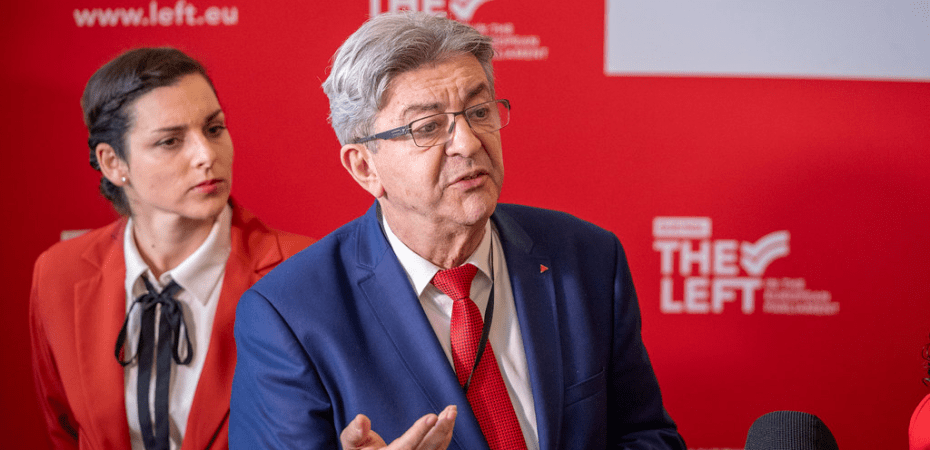
Image: Jean-Luc Mélenchon. https://www.flickr.com/photos/theleft_eu/53848241388 Copyright: GUE/NGL Licence: Attribution-NonCommercial-ShareAlike 2.0 Generic CC BY-NC-SA 2.0 Deed
 Labour Hub