
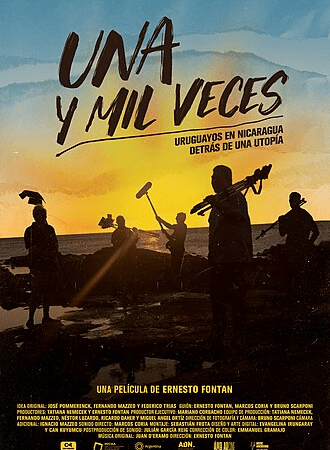
Mike Phipps reviews a new film about the participation of political exiles in the final days of the Sandinista Revolution.
“Una y Mil Veces” (“I’d Do It All Over Again”) is a documentary film about 52 Uruguayan political activists, who in the 1970s left their own country, at the time under a brutal dictatorship, to go to Nicaragua to join the Sandinista National Liberation Front to help overthrow the decades-old Somoza dictatorship.
They journeyed through Chile and Argentina, received military training in Cuba and entered Nicaragua to take part in the final days of the guerrilla struggle that produced the 1979 Revolution.
The documentary focuses on those, both men and women, who undertook this mission. Some fathers left behind very young children. One never returned, tragically killed in action three days before the July 19th Triumph. His now grown-up children wrestle with their emotions in powerful and moving interviews.
The late 1970s were a tough time for Latin American activists. Operation Condor, a coordinated cross-border campaign of political repression by brutal dictatorships across South America, financed and backed by the USA, was in full swing. Up to 60,000 people were killed as a result of its operations, with six times that number imprisoned.
I watched this film at a special screening at the London School of Economics on the fiftieth anniversary of the military coup in Argentina. Some 30,000 people were killed under its rule, an open wound which endures to this day. Fifty years on, families are still searching for their loved ones, and the remains of victims of the regime are still being identified. The painstaking work that has seen over 1,000 perpetrators convicted is now under threat from Argentina’s current President Javier Milei, who has questioned the scale of human rights abuses and cut government funding to projects investigating them.
This film is part of a wider tradition of remembering – reconstructing a narrative that challenges the right wing backlash now being orchestrated in Argentina, Chile and elsewhere that suggests ‘excesses’ were committed on both sides during these years of repression.
A military dictatorship ruled Uruguay for over a decade after 1973. During this time, more than 5,000 people were arrested for political reasons and almost 10% of Uruguayans emigrated from the country. Torture lasted until the end of the dictatorship in 1985. Uruguay had the highest number per capita of political prisoners in the world, with almost 20% of its population arrested at some time. In these conditions, risking one’s life to fight dictatorship elsewhere in the continent did not seem to many to be so extreme.
Nicaragua, where revolution looked winnable against an ailing dictatorship, was an obvious choice. Yes those who went, mainly in their twenties, were not well-prepared and were shocked and impressed by the discipline and commitment of the often teenage fighters of the Sandinista Front. It’s clear that those who did go and fight were motivated more by a belief in shared humanity than a lust for heroism.
The Triumph in Nicaragua was a glorious moment in an otherwise very bleak time for Latin America. The Sandinista Revolution stood as a beacon for many years across the Central American region at a time when other states, backed militarily by the United States, were perpetrating genocidal repression against their own peoples, in Guatemala and El Salvador especially.
In government, the Sandinistas introduced significant economic and social reforms that benefited the mass of people in one of the poorest countries of the hemisphere, despite a Washington-supported terror campaign. The US even mined Nicaragua’s harbours, a crime that was ruled unlawful at the World Court but for which Nicaragua has never received a cent of compensation. The Sandinistas were voted out of office in 1990, but in 2006 its leader Daniel Ortega was re-elected as President and has ruled the country ever since, in an increasingly authoritarian fashion.
Many of the gains of the Nicaraguan Revolution still survive, despite the unrelenting hostility to it from US administrations of either party. But the wave of domestic repression that the Ortega government unleashed in 2018, grabbing headlines around the world, has not abated. As Labour Hub reported in December 2024: “Hundreds of opponents have been stripped of their Nicaraguan nationality, their pensions cancelled. A 2021 reform to the Criminal Code extended the period for detention without charges from 48 hours to 90 days, violating the right to the presumption of innocence. Hearings have been held behind closed doors, with detainees denied the right to choose their legal counsel. Political prisoners allege beatings, electric shocks and other forms of torture.”
Amnesty International concluded in the same month: “The year ends with systematic repression and a streamlined state strategy against any form of dissent.” One former Sandinista commander, now in exile, says: “This dictatorship is worse than it was under Somoza.”
Last year a force of thousands of new ‘volunteer’ paramilitaries loyal to the regime was created. Scores of media outlets have been shut down and hundreds of journalists have gone into exile – although the recent assassination in neighbouring Costa Rica of a former Nicaraguan Army major who had criticised the regime suggests that even this may not guarantee personal safety.
There are many who risked their lives fighting for a free, democratic Nicaragua who are appalled at the way the corrupt Ortega dynasty runs the country today. Yet the Sandinista experiment wasn’t the first and is unlikely to be the last revolution betrayed by some its leaders.
But the ideals of that revolution were something worth fighting and even dying for persists. Milan Kundera said that the struggle of people against power is the struggle of memory against forgetting. This powerful film plays a part in recovering that memory.
Mike Phipps’ book Don’t Stop Thinking About Tomorrow: The Labour Party after Jeremy Corbyn (OR Books, 2022) can be ordered here.
 Labour Hub