
Anastasia Chebotaryova, a representative of the Ukrainian feminist movement, addressed a meeting of the European Network for Solidarity with Ukraine on March 21st. She highlighted the importance of International Women’s Day marches in Ukraine as a key form of feminist activism, helping women build organisational experience and raise awareness of feminist ideas.
This year marked the first Iinternational Women’s Day (IWD) march in Kyiv since the start of the full-scale invasion in 2022. More than 3,000 people took part, carrying handmade posters and banners. The march addressed issues including women in the armed forces, women prisoners of war held by Russia, the use of sexual violence as a weapon of war, and concerns about a new draft Civic Code containing discriminatory provisions.
The Ukrainian Feminist Network organised a dedicated column within the march and prepared a manifesto highlighting the socio-economic crisis and its impact on women, including gender-based violence. Participants from the Ukrainian Social Movement also joined. A second march took place in Lviv; although smaller, it faced attacks from anti-gender groups.
While these marches are gaining increasing recognition, there is also an ongoing debate about the relevance of IWD in Ukraine. In post-Soviet countries, the day was largely depoliticised. After World War II, Soviet authorities shifted its focus away from political struggle toward encouraging women’s unpaid reproductive labour, and later toward symbolic gestures such as giving flowers and celebrating “femininity.” Independent Ukraine inherited this altered tradition rather than the day’s original emphasis on women’s rights.
Feminist activists are working to reclaim IWD’s political meaning, using it as an opportunity to raise demands, advocate for change, and build solidarity.
However, this grassroots work is not always reflected in policymaking. There are proposals in the Ukrainian parliament to abolish March 8th as a public holiday and replace it with a “Day of Ukrainian Women” on February 25th. Critics argue this risks isolating Ukraine from the international feminist movement, and note that the proposed date falls close to the anniversary of the 2022 invasion—a time associated with national mourning.
Women’s rights cannot be secured under occupation. The struggle for gender equality is linked to the fight for national self-determination and sovereignty.
The Ukrainian feminist movement has also opposed a draft civic law that contradicts principles of equality and European integration. Proposed measures include lowering the legal marriage age to 14 in cases of teenage pregnancy and defining marriage exclusively as a union between a man and a woman.
The latter issue is particularly significant for Ukraine’s LGBTQI+ community, which is advocating for same-sex civil partnerships. With many LGBTQI+ individuals serving in the armed forces and facing daily risks, legal recognition is crucial to ensure partners’ rights to hospital visitation and inheritance.
These legislative developments reflect the underrepresentation of women in decision-making: women make up only 21% of MPs in Ukraine’s parliament (the Verkhovna Rada).
Finally, we should note the growing burden on women in Ukrainian society. Due to limited childcare provision, many women remain outside the formal labour market. At the same time, mass conscription has pushed many into the role of primary earners. Alongside paid work, women often carry the bulk of domestic responsibilities and volunteer work supporting both the military and their communities. Despite these contributions, their needs are not always adequately recognised, so the feminist movement is going to continue its advocacy work.
Anastasia Chebotaryova is co-founder of the Ukrainian Feminist Network for Freedom and Democracy and has been active since 2017.
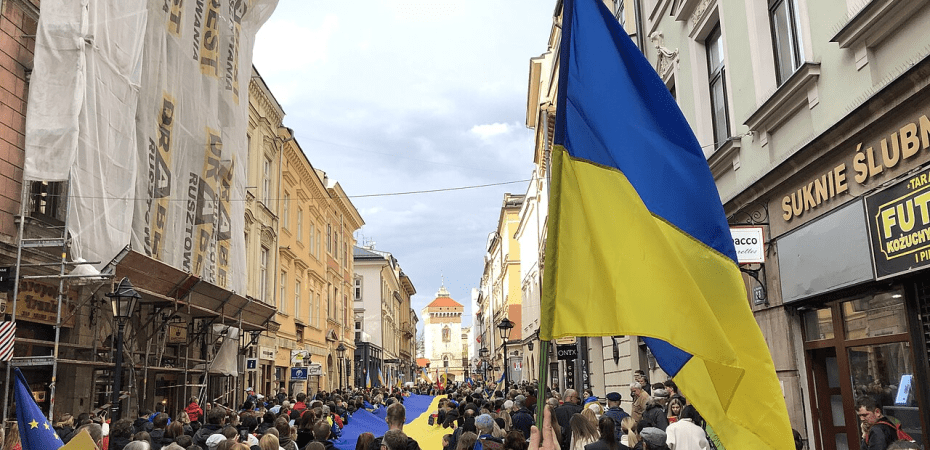
Image: Demonstration of solidarity with Ukraine in Kraków, Poland, April 2022 https://commons.wikimedia.org/wiki/File:Demonstration_of_solidarity_with_Ukraine_in_Krak%C3%B3w,_Poland,_April_2022.jpg Author: Franek Vetulani, licensed under the Creative Commons Attribution-Share Alike 4.0 International license.
 Labour Hub
