
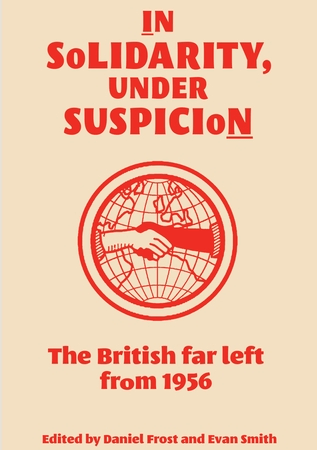
Mike Phipps reviews In Solidarity, Under Suspicion: The British Far Left from 1956, edited by Daniel Frost and Evan Smith, published by Manchester University Press.
This book covers a huge range of material. There is a wealth of detail about state surveillance of left groups, much of it unearthed in the Undercover Policing Inquiry. The Anti-Nazi League and School Kids Against the Nazis were targeted, in contrast with the far right, a genuinely serious threat to public order, who were not infiltrated at all.
It was impossible for the state to infiltrate Britain’s Black Power movement, as the Metropolitan Police had not recruited a single non-white officer before 1967. The Government took the threat of the movement very seriously, so it opted for legal harassment regarding the content of the movement’s leaflets and its sparsely-attended public speeches. Disrupt, but avoid creating martyrs, seems to have been the basis of operations.
Nobody who has been active on the left for any length of time will be surprised by these revelations, although it is useful to have the activities of undercover policing catalogued so systematically. Many might question the institutional biases that led to the infiltration and disruption of so many nonviolent left wing causes, sometimes involving great human distress, while genuine terrorism was often ignored – and wonder at the role of our political masters, including Labour governments, that determined the priorities on which public money was to be squandered.
More positively, the book looks in detail at many movements and campaigns that have been neglected in recent years. One example is the Institute for Workers’ Control, and the differences it had with other organisations over orientation and structure, in the context of the late1960s wave of radicalisation, particularly among students, and the growing Vietnam Solidarity Campaign and important currents within it, like the International Marxist Group.
The most interesting chapters are those that go beyond mere description and attempt to analyse the material at issue. To what extent was the cultish behaviour of the Workers Revolutionary Party rooted in its application of Leninist vanguardism, which took an unrelenting masculinist form, which helped its leader perpetrate violence, including predatory sexual abuse, against the group’s members over a long period? Was it simply a desire to be contrarian, or something more fundamental to their original politics, that impelled leading figures of the Revolutionary Communist Party and its journal Living Marxism, with their early commitment to anti-racism and Irish solidarity, to evolve into opponents of all things ‘woke’, eventually celebrating the continuity of institutions like the monarchy and British traditions like fox-hunting?
The chapters on international solidarity organisations are especially interesting. The democratically elected government of Salvador Allende in Chile caught the imagination of many on the British left. Its overthrow by the US-backed Pinochet coup sent shock waves through the movement. Left Labour MP Eric Heffer “wept unashamedly” at the death of the President, “for an attempt to achieve socialism through the Parliamentary process had been murdered too.”
The fact that the then Tory government promptly recognised the new regime gave further impetus to the rapid development of the Chile Solidarity Campaign, which exposed the crimes of the regime, supported the UK resettlement of Chilean political refugees and encouraged and celebrated trade union-led boycotts of goods from or for Chile. It also had some success in getting the incoming Labour government to limit its ties to the military regime, in particular stopping new arms sales. The campaign was a rare example of something both explicitly political and a broad church of diverse perspectives.
Solidarity initiatives with those suffering under the British military occupation of the north of Ireland did not enjoy such unity. Conditions were much more repressive, with wide layers of the Irish community in mainland Britian facing state harassment: over 6,000 people were detained under anti-terrorism legislation between 1974 and 1985, only 164 of whom were ever charged with any offence. The chapter here focuses on the conflicting perspectives of the Connolly Association, the Irish in Britain Representation Group and the Anti-Internment League. Disappointingly, there is very little on the Troops Out Movement, which played a significant role in mobilising support, particularly during the hunger strikes by Republican prisoners during the first Thatcher government.
There’s a great deal here of interest – about claimants’ unions, trades councils, the early Women’s Liberation Movement and the Anti-Nazi League. Today’s activists shouldn’t dismiss these contributions as historical, academic exercises. On the contrary, there is a lot here that could teach us how to help build contemporary social movements. Many of the currents who made a mess of united front activity fifty years ago are still leading campaigns today – and if they are unable to learn from their mistakes, others should at least try.
Mike Phipps’ book Don’t Stop Thinking About Tomorrow: The Labour Party after Jeremy Corbyn (OR Books, 2022) can be ordered here.
 Labour Hub