
It’s time for Labour to make good on its promises, says Michael Calderbank, previewing an important meeting in Parliament next week.
For well over four decades now – since the election of Margaret Thatcher in 1979 – British governments of all political persuasions have been firmly in the grip of the ideology of privatisation and outsourcing. Under the cloak of the alleged superior efficiency’ of the private sector under the ‘rigours of competition’ (an ugly phrase which remains part of the ‘new’ Clause IV introduced under Tony Blair), there has been a deliberate project of leveraging open new markets for highly lucrative contracts from government.
This entails transforming the state from a provider/deliverer of services, to a mere ‘procurer’ of services from elsewhere, as firms bid to run them for the lowest price. While theoretically open to small and highly specialist outfits to compete for particular contracts, in reality this new ‘market’ has been dominated by a small cluster of outsourcing giants (the likes of Serco, Capita, G4S, Sodexo, ISS and OCS). Given that these companies exist to return a dividend for their shareholders, in practice they can often only deliver the services at a profit by a combination of driving down the pay and conditions of their workers and/or reducing the quality or extent of the services provided.
Despite the rhetoric of delivering greater ‘efficiency’ and ‘value’ to the taxpayer, the practical result of outsourcing has been quite the opposite – leading to regular conflict with trade unions and consumer groups. From the pollution of our rivers and seas overseen by privatised water companies, to the rip-off energy companies, and the costly, overcrowded and unreliable train services provided by private Train Operating Companies, the story has been much the same.
The outsourcing of contracts for services like security, cleaning, maintenance and administration has been less newsworthy perhaps, but has been similar in its impacts. Often those employed by these outfits are lower paid and precarious, in comparison to staff working in the same departments but directly employed. This was particularly acute in the COVID pandemic, when low paid outsourced staff (predominantly women or from BAME backgrounds) were forced to risk their own health and safety by cleaning empty government offices while senior civil servants (mostly white) worked in the comfort of their own homes.
Under the leaderships of Ed Miliband and Jeremy Corbyn, the position of Labour in opposition began to change, to reflect this reality. While the programme of a systematic renationalisation of public utilities promised by Corbyn was watered down under the leadership of Keir Starmer, the manifesto on which Labour was handed a huge majority still promised to bring private rail contracts back under public control. Significantly too, the document Make Work Pay and the election manifesto promised to deliver the “biggest wave of insourcing for a generation”. Great. But as we approach the second anniversary of Starmer’s Labour Government coming to power, there has been precious little sign of it so far.
In fairness, Labour has inherited a situation where the Tories had already signed off on some contracts which only came into force after the General Election. One example of this was the decision to award the contract for administering the civil service pension scheme to Capita – starting on 1st December 2025. This in itself was an outrageous decision since Capita (famously dubbed “Crapita” by Private Eye magazine for its record of incompetence) had already been stripped of the Teachers Pensions Scheme contract, after it had been accused of overseeing major delays and leaving the system in disarray!
The previous provider on the civil service pensions contract, MyCSP (majority owned by another private company, Equinity) had built up considerable delays, not least because of the industrial action arising from its refusal to recognise the PCS union to negotiate TUPE [Transfer of Undertakings (Protection of Employment)] terms when the contract passed to Capita. PCS gave repeated warnings to the Cabinet Office about Capita’s readiness to take over, but were ignored on the grounds that ‘assurances’ had been provided.
Fast forward just a few weeks, and MPs’ constituency casework files were flooded with complaints about the service they were receiving from Capita. Recently retired workers who had dedicated their whole careers to public service were now receiving no pension benefits and facing being unable to pay mortgages or other bills. Recently bereaved individuals were re-traumatised by being unable to sort out their financial arrangements. Others contemplating retirement were unable to receive calculations of their entitlements or advice. There were even reports of suicides given the anxiety and stress of people being unable to sort out their financial circumstances.
For its part the Government has accepted the situation is “unacceptable” and has mobilised an HMRC task force to help Capita sort themselves out – some contractual penalties have apparently been applied although it is not clear whether this will cover the cost of the ‘assistance’. A financial assistance package of loans has also been offered to enable people not to incur additional costs by running into debt. Yet when challenged on why they had not terminated Capita’s contract and started to bring the service back in-house, Baroness Anderson (the name taken by former MP Ruth Smeeth) reported that this “was not possible” under the terms of the contract. In actual fact, the contract does allow for termination in the event of “critical performance failure” but it is not clear how government determines whether this has occurred.
While there is some basis for Labour ministers blaming the previous Government for Capita’s disastrous handling of the Civil Service Pension scheme administration, it is staggering that at the same time they would be prepared to hand Capita further lucrative contracts.
But, unbelievably, this is exactly what has happened. At the very same time that MPs are repeatedly raising issues for their constituents and two select committees are holding evidence sessions into these failures, the Department for Work and Pensions has decided to award the “Synergy” contract – worth up to £950m – to Capita for operation payroll services across four major government departments and several arm’s-length bodies. As Lorraine Beavers MP asked the House, “Are they having a laugh?” Civil servants are now understandably worried that they will face delays in having their salaries paid, and face financial hardship as a consequence.
If that were not enough, a fresh failure by Capita has emerged after a data breach exposed the personal details of 138 civil service pension scheme members. The breach included sensitive information, such as names and addresses and is being reported to the Information Commissioner by the Cabinet Office.
PCS General Secretary Fran Heathcote said: “This is yet another hammer blow to members’ confidence in the administration of their pensions. “This government came to office promising the biggest wave of insourcing in a generation. With every failure like this, the case for bringing essential services back in-house gets stronger.”
Why are these important contracts still being given to poorly performing companies, under a Labour government which continues to promise us the “biggest wave of insourcing for a generation”? Capita is not an isolated example. The tendering process for prison maintenance, for example, has been reissued with no thought apparently given to preparing an in-house bid for consideration.
Labour-affiliated unions are mostly quiet on the issue – at least in public – perhaps in return for gains in the Employment Rights Act. But Ministers are facing critical decisions which will impact on the lives of workers across the UK. Will the cleaning contracts on Great British Railways be returned in-house, for example”? This should be non-negotiable. But can we rely on it happening?
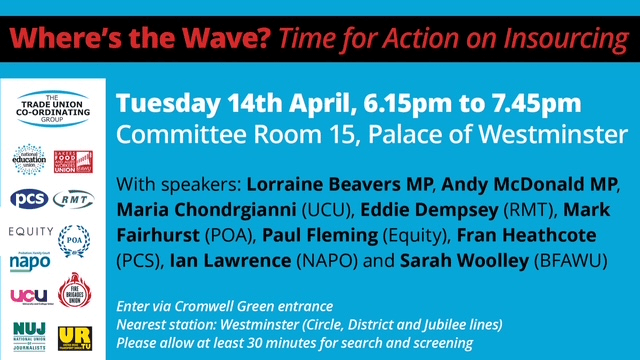
That’s why the Trade Union Coordinating Group are holding a rally in Parliament next week to say Enough is enough! It’s time for Labour to make good on its promises.
Michael Calderbank is the Trade Union Liaison Officer of Tottenham CLP and works for Solidarity Consulting.
Where’s the Wave: Time for Action on Insourcing
Tuesday 14th April, 6.15 – 7.45, Committee Room 15
Speakers: Lorraine Beavers MP, Andy McDonald MP, Maria Chondrogianni (President, UCU), Eddie Dempsey (General Secretary, RMT), Paul Fleming (General Secretary, Equity), Mark Fairhurst (National President, POA), Fran Heathcote (General Secretary, PCS), Sarah Woolley (General Secretary, BFAWU).
Chair: Ian Lawrence (General Secretary, NAPO)
 Labour Hub