
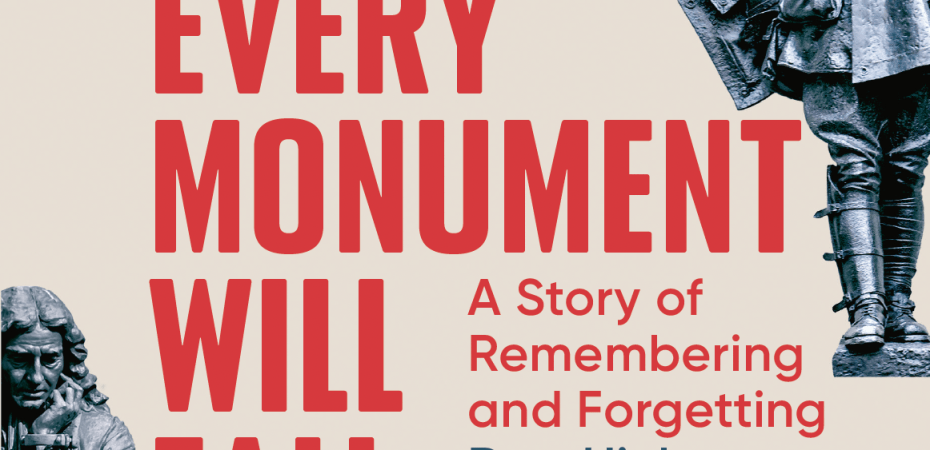
Ahead of the publication of the paperback edition of his new book and an upcoming speaking tour, Professor Dan Hicks explains why we need an understanding of corporate-militarist colonialism to make sense of the world today.
Like many who were students in the 1990s, I was taught to think about the legacies of empire through the lens of ‘post-colonialism’. Across studies of literature, politics and history, back then questions of empire were framed as something that had been brought to an end through the processes of post-war decolonisation, and so could be interpreted, analysed or discussed now those events were over. For those of us who had protested against the First Gulf War of 1991, and who would later return to the streets to join the millions who marched against the Second Gulf War from 2003, that framing always felt problematic. Today, as the prospect of a Third Gulf War looms, it’s simply impossible to square with the facts.
Just open a newspaper and there is Putin’s “special military operation” in Ukraine, Israel’s genocide in Gaza, and a new phase of bombing Lebanon. Or doom-scroll your social media and there is Trump threatening new American attacks on Venezuela and Iran alongside ideas of invading Cuba, even annexing Greenland or Canada, and pronouncing “we will pursue our Manifest Destiny into the stars.” Imperialism is back, the pundits tell us. More probably, colonialism never went away.
So if the idea of postcolonialism has become as antiquated and irrelevant as the idea of postmodernism, what new framing do we need in its place?
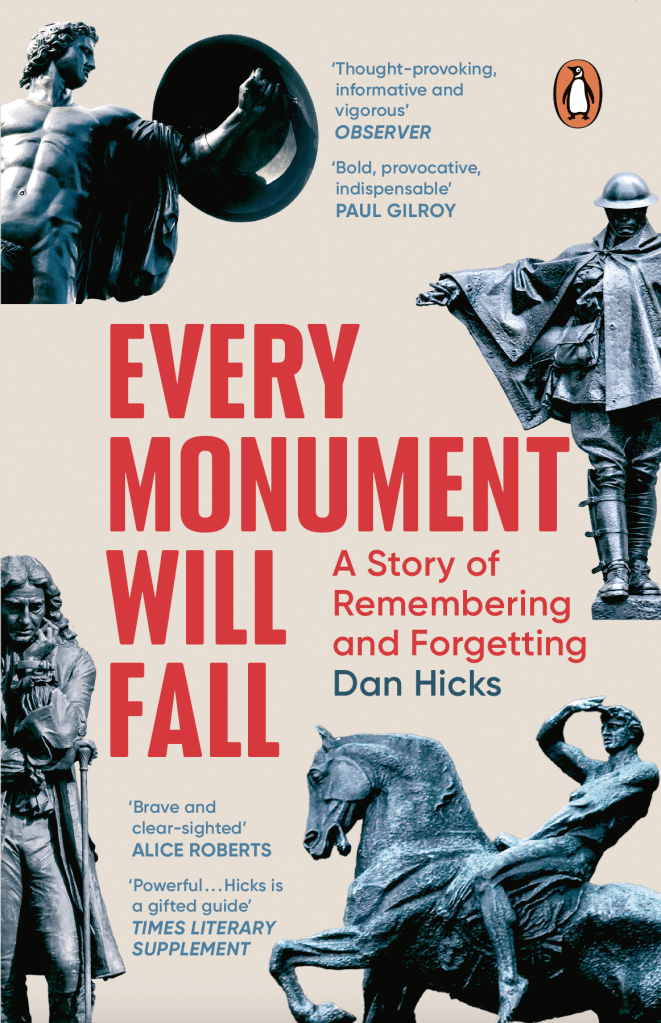
My book Every Monument Will Fall: A story of remembering and forgetting, which is published in paperback on May Day 2026,offers one possible answer. As a curator whose research operates between the ‘four As’ (art, archaeology, anthropology and architecture), and as the world’s first Professor of Contemporary Archaeology (a field that some will insist is an contradiction in terms), I am interested in the traces of the recent past and the near-present. From my perspective the answer to the question about how to think about colonialism beyond ‘postcolonialism’ is twofold. First we must examine what exactly it is that survives into the present. And second, we need to understand how it has been made to endure.
You might imagine that the cultural and artistic dimensions of ongoing colonialism are a distraction from what we think of as the ‘real work’ of anti-imperialism, anti-war activism and anti-racism. But for over a century, three parallel grassroots movements, largely led by Indigenous, South Asian, African, African-American and Caribbean scholars and activists, have shown how crucial the dimension of culture has been (and continues to be) for how ideologies of White supremacism and structures of colonialism have survived.
First is fallism. The fallism movement has worked towards the removal of statues of colonisers and enslavers – a history that reaches back at least to the Neill Statue Satyagraha protest in Chennai (the 100-year anniversary will fall next year in 2027). It has included significant movements in Algeria, has seen the removal of statues of Cecil Rhodes in Zambia in 1964, in Zimbabwe in 1980, and in Cape Town in 2015. It has been a central element of the civil rights movement in the United States since the 1970s.
In my own workplace, Oxford University, the statue of Rhodes, this institution’s shameful celebration of the foundations of apartheid, still stands — for now, at least. But as Nick Mirzoeff pointed out in his 2023 book White Sight, the statues were never ‘just statues’ – they were crucial elements of the infrastructure of cultural Whiteness.
Second is restitution. As I showed in my previous book The Brutish Museums, the movement for the restitution of looted artefacts, artworks, and ancestral human remains to formerly colonised nations and descendant communities has a long history, which has seen many returns since the first items looted from the Kingdom of Benin in what is today Nigeria returned in 1937. Some still claim returning stolen goods is an attack on museums; but with every return the reality becomes clearer: on a case-by-case basis restitution is how we remake our galleries and collections to bring them into step with the facts, and with our times.
Third is the broader movement for the decolonisation of knowledge – the undoing of the creation of academic disciplines and structures of knowledge — disciplines and structures in which the founding of those four fields (the ‘four As’) was a cornerstone. Today when you hear JD Vance or Elon Musk telling people that Europe is at risk of “civilisational erasure”, or when Donald Trump talks of “shithole countries” and how his bombs will bring Iran “back to the Stone Ages, where they belong”, it is these old structures of thought that provide the framework for the divisive language of civilisation and barbarism, culture and savagery. Who is the barbarian and the savage here, people increasingly ask.
In these ways — whether with monuments in the streets, or with stolen objects in a museum vitrine, or with the very ideas and framings used in academic seminars or in the books in the university library and on the reading lists — these three movements have shone a light on the unfinished history of how art, culture and even knowledge itself have been weaponised.
In Every Monument Will Fall I make the case that in a broader historical perspective, these three grassroots movement represented resistance against a single enduring historical phenomenon to which we need to pay attention today. In an older Marxist language they might have called this the ‘naturalisation’ of inequality, or simply ideology. In the book, I offer a name for this movement of politics, art, aesthetics and culture that co-opted our public spaces, museums and universities from the 1870s to the 1920s – ‘militarist realism’.
The militarism is clear – culture was put to work as part of the rationalisation and justification for colonial violence. As for the realism in play, it is a precursor to the realism described by the late great Mark Fisher in his 2009 book Capitalist Realism – that powerful sense experienced under late capitalism that the world could never be otherwise.
And here it becomes clear what the fallism, restitution and decolonisation movements teach us about the condition that militarist realism in monuments, museums and universities still serves to naturalise: the condition of corporate-militarist colonialism, as it emerged in the final third of the 19th century, and as it persists today in the first third of the 21th century.
For these reasons, I worry about how the American left have responded to the rise of Trump and Musk. On the one hand, it has been claimed that this is a return to feudalism, and the slogan has become: No Kings. On the other, we hear that this is fascism, and we hear that Trump is a kind of neo-Nazi. A third historical and political framing is possible, and it’s one that emerges if you pay attention to the lessons of movements for fallism, restitution, and decolonisation. On a Cecil Rhodes or Teddy Roosevelt model, in a new iteration of that ‘rough rider’ mentality with its chilling mantra “carry a big stick”, what we’re seeing is neither simply feudalism nor fascism but an enduring corporate-militarist colonialism.
The right’s war on culture has a long history — one which always involved placing stolen objects in museums, supremacist ideas in academic disciplines, and statues of enslavers and colonisers in the streets. As the Trump administration attacks national museums and public universities, and re-erects fallen Confederate statues, this is just the latest front in an longstanding transatlantic war for cultural supremacism. Those on the left can no longer afford to disengage, abandoning culture, ‘heritage’ and the arts as battleground of the original culture warriors.
So what new framing do we need to replace the idea of post-colonialism? The answer in my view is that we need to understand the enduring remains of the past not as national heritage but as public memory.
The fate of the statue of Cecil Rhodes at Oriel College, Oxford is an urgent case in point. Following a series of public protests, and the democratic decision by the governing body of Oriel College, Oxford to relocate the statue of Rhodes made in 2020 and reaffirmed in 2021, the monument is still there. Why? Nobody knows. The last Conservative administration sought to turn the phrase ‘retain and explain’ into a political slogan and a universal mantra, and a kind of chilling effect began to spread. But an alternative view to a world preserved in amber is possible: one that begins with the idea of the legacies of the past not as heritage, but as public memory. So let us demand the democratic right for nations, cities, institutions and communities to reshape their memory culture – to choose who is remembered, and how.
Drawing together debates about statues in the streets and ancestral human remains in institutional collections, Every Monument Will Fall: A story of remembering and forgettingmakes the case for reimaging national heritage as public memory as a first step in reimagining our national past in and for the present — caring about communities more than collections, and thus caring about people more than we do for things.
Dan Hicks is Professor of Contemporary Archaeology at the University of Oxford, Curator at the Pitt Rivers Museum, and a Fellow of St Cross College, Oxford.
Bluesky: https://bsky.app/profile/profdanhicks.bsky.social
Instagram: https://www.instagram.com/profdanhicks
LinkedIn: https://www.linkedin.com/in/dan-hicks-8527b867/
Every Monument Will Fall is published in paperback by Penguin on 1st May 2026, and is also available as an audiobook.
Dan’s upcoming paperback book tour includes the following UK dates:
THUR 30 APRIL
BIRMINGHAM UNIVERSITY/THE HEATH BOOKSHOP
(WITH CORINNE FOWLER & LEIRE OLABARRIA)
TUES 5 MAY
OXFORD DAUNT BOOKS SUMMERTOWN
(WITH PAULA AKPAN)
WEDS 6 MAY
MANCHESTER MUSEUM
(WITH SADIA HABIB)
THURS 7 MAY
LONDON WATERSTONES TRAFALGAR SQUARE
(WITH SARAH STEIN LUBRANO)
TUES 19 MAY
BRISTOL EAST BRISTOL BOOKS
(WITH MAI MUSIÉ)
SUN 14 JUNE
CLEVEDON CURZON CINEMA AND ARTS
(WITH THANGAM DEBBONAIRE)
Full details and tickets: www.danhicks.uk/talks
 Labour Hub