
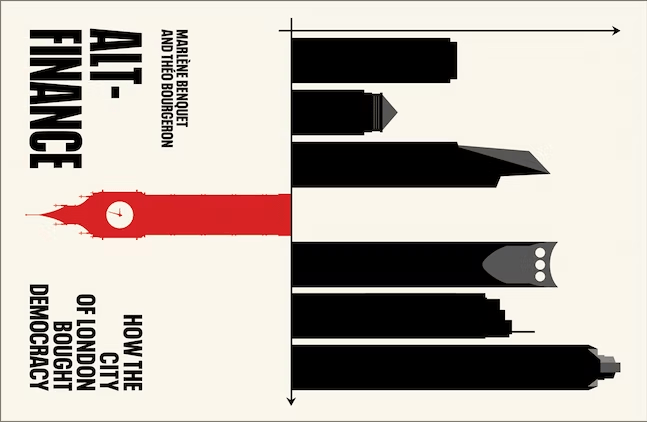
Labour Hub interviews Marlène Benquet and Theo Bourgeron about some of the ideas in their new book Alt-Finance: How the City of London Bought Democracy, published by Pluto.
Q: Finance capital has always had a major influence over governments, democratic or not. What is distinctly new in the current way that that influence is wielded?
A: You are perfectly right about the role that finance capital plays in politics. We do not say that there is anything new in the way that influence is wielded. Here, influence is wielded through electoral donations, through think tank influence and through other direct and indirect means.
The original thing that we are witnessing today is rather the fact that there is an open struggle within the British financial sector. This is not entirely new; it has already happened in the past as we show, but it happens rarely. We explain that we are witnessing a moment in which the two main fractions of the British financial sector have strongly diverging interests, and struggle to influence British politics in alternative ways.
We have seen that with Brexit, where most of what we call first-wave finance supported Remain, and most of what we call second-wave finance supported Brexit. We have seen that more recently during the Truss government, when some financial actors (hedge and private equity funds) rejoiced at the prospect of the mini-budget while others (stock markets actors) were quite concerned.
In our book, we show how the current period is original, because we are witnessing the takeover of a rising subset of the financial sector over British politics, and how this involves clashes with other subsets of the financial sector that were previously dominant. We show that these rising classes have original political interests, as they lobby for a new round of social, environmental, and financial deregulation, that would involve quite a radical transformation of the British political regime to be implemented.
Q: Commentators talked of the power of “Tufton Street” within the Truss government. Are think tanks of this type the biggest way that finance capital’s influence is wielded?
A: It is hard to say whether it is the biggest, but it is certainly a necessary component. When you study these think tanks, you find out quickly that they are related to business actors, and especially what we call ‘second-wave finance’ actors. For some of them, like the Legatum Institute, it’s quite straightforward, as the institute has the same name as the hedge fund Legatum Capital, its sponsor. In other cases, it is less visible, but you always find such business sponsors behind these radical right-wing think tanks.
The interesting thing is how these think tanks are involved in turning the economic interests of the actors that support them into ideas. The actors that sponsor them have specific interests that are not necessarily represented by traditional right-wing think tanks (Chatham House, for instance). So at some point, they needed their business interests to be represented in the world of ideas, and this is where Tufton Street comes from.
But the reconfiguration of British politics goes beyond this. You can also see quite clearly how in the past decades, there was a transformation of the Conservative party, with the rise of a libertarian wing that constituted the party base of Liz Truss’s government and that did not exist two decades ago. And it goes beyond the political world. This political shift that we have witnessed in the UK right-wing movements also benefited from transformations in the worlds of media and academia. So there is no one single actor behind this shift (for example, Tufton Street): there is a plurality of actors involved. The good news, however, is that you can actually map these actors and try to get some knowledge of them – which is what we do.
Q: In the research for your book, what were the most startling discoveries you made?
A: The first discovery precedes the book. It is that of the unexpected electoral results of the year 2016: in particular the victory of Leave on June 24th 2016 with 51.9%, and the election of Donald Trump, on November 8th 2016 with 55.67% of the vote. These two events had not been anticipated by the polling institutes and seemed contrary to the wishes of the financial markets.
In the British case, the Chancellor of the Exchequer, the Governor of the Bank of England, representatives of the banking sector and the City of London Corporation (the City’s lobby) had taken a position against Leave. The intuition that I wanted to verify was the following: were there less visible financial supporters of these political options?
The second surprise was to learn that in the United Kingdom there is an electoral commission that centralizes all donations made by legal entities, individuals and associations to parties or campaign groups available to all. The situation is the same in the United States where the data is also available. This is rarely the case in Europe. This poses a major democratic problem: there is no transparency regarding the fundings of political organizations and it is therefore much more difficult to analyze the links between the various business sectors and political projects.
The third surprise was the confirmation of this initial intuition: the different modes of accumulation within finance and notably the mode of accumulation of first-wave finance and that of second-wave finance (‘alt-finance’) determine divergent political orientations: a rather neoliberal orientation and a rather libertarian and authoritarian one.
Q: There are significant differences between the Truss experiment and what Sunak plans, as well as differences between the UK government’s approach and that of other governments. To what extent do the “powerful financial forces” speak with one voice?
A: No, we do not believe that finance speaks with one voice. The situation varies greatly from one country to another depending on its place in the global circulation of capital, the size of its financial sector in general and the respective weight of these different sub-sectors.
In the case of the United Kingdom, the financial sector represented 7% of GDP in 2018, of which 12.4% of assets was managed by the second financialization. This is much more than Germany where finance represents less than 4% of GDP. The British situation is still confused. Liz Truss is close to Tufton Street think tanks: she had chosen five of her closest advisers from among Tufton Street alumni, including her chief economic adviser and political secretary, and nine other Tufton Street alumni were scattered across other major departments.
Rishi Sunak seems more moderate. On the issue of bankers’ bonuses, on which Liz Truss proposed to remove the cap, William Wright, founder of the neo-liberal think tank New Financial, said that the proposal made by Rishi Sunak when he was Boris Johnson’s finance minister was sufficient because: “Any move by the UK to remove the cap on bonuses would be met directly or indirectly with a response from the EU.”
The mainstream finance, including the banking sector, the Bank of England and pension funds, pushed the former Prime Minister out. But her mandate contributed to the normalization of the libertarian project. Moreover, this project is expanding around the world. Different configurations are emerging. In the United Kingdom and the United States, the actors of the second wave finance are managing to build political victorious coalitions. Other countries, such as France, the Netherlands, Italy and Ireland, have a strong financial sector and a large second-wave finance sub-sector, but do not seem to engage in a change of accumulation regime. Their governments are managing to accommodate the distinct interests of the different financial sectors.
Finally, some countries remain outside the second wave finance, but interact with this emerging political regime of accumulation. This is the case, for example, in Poland and Hungary. The authoritarian right-wing governments of these countries put pressure on the neoliberal governments through their affinity with the libertarian-authoritarian agenda. They may indeed have common economic interests with the actors of the second financialization.
Q: Does the different approach of finance capital and manufacturing capital to both Brexit and now austerity mark a permanent fracture in the outlooks of these forces and if so, are there implications for building a broad movement against austerity?
There is no systematic opposition between financial and industrial capital. The modes of accumulation induce political orientations, but there are common political interests between sectors with different modes of accumulation. These common interests are the basis of political coalitions.
A study of the supervisory boards of Tufton Street think tanks shows, for example, that they represent the interests of the actors of second-wave finance, but also those of industrial sectors such as construction, the fossil fuel industry and tobacco.
In the case of the Brexit referendum, industrial sectors and traditional financial actors campaigned together. John Cridland, chief executive of the Confederation of British Industry (CBI, Britain’s largest employers’ organization) published an op-ed as early as June 2014 in favour of Remain: “The EU is our biggest export market and remains essential to our economic future.”
The Institute of Directors (IoD), a federation of British business leaders, conducted a survey of more than a thousand of its members from which it emerged that 64% of leaders believed that the exit of the United Kingdom from the European Union will be “negative for their business.”
In addition, there are some overlaps between the libertarian and neoliberal orientations, which are the two main policies promoted by business circles in the so-called global North (excluding China and Russia) at this time. Budgetary austerity is one of them.
How can we think about resistance in this context? There are experiences of resistance all over the world that can be local, global, electoral or not, based on different identities, more or less intersectional. Lula’s win in Brazil is an example of resistance to the austerity policies of Jair Bolsonaro’s authoritarian libertarianism. It is difficult to know, among all these experiences of resistance, which ones can be fruitful. The current political changes tend to close some fields of struggle and open others.
Some of the problems that have arisen in the South are now shared in the North, such as environmental issues of course, but also those of access to health and housing. This opens the way to common fronts.
Q: To what extent do you think a Labour government would be able to resist the new power of the City of London?
Actually, we do not really describe the “new power of the City of London”. The British financial sector has had a very powerful role in British politics since at least the 1970s. We rather describe the takeover of a new subset of the financial sector over British politics, in other words, a shift of power in the financial sector.
In my opinion, there are two insights to get from this for the labour movement. The first insight is that the British business community is hugely divided. We show the division within the financial sector, between distinct financial actors that have distinct interests. This division is quite new. In the past decades, Conservative and New Labour governments managed to make policies that met the interests of both subsets of finance, whereas now it does not seem to be possible anymore to accommodate all these different forms of finance.
The division of the British business class opens opportunities for the labour movement. Of course, each of these two subsets of British finance will always prefer to realign itself behind the other subset rather than have to deal with a radical left government that defends the interests of workers. However, there can be miscalculations and mistakes during the course of the clash between these various subsets of the British business class and the labour movement could benefit from these.
The second insight relates more to the shape of the phenomenon that we describe. We show how a new, emerging financial class has been able to rise to power in the last decades. We highlight the political construction that this has required – not only electoral donations, but more broadly the creation of professional associations, think tanks, and so on and so forth.
This process is worth observing for the left. To exert power, you don’t only need to win an election. You also need to create all these intermediary power strata between your economic interests and political institutions. So that you don’t just win an election (for example, Brexit), but you create a political event that you are able to sustain through several years of political struggle.
Although the actors involved are different, we could also transpose this to the case of an eventual Labour government. It seems likely that a Labour government would be able to lead transformative change in favour of the working class only if it is supported by such intermediary strata (trade unions, left-wing think tanks, left-wing media, left-wing MPs). Otherwise, it will win an election, but then it will become the tool of other social classes.
Marlène Benquet is a CNRS research fellow at the University of Paris Dauphine. She is the co-editor of Accumulating Capital Today: Contemporary Strategies of Profit and Dispossessive Policies. Théo Bourgeron is a Leverhulme Early Career Fellow at the University of Edinburgh. He has published in international journals such as Economy & Society and Organization, and is the co-editor of Accumulating Capital Today: Contemporary Strategies of Profit and Dispossessive Policies.

