
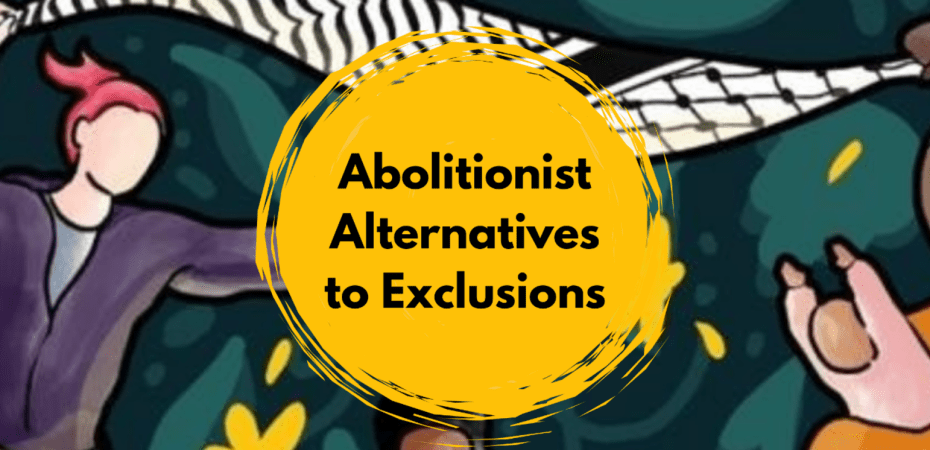
No More Exclusions yesterday launched its new guide Abolitionist Alternatives to Exclusions: Re-imagining care, education and wellbeing in schools.
No More Exclusions is a Black-led and community-based abolitionist grassroots coalition movement which foregrounds the voices and experiences of children and young people who have experienced oppressive education and exclusion.
This new guide aims to offer tangible alternatives to excluding young people from school and explore what an education system without school exclusions would look like. It is aimed at school staff, educators, students, care-givers, parents, policymakers and members of the public who are concerned about school exclusions and are seeking ways to better support children and young people.
The guide examines how the presence of police in schools creates a culture of hostility and suspicion for both students and staff, and can lead to young people being criminalised for minor issues or non-conformity to school rules. This concern extends beyond the physical presence of police officers and includes state-mandated surveillance programmes such as the Prevent Duty, surveillance cameras and body searches of students by school officials. Instead, it proposes a trust-building approach engaging parents and carers with a view to collective problem-solving.
In many schools, ‘disruptive behaviour’ by students leads to isolation booths, where students are required to do often meaningless work in complete silence, followed by pupil referral units and other spaces which “breed assumptions about students, particularly racialised and marginalised, who are already subject to many negative and inaccurate stereotypes.”
The guide sets out why many current practices, such as zero tolerance, community service and even awards for good behaviour are harmful. It advocates alternatives – a liberatory model of teaching that align with students’ emotional, physical, educational and cultural needs, and care-centred conflict resolution.
The guide is presented in a really engaging way for all audiences, with thoughtful design, a further reading list and frequently asked questions. The rapper Akala, a vocal supporter of Jeremy Corbyn’s leadership of the Labour Party, spoke at the launch. He is quoted in the guide from his 2018 book Natives: Race and Class in the Ruins of Empire: “State schooling in Britain both today and when I was a child seems stuck in a Victorian-era paradigm, guided by notions of discipline, obedience and deference to one’s betters, of becoming a good worker and getting a good job. The idea that we go to school to find our passions, our calling, to learn to be happy, to ‘draw out that which is within’, as the root meaning of the word ‘educate’ commands, is almost entirely absent.”
The idea that our education system mirrors the institutional racism found in the rest of society is something that needs to be emphasised in the context of expanding exclusion, isolation rooms, off-rolling and pupil referral units. As Akala said in the same book: “We have been trained to see racism as an issue of interpersonal morality – bad people are racist, good people aren’t. This is why poor people’s overt racism is condemned much more than the institutional racism that benefits the middle class.”
Abolitionist Alternatives to Exclusions: Re-imagining care, education and wellbeing in schools can be viewed here.

