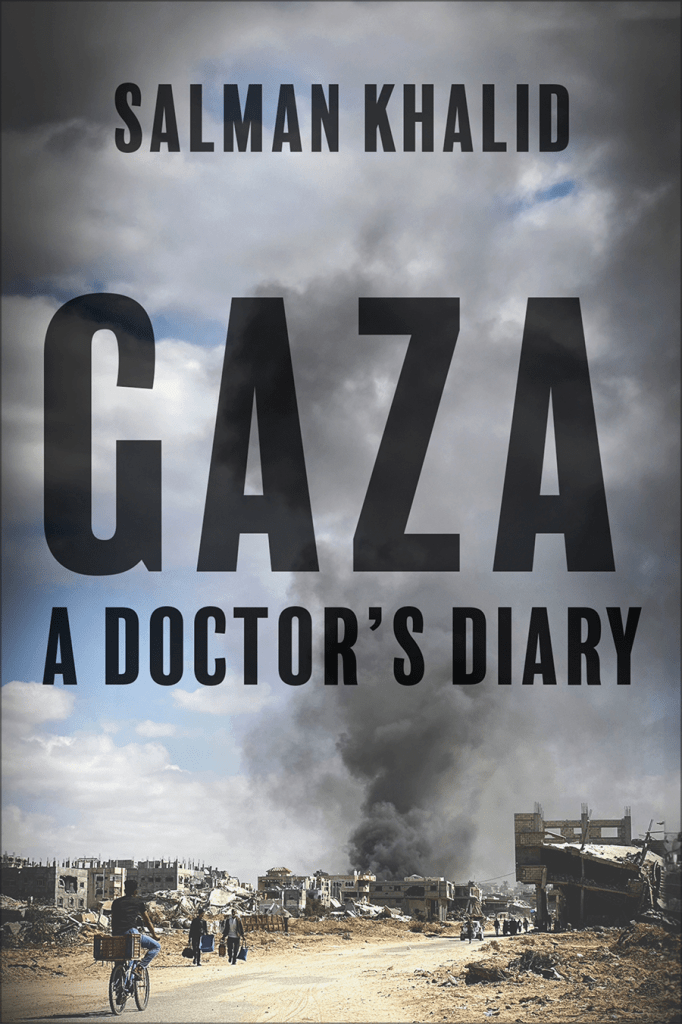
Mike Phipps reviews Gaza: A Doctor’s Diary, by Salman Khalid, published by Pluto.
The author of the Foreword of this book, Dr. Fozia Alvi, had worked with the survivors of genocide before, bringing medical aid to the Rohingya refugees. But nothing prepared him for what he found in Gaza: “the heart-wrenching reality of encountering so many children— innocent lives shattered with shrapnel and bullet wounds. I witnessed a generation of amputees, children robbed of their childhood and broken in unmendable ways. I saw mothers consumed with grief, unsure of which of their children to mourn—the ones killed, the ones clinging to life, or the ones left broken, with limbs torn away.”
The journal he introduces was written by Dr. Salman Khalid during his 29-day deployment at Al Aqsa Martyrs Hospital: “no other physician has so thoroughly documented the personal and medical toll of this genocide.”
In August 2024, Emergency Physician Salman Khalid left Canada, his wife and three children to work in Gaza as part of an international team. Crossing into Gaza, “all one could see was miles and miles of ash-coloured, bullet-riddled, crumbled buildings.”
Once he begins work, the stories are heart-breaking. One of his first patients was “a four-year-old boy, who was the size of my two-year-old daughter. His home in the designated humanitarian safe zone was bombed today.” He showed signs of severe brain injury and impending brain death but the overwhelmed staff were unable to place him on oxygen or a cardiac monitor. Gaza has only one-third of the medical residents it had before October 2023.
The next day at 4am, an Apache helicopter fires three missiles into the tents inside the hospital grounds killing four people, 100 metres from where Khalid is sleeping. This was despite the IDF having marked this as a safe humanitarian zone.
Another injured family is brought in; the woman dies. “I found myself imagining how this man would feel when he wakes up to realize that he is missing a leg, his son will have to defecate in a bag for potentially his entire life, and his wife and mother of his child is dead. If I was in Canada, this shift would rank among the most difficult of my entire career, but it seems like this will be just another day in Gaza.”
A few days later he and his colleagues spend over two hours trying – unsuccessfully – to resuscitate a nine-year-old boy, with a blast injury to the head and chest, whose father, an ER nurse, is assisting in the process. Other children come in with shrapnel embedded over their entire skin like tiny razor blades, or horrific burns. Khalid’s anger gives way to exhaustion.
Khalid describes the ER at Al Aqsa Hospital as “absolute chaos. It is a zoo, a madhouse.” It treats between 1,000 and 1,200 patients per day, in an area that is less than half of his ER’s size back home, which treats between 150 and 250 patients per day. There is no sterility, no air conditioning and the room is crowded with patients and relatives. Tensions between staff, the intrusive media and family members sometimes escalate into brawls.
“There are patients everywhere in the hospital. Rooms are full. Patients are laying on small mattresses they brought from home in hallways, stairwells, lobbies, outside administrative offices… pretty much anywhere there is open floor space.”
What is most distressing in this account is the sheer number of child victims. Khalid reminds us that half of the 2 million people in Gaza are children, so every time the Israelis bomb, half the victims are likely be children. It feels, he says, like killing just for the sake of killing – pointless, cruel torture.
Day 24: “Another 4am bombing of the Nuseirat camp brought mass casualties to our door… Around 1:30pm, we received another wave of casualties from an airstrike at Al-Shati camp.” Most cases Khalid describes in medical detail, but some arrive already taking their final breaths. Others die because of lack of functioning equipment -replacements are refused entry into Gaza by the Israeli authorities.
The following day, wave after wave of casualties arrive. “Of the patients with critical, life-threatening and catastrophic injuries today, half were children… Just when we thought we had things sort of under control, a fresh pile of bodies was dropped to the Red Zone floor with a crowd of more than 20 people trying to figure out who had the most immediately life-threatening injuries in all the chaos.” Yet despite this being Khalid’s worst day so far, other staff tell him that this is barely 30 percent of what they were experiencing just a few months earlier.
There are uplifting moments – but not many. The sheer misery of the situation is deeply affecting. Alongside the new trauma cases, there are patients with massive bed sores, the smell of vomit and necrotic flesh and malnourished patients, particularly children, who appear to be three to four years younger than their actual age. Khalid notes that he’s seen more amputees at this hospital in a single day than he has in his entire career.
As he prepares to leave, Khalid asks a 26-year old colleague what message he should take k to people back home. His answer is shockingly direct: “Don’t worry about us; we have one test and that is to be patient. You have many tests that you have to overcome: greed, free time, and all of your privilege in the West that has caused you to be lazy about fighting for justice. Don’t worry about us. Fix yourselves first.”
Khalid draws a similar conclusion at the end of his stay: “The only difference between September 3rd and today is that on September 3rd I thought the world was still watching, but today I know that no one is.”
Salman Khalid was not obliged to go to Gaza. As he says, “I have no Palestinian blood coursing through my veins.” But, as many who have boarded flotillas to break the siege of Gaza or taken other direct action to help the Palestinian people would understand, he adds: “I believe it is a litmus test for all of us who live in the West. Do we really stand for human rights for all people, or only a select few?” It’s as simple as that.
Not everyone can be an emergency physician in a war-ravaged hospital. But they can speak out, be careful of whose products they buy, write letters and sign petitions, donate.
With the Middle East war ever-widening and the Israeli barbarities in Gaza increasingly rendered acceptable by a complacent media, the plight of the Palestinians is in danger of slipping down the news agenda. Israel’s ‘ceasefire’ in Gaza appears increasingly to be a branding exercise crafted for international opinion: meanwhile, the war crimes continue.
Lat month, United Nations human rights experts highlighted the case of Dr. Hussam Abu Safiya, a Palestinian physician and hospital director who has been imprisoned for more than 450 days and reportedly tortured by his captors.
There is more first-hand testimony from Gaza surgeons available to Western readers. Bleak though this reading may be, it is vital first-hand material that reminds us that the majority of the victims of the indiscriminate carnage unleashed by Israel have no ideology or involvement in the conflict. This war on the innocent must never be normalised.
Mike Phipps’ book Don’t Stop Thinking About Tomorrow: The Labour Party after Jeremy Corbyn (OR Books, 2022) can be ordered here.