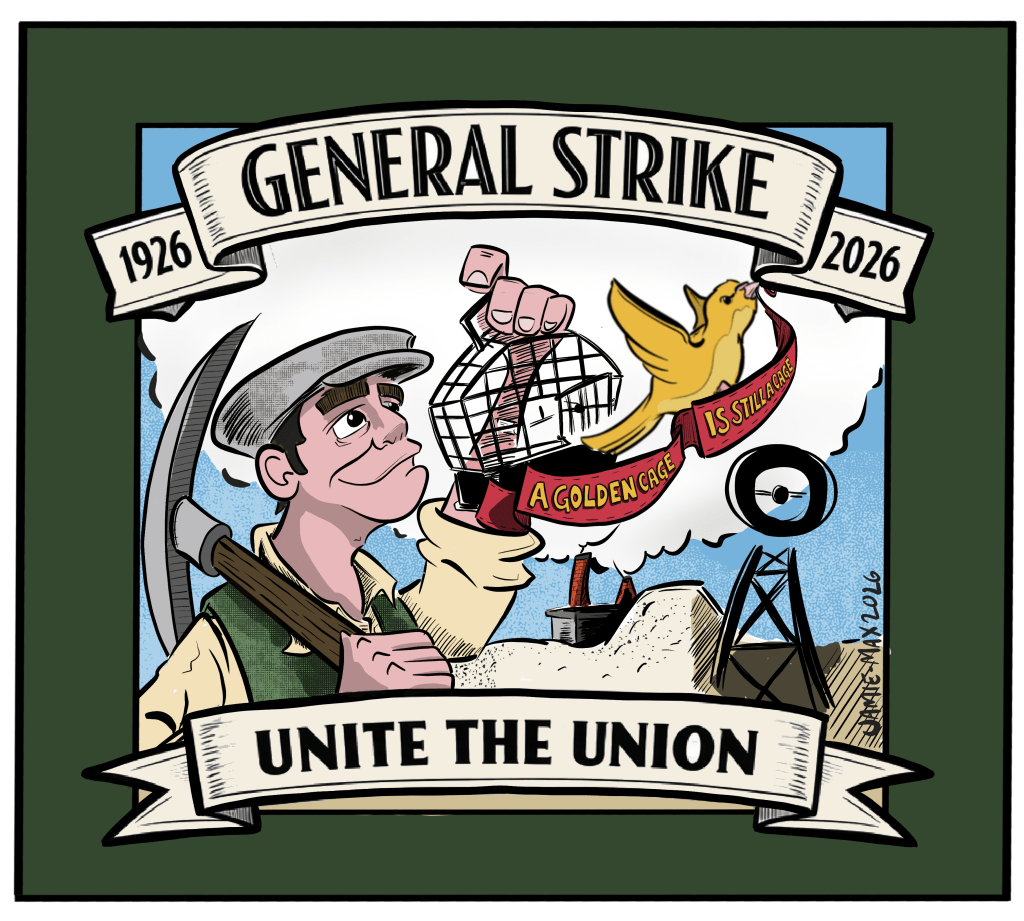
Joe Rollin of Unite invites supporters to celebrate the centenary of the 1926 General Strike.
Sick leave, maternity and paternity leave, paid holidays and safer workplaces – many of us take all of these for granted in our working lives. But these rights are not and were never guaranteed. They were hard won by trade unionists, standing together in their fight for change.
And we can trace the origins of these rights back to 100 years ago. On May 3rd 1926, the General Strike began, with 1.7 million workers across different industries walking out and bringing Britain to a standstill.
Steel workers to printers, dockers to transport workers and engineers to postal staff and many more: it was a lesson in what happens when workers who make up the backbone of the country stop working.
Public transport ground to a halt, deliveries of food, letters and other essential items stopped, newspapers weren’t printed and electrical services were cut off – these were just some of the effects.
Workers across the country had walked out in solidarity with coal miners, who faced devastating cuts to pay and conditions by mine owners who wanted them to work longer hours for less pay.
In short, ensuring the bosses still made profits at the expense of workers. If this sounds familiar, it is because it is a common theme behind strikes that happen today.
The words of the coal miners’ leader A. J. Cook, which are synonymous with the General Strike, “Not a penny off the pay, not a minute on the day!” are still as important for workers now as they were in 1926.
While the General Strike started with momentum, it ended quickly. The Trades Union Congress – who had initially called for workers across key industries to go out – called it off after just nine days.
The government, led by Conservative Stanley Baldwin, used strike breaking tactics such as bringing in the army and asking for volunteers to get the country running again.
Unions were left struggling financially while in general the industrial action was viewed as divisive – volunteers, the majority of whom were upper and middle class, were seen as heroes by the Conservative government and right wing press. Striking workers viewed them as undermining the struggle for improvements to their rights.
The miners carried on striking for seven months, before eventually returning to work – many of them on worse conditions than they had worked under previously.
While it did not achieve its initial goals, the General Strike left a lasting impact and was extremely important in shaping the labour movement as we now know it.
This is why Unite – the UK’s largest union – is marking the centenary of the General Strike with a memorable event in Barnsley on 2nd May.
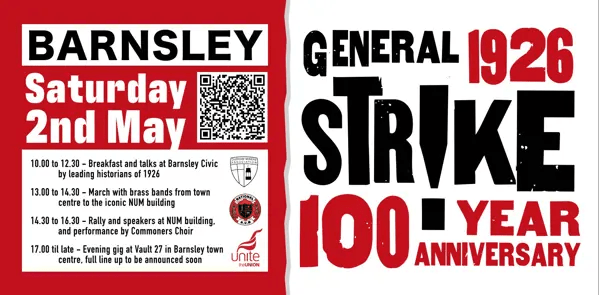
Working with the Durham Miners Association and the National Union of Mineworkers, we are bringing together trade unionists, historians and artists for a march and rally – a celebration of working class pride.
This event will be followed by a gig at Barnsley’s Vault 27, which will see a stacked bill of raucous political bands and artists playing from 5pm. All funds raised from the concert will be donated to Unite’s strike fund to support our members who are currently involved in industrial disputes.
Marking the centenary of the General Strike is the perfect time to celebrate trade union history, remember those who stood together for their working rights and to use those lessons to fight for a better future. Because despite all the wins, the fight is far from over.
While the world of work is significantly different to how it was a century ago, thanks to the hard work of unions and our focus on collective organising, there is a huge amount still to be done.
Back in 1926, striking workers were dealing with falling living standards, unscrupulous bosses and profiteering from employers and the super-rich as they saw their own pay being cut and costs of essentials rise. We can easily see the parallels.
At this particular moment in history, it can feel like we are going backwards. Today, workers are still being penalised for crises out of their control, such as the war in the Middle East which is causing prices rises of food and fuel. The cost of living crisis has been going on for several years and shows no sign of abating – but corporations are profiting from the situation. Just look at BP crowing about its ‘exceptional’ oil trading results recently.
Food inflation up is 38 per cent while supermarkets rake in huge profits and some of their staff claim Universal Credit to supplement salaries too low to live on. Consumers are paying more than ever in their water bills to make up for company failings while their CEOs earn millions.
British workers are supposed to be content with wage stagnation, while those in the public sector in key roles have faced constant real-terms pay cuts leaving many struggling to afford the basics.
Food bank use is soaring – 655,000 people used Trussell Trust services for the first time in 2023-24 – a rise of more than a third since 2018-19.
This unacceptable situation cannot continue. A better world for workers is possible and Unite strives towards this every day.
We work hard to secure the best deals on pay and conditions for our members, as well as fight against the scourge of corporate greed and arguing for a wealth tax on the richest in this country.
Since 2021, we have put £620 million back into the pockets of those who deserve it the most – the workers.
But it was the workers who took part in the General Strike who initially showed there was power in the union and we must thank them.
It was because of them that industrial issues were brought to the forefront of public consciousness and workers’ rights became an important part of the political agenda.
The strike was a showcase of working class solidarity and unity. Collective action was at its heart. These remain very important tenets of the trade union movement today – trade unionists know this is our strength and it is something we will always celebrate.
For more information, see here.
Joe Rollin is a senior organiser at Unite the union.
Images c/o Unite.