
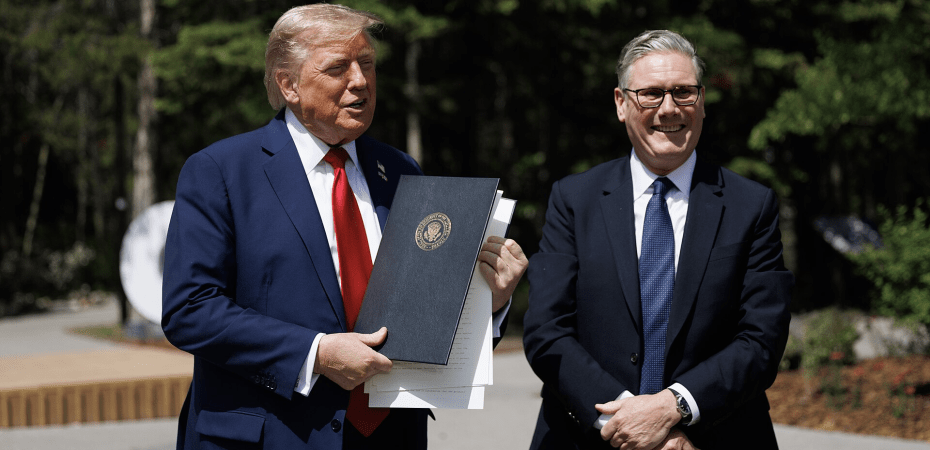
The architects of Operation Epic Fury spent years building toward this moment. By giving them British legitimacy, Keir Starmer has handed Labour’s opponents a weapon they’ll use for a generation, argues Hassan El Biali.
There’s a moment in every Labour foreign policy disaster where you can see the decision being made. Not the formal vote, not the parliamentary statement, but the earlier moment, quieter, when the leadership decides that the political cost of dissent is higher than the political cost of compliance.
With Blair and Iraq, that moment came somewhere between the second dossier and the resignation of Robin Cook. With Starmer and Operation Epic Fury, I’d place it earlier, around the time the White House made clear that criticism of the Iran campaign would be treated as an unfriendly act by an administration that holds considerable leverage over the UK economy.
The result is the same either way. Labour says nothing meaningful. The war continues. And somewhere down the line, the Party pays.
Who built this war — and why it matters for Labour
Before we get to Starmer’s failure specifically, it’s worth understanding what he chose not to criticise. Operation Epic Fury didn’t emerge from a policy vacuum. It was the product of years of groundwork by a specific ideological network: the Foundation for Defense of Democracies, supported by pro-Israel mega-backers; Jack Keane, the retired general turned Fox News commentator who sat on the board of General Dynamics and has been calling for military pressure on Iran for the better part of a decade; Lindsey Graham, whose Senate floor performances in favour of Iran confrontation have been so consistent they border on performance art; and Jared Kushner, whose Gulf business interests and Abraham Accords vision both depend on Iran remaining isolated and pressured.
This is the neoconservative machine that produced the war. It is an American machine, primarily. But it requires international legitimacy to function — and that legitimacy, in the Anglo-American relationship, has always run through London.
Blair gave it to Bush. Starmer is giving it to Trump. The mechanism is identical. The consequences, historically, have also been identical.
The Blair precedent Labour refuses to learn
Iraq didn’t just kill people. It killed Labour’s working-class coalition. It created the conditions for the collapse of trust in the political establishment that eventually produced Brexit, Boris Johnson, and the Tories’ so-called ‘red wall’ breakthrough. The through-line from the second Iraq dossier to Labour’s 2019 general election catastrophe is not straight, but it exists.
Labour has spent years conducting internal post-mortems on Iraq. Chilcot. Apologies. Promises that it will never happen again. And now here we are, with a Labour government that has offered no meaningful parliamentary debate on British support for a U.S. military campaign that has — according to human rights monitors — killed over 3,400 Iranians, including 254 children. This includes the 31 children killed in the Minab school strike of March 2026, which received approximately four column inches in the British press before disappearing entirely.
What does it say about Labour’s institutional memory that the Party could go through everything Iraq cost it and still produce a leadership that makes the same calculation: Washington matters more than principle?
I’m not sure it says anything flattering.
The electoral arithmetic Starmer is ignoring
Let’s set aside the moral argument for a moment — not because it doesn’t matter, but because the Labour leadership has demonstrated it can set it aside quite comfortably. Let’s talk about votes.
Muslim voters in Britain are not a monolith. But they are a significant bloc in dozens of marginal constituencies, and their relationship with Labour has been deteriorating since Gaza. The Iran war — prosecuted with U.S. munitions, supported by British silence, with civilian casualties mounting — is accelerating that deterioration. The Greens and various independent candidates are ready to receive those votes. They are, in fact, actively campaigning for them.
Then there’s the younger, progressive voter — the one Labour needs to replace the older working-class support it has been haemorrhaging. This demographic does not experience the U.S.-Iran war as a distant geopolitical abstraction. They see it through social media footage of the Minab aftermath, through the de-platformed journalists trying to cover Iranian civilian casualties, through a media environment that the neocon infrastructure has shaped but that younger audiences navigate around.
Starmer’s silence on the war is not neutral. It is a choice. And it is a choice that gifts Labour’s opponents — the Greens, Reform on the other flank, and any future left challenger — a ready-made narrative: Labour had a chance to be different from Blair, and it chose not to be.
What an independent Labour foreign policy would look like
I want to be clear that I’m not arguing for a position of naive pacifism or reflexive anti-Americanism. I’m arguing for something much simpler: an independent assessment.
Labour could have called for an immediate ceasefire and independent investigation into the Minab strike without breaking the Anglo-American alliance. Ireland managed it. Norway managed it. Several NATO members have expressed reservations about Operation Epic Fury without being expelled from the Western order. The idea that any criticism of the war would constitute a catastrophic diplomatic rupture is a fiction — and it’s a fiction that happens to serve the neoconservative network that built the war in the first place.
A Labour Party with a functioning foreign policy conscience would name Jack Keane’s conflicts of interest. It would ask questions about FDD funding in parliamentary debate. It would note, loudly, that the architects of this war have been wrong about every Middle East military intervention for twenty-five years and have faced no professional consequences whatsoever.
That Labour Party does not currently exist at the leadership level. It exists in the membership, in the trade unions, in the constituency parties that passed emergency motions on the Iran war that the bureaucracy quietly buried. It exists in the tradition of Robin Cook and the handful of MPs who have broken with the front bench line.
Whether it can reassert itself before the electoral cost becomes permanent is, at this point, genuinely uncertain.
The question Labour has to answer
I started with Blair. Let me end there too.
Robin Cook resigned from the Cabinet in March 2003 rather than support the Iraq invasion. His resignation speech is still quoted as one of the most principled acts in modern British parliamentary history. It didn’t stop the war. But it drew a line. It said: not in my name, not from this dispatch box.
The question for Labour in 2026 is whether there is a single senior figure willing to draw that line on the Iran war. To say, clearly, that backing a neoconservative military project built by donors and think tanks and TV generals with defence industry board seats is not what the Labour Party is for. That the children of Minab deserve the same column inches as any other children killed in any other conflict that Britain had a hand in enabling.
So far, the answer appears to be no.
Labour’s opponents are taking careful note.
Hassan El Biali is a political analyst and writer covering U.S. foreign policy, international security, and Middle East geopolitics. He writes for Independent Australia, Counterfire and other international affairs outlets, and publishes on Substack at Megam226.substack.com
Image: https://commons.wikimedia.org/wiki/File:Prime_Minister_Keir_Starmer_attends_the_G7_Summit_in_Canada_%2854594328961%29.jpg Source: Prime Minister Keir Starmer attends the G7 Summit in Canada Author: Number 10, licensed under the Creative Commons Attribution 2.0 Generic license.


