
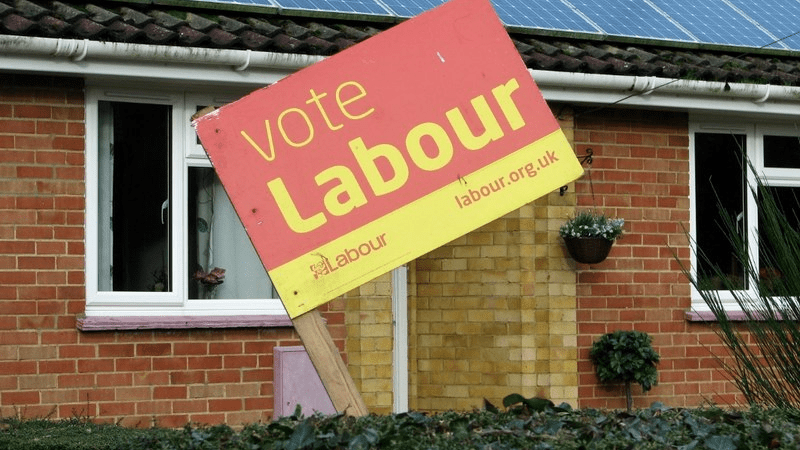
Labour Councillor Jumbo Chan, blocked by the Party apparatus from being on the ballot tomorrow, explains what has gone wrong with his Party.
Amidst the heavy damage done to Labour by the now-departed, disgraced Peter Mandelson, perhaps one of the most consequential, yet underdiscussed blowbacks of the hyper-factionalism driven by him, his protégé Morgan McSweeney and other key allies surrounding Starmer is the potential of what I would term the NPCification of Labour.
Originally a video game term, non-player characters (NPCs) are AI entities that operate via pre-programmed scripts to give some semblance of life to the virtual worlds which they populate. It is now entering into everyday speech as a colloquialism to describe people who seemingly lack independence and assertiveness, wandering around robotically, repeating fixed, predictable lines. Before sketching a brief picture of the NPC politician and the risk they would pose to Labour, it is important to first discuss how they may end up dominating the party.
Along with the targeting of Sam Tarry, Faiza Shaheen and many other perceived enemies before the 2024 general election, perhaps the most prominent example of the intense factionalism underscoring the present leadership was the blocking of Andy Burnham. Shielded by less public limelight, the clique orbiting Starmer has also purged swathes of local Labour representatives, including in upcoming battlegrounds such as Hackney, Lambeth and Brent. In the latter, all candidates were centrally handpicked.
A decade-long Labour councillor, I was also blocked for supposedly “contradict[ing] agreed Labour positions” by co-authoring a pro-trade union open letter, and coordinating hundreds of Labour colleagues to urge an equivocating Starmer to call for a ceasefire in Gaza. I will never retract my public support for trade unions and innocent children, but the intense factionalism goes far beyond the immediacy of any purges. By stabbing at Labour’s historically rich pluralism, Starmer’s allies have, as the party stares into the abyss, damaged its best chance to course correct.
With the constant threat of alleged secret spreadsheets, voting rigging, private surveillance and the punishment of dissent looming over Labour members, potential candidates, councillors and MPs, the Party’s famous broad church is a shadow of its former self. If this intimidatory culture, where silence and compliance are the name of the game, were to become ingrained in the party’s DNA, there is a profound danger of Labour transmuting into an institution dominated by what I would call the NPC politician.
Docile and vacuous, the NPC politician would lack the political depth which an otherwise open political culture would select for. Indeed, they would be able to get ahead precisely because of their political emptiness. And unlike either Tony Benn’s principled signposts or even the more opportunistic weathercocks, they would not see their role as remaking the country, let alone, shaping history. Instead, politics for the NPC politician would simply be another choice of career in which they are just trying to get by or climb up, executing instructions as scripted by the top.
Because of their inability to offer their own political vision to the public, personality politics would be the default terrain for the NPC politician: “I am the son of a takeaway owner and an immigrant cleaner; I was born here and I love food; and I am a nice guy who organises litter picks” not only serves to hide a dearth of politics, but also functions as the most substantive marker to differentiate one NPC politician from another. An NPCified Labour would not so much regress to political monoculturalism as to political sterility.
All this lies in stark contrast to outspoken outsiders such as Green victor in the Gorton and Denton by-election Hannah Spencer (whose victory speech could have been delivered by a Labour socialist) and, further afield, New York mayor Zohran Mamdani. Their fresh, bold socialist perspectives have clearly resonated with the public. But under the present leadership — whose clique would reportedly “rather burn Downing Street down” than give an inch to perceived opponents — these avowedly non-NPC politicians would have likely been blocked from even offering their views to Labour members.
The NPC traits of silence and compliance fostered by the current climate of fear might explain why, despite Britain’s dislike of a prime minister who is seen “as a cross between a jellyfish and doormat”, and with Labour facing great peril as forewarned by Burnham, the Party seems unable to do anything except to plough on as before. Therefore, a Britain being rocked by multiple crises and hungry for an radical change to society will only continue to look elsewhere for its politics.
The Labour Party was founded as the political wing of the labour movement, and cannot fulfil this historic role and, thus, regain public confidence, until ideas and people are allowed to flourish in the party. This must necessitate a restoration of Labour’s pluralistic, democratic tradition, best typified by Restore Labour Democracy and Reset Labour. After all, Labour’s founders foresaw over a century ago that the then-new Party would only succeed if it reflected the broadest traditions of British socialism and the working class. If Labour cannot expunge the poisonous hyper-factionalism and restore its historic broad church, it is unlikely that history will grant it another century.
Jumbo Chan is a Labour Councillor in the London Borough of Brent.
Image: https://www.geograph.org.uk/photo/6338634 © Copyright Evelyn Simak and licensed for reuse under this Creative Commons Licence.Attribution-ShareAlike 2.0 Generic CC BY-SA 2.0 Deed


[…] up winning back their previous seats, having been deselected for reasons including speaking out against Winter Fuel Payment cuts or organising letters calling for a ceasefire in Gaza. Many have now turned their back for […]
[…] the way parliamentary selections have been manipulated in recent years to favour the mediocre – NPCs, as they have been […]