
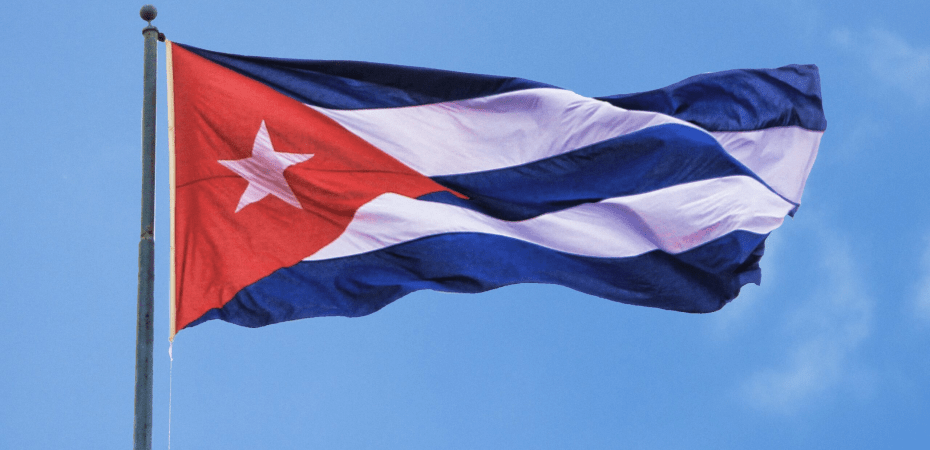
Bernard Regan explains the impact of Trump’s sanctions – and what needs to be done about it.
The United States’ military budget is roughly ten times the size of the entire Cuban domestic budget. In a year, Washington spends 500 times as much as Havana on its military budget and with more than one and a quarter million troops at its disposal it has more than 20 times the number of troops.
Despite these staggering statistics, President Trump on 1st May 2026 declared that Cuba was an “unusual and extraordinary threat” and that its policies were designed to harm the United States. The term is a legal formula used by the White House to legitimise the President imposing sanctions without having to seek the approval of Congress. During his first term of office and since coming to office in January 2025, he has imposed 227 sanctions including designating Cuba a State Sponsor of Terrorism (SSOT). These sanctions, largely left in place by President Biden, intensify the blockade of the island by denying access to recognised financial services such as the Society for Worldwide Interbank Financial Telecommunication (SWIFT), used by around 11,000 companies in some 200 countries and regions, through which it can trade.
The attack has been further intensified by threatening any country which supplies oil to Cuba. Venezuela, following the kidnap of President Maduro, has ceased any oil transportation to the island, although it had ceased to be the major source of fuel. Mexican President Claudia Sheinbaum has said she will not be bound by Washington’s diktat, but even she has found problems of meeting the level of supply needed by Cuba.
The humanitarian consequences are devastating. For the time being, no oil means constant power outages impacting every facet of life: domestic, industrial, agricultural, education and most dramatically in the health sector. Given Cuba’s climate, refrigeration is essential for the preservation of foodstuffs and medicines. The absence of electricity hits doctors and nurses conducing operations, with them having to use mobile phones to provide the lighting to carry out the delivery of babies. Vital life support machines are vulnerable and urgent medical treatment is being postponed. None of this of course is reported in the western media. Claims of ‘mismanagement’ by the government as being the root of the problem are regurgitated by the likes of the Financial Times and the Guardian.
Cuba is facing a medieval siege. The damage inflicted on the Cuban people is not as visible as the tragic images of other victims of direct military aggression, but the cumulative impact is growing. Infant mortality figures, which were the best in the whole region and indeed better than many states of the USA, are deteriorating.
Cuba is not standing still but is taking measures to address the electricity deficit caused by the oil blockade. Vast numbers of solar panels have been imported and installed across the island. The panels are being put in place across the island, ensuring remote areas are covered; but it will take some years to completely replace the need for oil-generated power. Cuba does have oil but it is very crude and needs to be refined in order to fit the purpose of fuelling power services and vehicles, for example. Cuban hydrocarbon engineers are working on this and have made some breakthroughs. However, these measures will still leave Cuba well short of the levels that are needed and in any case will take some time to be fully operational to meet the shortfall that is a consequence of Trump’s aggressions.
The question everyone is asking is whether Trump will choose to invade the island. The blockade, introduced by President Eisenhower virtually from day one of the revolution in 1959 and continued under Kennedy, in one form or another, has been in place for 66 years. The strategy of the USA was spelt out most clearly in a memo, entitled “The decline and fall of Castro”, issued by LD Mallory for his boss Assistant Secretary of State for Inter-American Affairs Rubottom on 6th April 1960 when he said that, “The only foreseeable means of alienating internal support is through disenchantment and disaffection based on economic dissatisfaction and hardship”.
Cuba, however, is not passive – over six and a half million Cubans, of a population of more than nine million, have signed a declaration of resistance to any assault on the island’s sovereignty. May Day mass demonstrations have repudiated Trump’s bellicosity. Whatever the provocations that may take place, the island is overwhelmingly united behind the revolution.
Since 1992, the United Nations General Assembly has passed 33 motions condemning the USA blockade of the island. In 2016, during President Obama’s term of office, 191 countries condemned the action while the USA and Israel abstained. Generally speaking, only these two countries have backed Washington’s blockade.
The United Kingdom’s representatives have voted 33 times against the blockade – in other words, on every occasion since 1992, when the first resolution on the topic was introduced, and most recently in 2025. Given this record, one would hope that the government would take actions to translate this vote into practical actions backing firms which want to trade with Cuba, sending oil, food and medicines as an act of solidarity.
The Labour government’s silence on Trump’s undeclared war on Cuba is deafening. According to the Prime Minister, Sir Keir Starmer, the government opposes any threat to the sovereignty of Greenland but has said nothing about the threats to Cuba. Over 100 MPs have signed an Early Day Motion calling for an end to Washington’s actions. Thousands have signed a statement defending Cuba’s sovereignty.
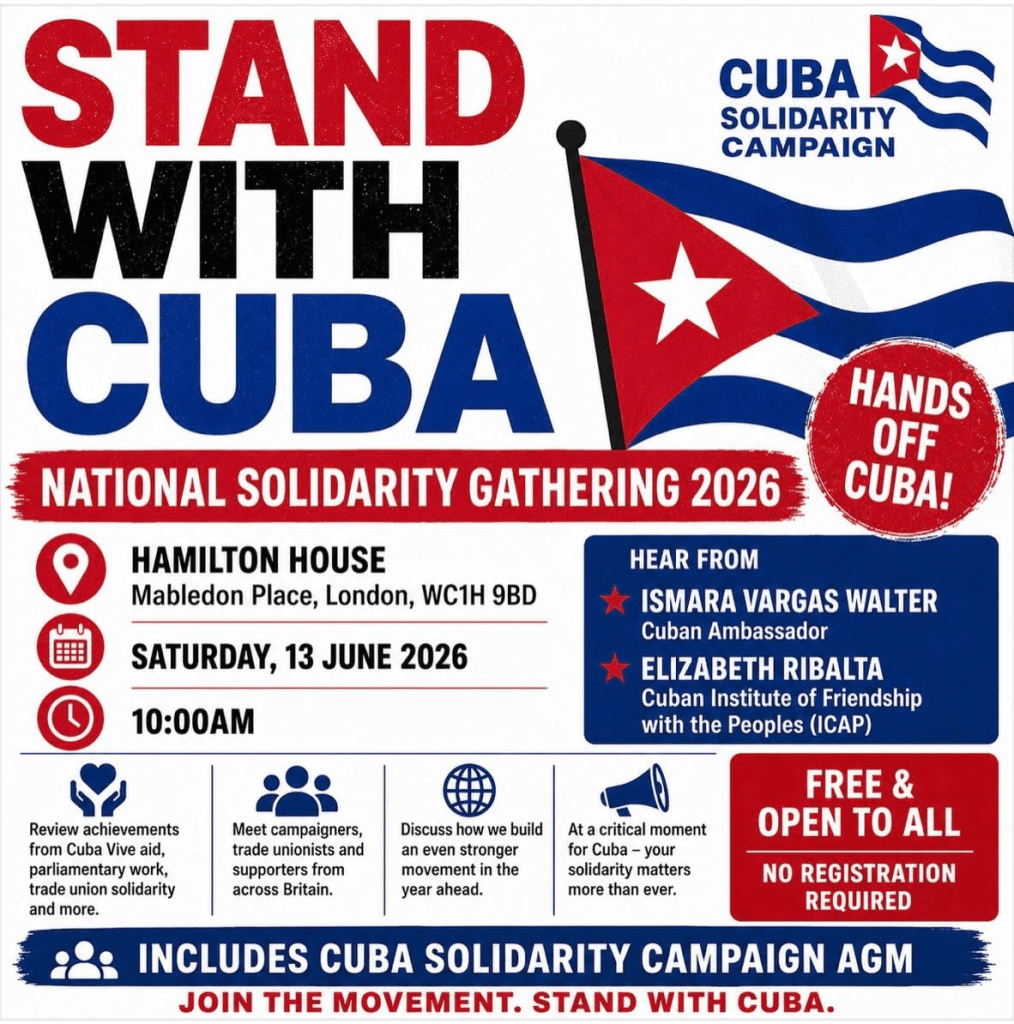
The Cuba Solidarity Campaign has launched a campaign called Cuba Vivé which has been backed by trade unions and has raised around half a million pounds, enabling the campaign to send vital medical equipment and foodstuffs, an initiative which is being replicated internationally. Backing this initiative is the most practical way of expressing solidarity with the Cuban people. (For details see https://cuba-solidarity.org.uk)
Bernard Regan is Secretary of the Cuba Solidarity Campaign.
Main image: https://rosalux.nyc/cuba-is-being-strangled/ Creator: rawpixel.com | Credit: rawpixel.com Licence: CC0 1.0 Universal CC0 1.0 Deed

