
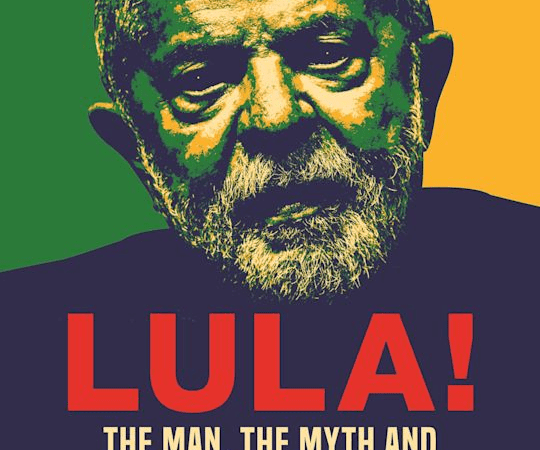
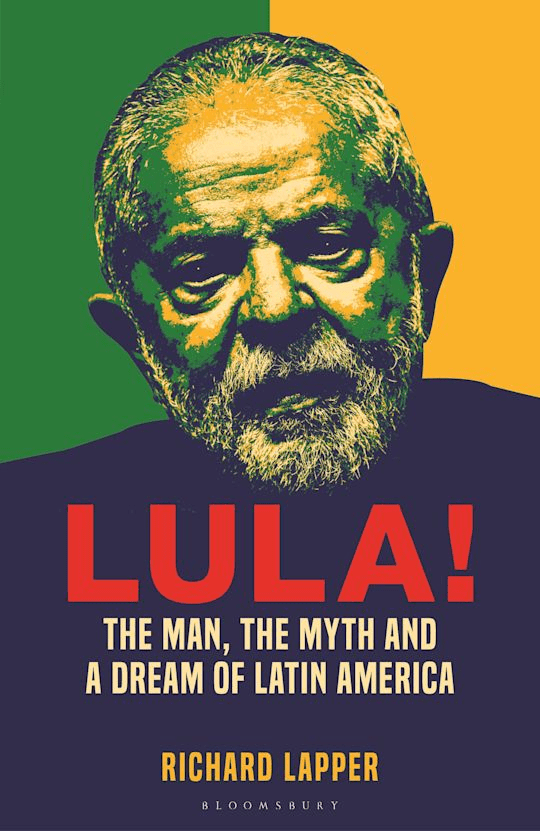
Mike Phipps reviews Lula! The man, the Myth and a Dream of Latin America, by Richard Lapper, published by Bloomsbury Continuum.
Union leader, founder of Brazil’s Workers Party (PT), three-times defeated in presidential contests in the 1980s and 1990s, Lula finally won the presidency in 2002, leaving eight years later with sky-high approval ratings. Jailed for corruption in 2018, he was released eighteen months later and ran for and won the presidency in 2022. It’s an impressive achievement that this new biography struggles to do justice to.
Foundations of the PT
Lula’s early life in brilliantly covered in Fernando Morais’s biography, reviewed here, from childhood poverty to skilled industrial worker, from union militant to founder of a new party, the PT, a fusion of autonomous trade unionists, left wing activists and radical Catholics. The latter was an often overlooked strand, which allowed the new organisation to reach places where no other left wing party had ever set foot.
The early PT was beset with many of the problems that face other new left formations: the tension between revolutionary propagandists and those who favour mass electoral politics, with all its inherent risks of opportunism and bureaucratism. Gradually its electoral performance improved: it won 37 cities in the 1988 municipal elections, including three of the largest. Lula’s presidential election campaign the following year saw him speak to up to seven meetings a day, including 50,000 in São Paulo and 60,000 in Belo Horizonte. In the last week of the campaign, he drew crowds of a quarter of a million people in São Paulo and Rio Janeiro. He was a phenomenon: he won 31 million votes, 45% of the total.
Lula ran again in 1994 and 1998, losing both times. When he finally won in 2002, it was on a far more moderate platform. Lula himself was repackaged as a strong family man, wearing smart suits and surrounded by qualified experts to compensate for his lack of education.
Lula in office
As perhaps befits a former Financial Times journalist, the author is heartened by the “extreme austerity measures” Lula’s government pursued once in office, supposedly to stabilise the economy, along with the increase in consumer lending. At the same time, the Bolsa Família (Family Allowance) benefit introduced by the previous government was extended to 12 million families and the economy strengthened, especially as trade increased with China.
As in many Latin American countries, the left can win the presidency, but rarely a legislative majority. The PT had under a fifth of the seats in either house of Congress, and rather than share power with parties to its right, it relied on bribery to get its way. The ensuing scandal prefigured the far more damaging ‘Car Wash’ scandal of 2014-2018.
But child malnutrition decreased by half in Lula’s first term and the average income of Brazil’s poorest 10% was now growing at 8% a year, which helped him win 60% of the vote in the second-round presidential run-off in 2006. Even if he was losing support among the better off, his government’s social programmes, including massive housing aid and water purification projects in the favelas, cemented his base among the poorest.
Lula’s government also demonstrated a genuine commitment to the environment. His Environmental Minister was Marina Silva, a black former rubber tapper, illiterate until age 18, who became a history teacher, then Senator. Lapper explores her rise to office and assesses her achievements, which included a 50% rise in the number of fines imposed on those responsible for illegal rainforest clearance and a significant increase in the creation of protected reserves. “Between 2003 and 2008 the Lula government was responsible for the creation of three-quarters of the world’s new protected areas.”
No country made a bigger contribution to fighting global warming at this time. Silva lost office in 2008 and became a fierce critic of Lula’s growth-oriented successor, but returned to her old job in 2023.
Things fall apart
Dilma Rousseff, a former guerilla activist from a well-off background, who had been tortured under the military dictatorship, served as Lula’s Minister of Mines and Energy and then his Chief of Staff. With his backing, she won the presidency in 2010 by a landslide.
Celebrations were more muted at her re-election in 2014, following a term if economic difficulties, popular protests for free public transit and an electoral campaign which spread ‘fake news’ about her left wing opponents. More is needed here on how Rousseff undermined her own political base; her anti-corruption crusade was certainly a factor, particularly when the PT itself fell under investigation. But her spectacular fall in popularity requires deeper analysis. Her emphasis on private sector-led growth alienated not only environmentalists: there were a number of strikes in the public sector; those by college professors left students unable to attend classes for months.
Two months into her second term, 2 million people demonstrated against corruption in the PT and called for her to go. It was a spectacular turnaround – the biggest mobilisation since Brazil’s 1985 return to democracy. Despite her “unshakeable honesty”, her 10% approval ratings in April 2016 made it easy for her to be impeached out of office.
There was clearly a partisan nature to the ongoing investigation into Lula and other PT officials, by a prosecution which illegally monitored communications around the president’s office and appeared to work closely with the right wing media to help demonize their targets. There is increasingly a pattern to such ‘slow coups’ in Latin America. The witch hunt aspect in Brazil was underlined by the way the investigation fizzled out once its key figures had been taken down. For its part, Congress blocked legal reforms which would have increased accountability for all.
The former president was now behind bars. A sense of the support that the jailed Lula still enjoyed is conveyed by the fact that trade unions banded together to rent a property opposite the prison. From here, demonstrators on a daily basis greeted him at 9am, 2.30pm and 7pm with shouts of “Good morning, President!”, “Good afternoon, President!” and “Good night, President!” Lula, whose spirits were lifted by this simple show of solidarity later said: “I was eternally grateful to them for this.”
Brazil was now firmly under right wing control. Lapper sees Jair Bolsonaro’s rise as something largely facilitated by the media. He was repeatedly hosted on talk shows and encouraged to be as offensive and controversial as possible, despising democracy and calling for civil war.
Politically Bolsonaro’s support was bolstered by the rising power of the agribusiness lobby, concerns about the growth of organised crime and the huge increase in right wing Protestant churches – by 2022, over a quarter of Brazilians identified as Protestant. Once elected, as with many other right wing populists, the Covid pandemic proved Bolsonaro’s unfitness for office, just as the attempted coup by his supporters in 2023 underlined his contempt for the electoral process.
The coup was aimed at Lula’s stunning comeback – he was elected anew to the presidency in 2022. But in Lapper’s analysis, the coup missed the point: the office of presidency had been irreversibly weakened in recent years by an activist judiciary and a more powerful but fragmented Congress, in which presidents struggled to assemble a majority.
Is Lula finished?
Lapper’s book is excellent on background context: it’s as much a history of post-war Brazil as it is of Lula. But with just over 300 pages of text and 60 years of political activity to cover, this inevitably makes the biography of the man rather superficial. Furthermore, he is too willing to go along with a mainstream media consensus about the strengths and weaknesses of his governments, underestimating the massive changes to the lives of Brazil’s poorest which Lula’s reforms brought about.
What happens next is anyone’s guess. The changing nature of Brazil’s economic structure is a significant challenge for a party founded on industrial trade unionism. In the mid-1980s, nearly a third of workers were trade unionised: now, industry has shrunk to just 13% of GDP and unions have lost two-thirds of their members, as workers move into the service sector, a trend accelerated by the Covid pandemic.
The PT performed poorly in the 2024 municipal elections, winning only 248 town halls out of a possible 5,569. It was the ninth biggest party in these elections and won just one state capital, compared to nine in the 2000s. If Lula’s popularity has risen recently, it is largely thanks to the economic warfare that the Trump administration has launched against Brazil.
Four years ago, Lula said he would not run again, but last year he changed his mind. Now 80 and with significant health problems, he will almost certainly face Flávio Bolsonaro, son of the previous President, later this year. Recent polls show them nearly tied, although Bolsonaro’s predicted share has dropped 5% in the last two months. But he has enthusiastic support from Brazil’s right wing media and Lula’s disapproval rating currently stands at 61%. The race could be even tighter than the 51% to 49% margin by which Lula won in 2022.
Days ago, Lula warned US President Trump not to interfere in Brazil’s upcoming presidential election. This was after Trump said, “ I hear they arrested somebody that’s running for office today,” apparently confusing presidential candidate Flávio Bolsonaro with his brother Eduardo, recently sentenced to a four year jail term for courting US interference in his father’s coup plot trial last year.
The US has already imposed tariffs and sanctions in response to former President Bolsonaro’s 27-year sentence for his attempted coup following his election defeat. In Argentina, Trump threatened to withhold economic support ahead of legislative elections last October, and in November, he warned he might also suspend aid to Honduras if his preferred candidate did not win.
Mike Phipps’ book Don’t Stop Thinking About Tomorrow: The Labour Party after Jeremy Corbyn (OR Books, 2022) can be ordered here.
 Labour Hub