
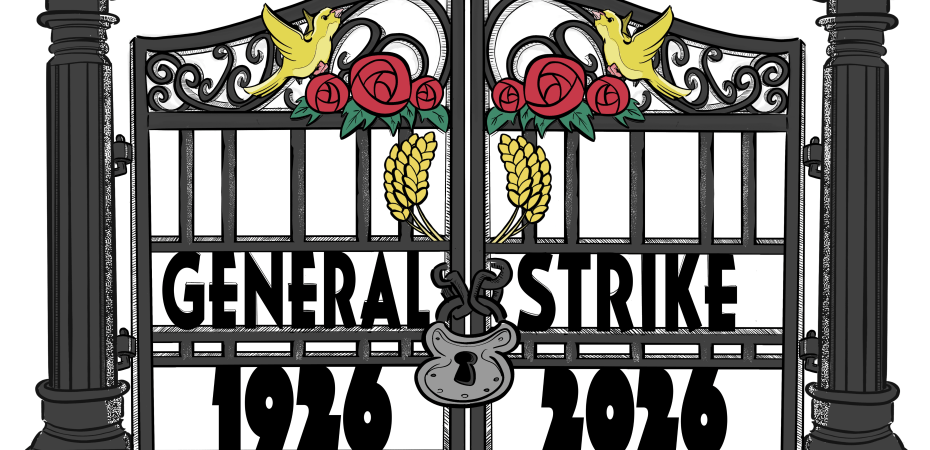
On its centenary, Peter Gurney explores why the 1926 Strike has been so little commemorated – and why it should be.
To those of us on the left, the importance of remembering the General Strike seems self-evident. However, it is worth reflecting more carefully on what it is we want to remember about the strike and also why it has often been forgotten. Not that there is a lack of literature on the subject: participants offered their particular views in the immediate aftermath of the nine-day stoppage and professional historians have produced a plethora of books and articles about the subject at regular intervals, encouraged especially by the commemorative urge.
But despite this attention, the tendency has been to downplay the significance of an event that has overwhelmingly been regarded as doomed to failure, little more than a hopeless gesture. More important, the General Strike has been to a large extent forgotten within the national culture and by the leadership of the mainstream labour movement. There is no monument to the strike, no statue to the miners’ leader A. J. Cook whose impassioned oratory electrified audiences during the dispute. Why has it been forgotten or at best seriously marginalised within popular memory?
This relative absence within the dominant culture is not hard to explain, owing much no doubt to the biased nature of the capitalist media and the state education system. Most of the press and the BBC were against workers’ interests in 1926 as they are against them today, while the General Strike does not feature on the national curriculum taught in schools.
Labour movement forgetting is harder to understand but can be accounted for by the fact that the memory of the General Strike has always been fiercely contested, its meaning and significance understood often in starkly divergent ways, when it happened and ever since. Labour Party leaders and the TUC have found it difficult to commemorate 1926, unlike say the Tolpuddle Martyrs, who were resuscitated in the 1930s by the TUC’s General Secretary Walter Citrine to help revive the fortunes of a flagging trade union movement. 1834 was easier to sanitise as a humanitarian cause than 1926, which was hard not to consider as anything other than an intense moment of class struggle. Typically, it has often been activists on the left who have done most to keep alive positive memories of the General Strike, without much support forthcoming from above.
It seems to me that Labour Party and trade union leaders have frequently ignored the General Strike, or else dismissed the episode with a few complacent platitudes, because it represented not only a defeat but also a victory they preferred to forget – one that generated sour memories. On the other hand, activists that have sought to sustain the memory of the General Strike have been motivated by both a sense of betrayal and unfulfilled working-class potential.
The desire to forget the trauma of defeat was understandable. The General Strike marked the climax of a period of trade union retreat, not advance, and it is unfortunate that the strike did not occur soon after World War One. During the half- decade following 1920, the trade unions lost 3 million members and workforce density declined from 45% to 28%. It is a commonplace of historical writing that 1926 vividly demonstrated the strength of anti-labour forces, mobilised most efficiently within civil society and by the state. Tens of thousands of middle-class professional men, university students and Society women volunteered to work on the docks, railways, buses, and as special constables, regarding their activities not as ‘strike breaking’ but as national service. In all, about 500,000 signed up for the Organisation for the Maintenance of Supplies.
The state was very well prepared. In the context of anti-Bolshevik fears in the aftermath of the October 1917 Russian Revolution and heightened labour unrest at home, extensive planning was undertaken to thwart any general stoppage. Historians have emphasised how such anxieties were overblown, though they were no less real for that. On labour’s side, there was little systematic thinking of what a general strike might entail and no agreement even on what the term actually meant.
Regardless, governing elites planned for the worst. Home Secretary Winston Churchill’s anti-labour credentials were notorious by 1926, but it would be mistaken to think that Prime Minister Stanley Baldwin was any less keen to give workers a hiding. Although he cultivated an image of himself as a moderate Englishman who embodied an ideal of ‘fair play,’ he was a sharply perceptive class warrior rather than tolerant class conciliator. He was not prepared to coerce the coal owners and withdraw the severe wage cuts that had provoked the miners’ strike which precipitated the wider confrontation. Admittedly, he showed restraint at times, on Red Friday in July 1925 when the government agreed to subsidise miners’ wages, in appointing Churchill editor of the anti-strike organ the British Gazette where he would do less harm, and in refusing to introduce anti-union legislation during the strike, but these and other actions reveal strategic capitalist thinking, not sympathy. We might note too how Baldwin put the knife in more deeply on 14th May, sending proposals to miners and coal owners that were even more severe than recommendations in the Samuel memorandum.
The General Strike revealed the state’s preparedness, then, but it also exposed more than ever before profound divisions within the working class. The split between so called reformists and revolutionaries is a well worked theme that can only be pushed so far, the terms being too clear-cut.
Of more importance perhaps in explaining labour’s weakness were divisions between workers organised as producers and those organised as consumers. Like the trade unions, co-operative societies suffered in the immediate aftermath of the First World War, but unlike trade unions they soon recovered strongly, with over 5 million members by 1926.
Often seen as quintessentially reformist, the co-operative movement was kept under surveillance by the state at the end of the war as a potential revolutionary organisation. Liberal as well as Conservative politicians feared that co-op societies would be able to sustain a prolonged national stoppage that might undermine the state, and such fears were not entirely misplaced. Tremendous material support was given to striking miners by local societies and the national movement in 1921, which was repeated in many localities in 1926 if to a lesser extent. But Ernest Bevin, General Secretary of the Transport and General Workers Union who was largely responsible for the organisation of the strike, had little time for the Co-op, insisting that their employees come out in support, his intransigent stance generating long-lasting acrimony.
The experience of defeat in May 1926 – the causes of which were obviously both structural and complex – was immediately portrayed on the left as a betrayal by the General Council of the TUC, which having marched the organised working class up the hill, deserted them. None felt this sense of betrayal more sharply perhaps than A.J. Cook, who singled out the self-seeking leader of the National Union of Railwaymen, Jimmy Thomas, for particular censure.
Cook’s quite restrained but damning comments about Thomas in The Nine Days, his contemporary account of the tawdry negotiations that took place between the government and some members of the General Council, no doubt accurately reflected the opinion of many workers. Although historians pride themselves on avoiding such judgements, it is difficult not to regard Thomas as nothing other than a renegade class traitor, a view confirmed by his corrupt conduct in the 1930s.
Unsurprisingly, Cook’s colleague Arthur Horner, later General Secretary of the National Union of Mineworkers, also blamed the General Council whose “single purpose those nine days,” he believed “was to secure an excuse for terminating the strike… We could have won if the General Strike had been seriously fought by the TUC General Council… neither the majority of the General Council nor the leaders of the Labour Party had any desire or intention to mobilise the strength of the working class.”
It was not only left leaders that used the language of betrayal. As Harry Watson, a London port worker, recalled: “It was hours later when we found out that there was no agreed settlement and the miners were still locked out. It was a betrayal, nothing short of betrayal… there was more resentment and signs of spontaneous violence from the men and women in the East End to the sell-out than there’d ever been all the way through the strike. It was a terrible experience and one I never forgot or forgave.”
From another angle, of course, the TUC’s climbdown could be seen as a victory not a defeat – a victory for advocates of realism in capital-labour relations. The General Strike strengthened the hand of pragmatic moderates like Thomas and Walter Citrine who recoiled from the remarkable display of working-class solidarity almost as much as Stanley Baldwin. The head of the most powerful centralised bureaucracy, Ernest Bevin believed in organisation more than agitation and though he alienated working-class co-operators, he had demonstrated his ability to successfully orchestrate the activities of hundreds of thousands of trade unionists, proving himself someone political and economic elites had to reckon with.
Understandably, this was a victory such men preferred to forget. Citrine may have found the miners’ leaders culpable, particularly Cook, but nevertheless emphasised the importance of forgetting: memory maintained old divisions and bred new ones. At the 1927 TUC conference of union executives convened to review the dispute, Citrine appealed for everyone to forget old feuds and work together for the sake of the movement. For him, the strike proved that confrontation between capital and labour was outdated and counterproductive. He advocated instead co-operation with employers in order to ‘rationalise’ industry and increase economic efficiency for the benefit of all.
Predictably, moderate leaders of the Labour Party too were keen to learn the lesson of pragmatic realism from this defeat. Ramsay MacDonald was most emphatic, declaring, “The General Strike is a weapon that cannot be used for industrial purposes.”
In his autobiography published eight years after the strike, Philip Snowden observed that hot-headed trade unionists “needed a lesson of the futility and foolishness of such a trial of strength” and took comfort in its after-effects: “Since then there has been no repetition of such a hopeless adventure, nor is it likely there will be so long as the memory of this unfortunate experience survives.”
As historian John McIlroy has noted: “The strike played a part in the process, which had been developing since 1920, of weakening the left and undermining belief in direct action. It helped to close the (labour) movement to Communists and separated out reform and revolution. It strengthened ever-present tendencies to constitutional industrial relations and gradualist politics and reinforced, at the national union centre and beyond, the moderation, responsibility and constructive engagement with the state that Citrine and Bevin came to embody.”
Although Citrine had no pretensions as a theorist or historian – his most well-known publication was entitled ABC of Chairmanship – he nevertheless played a key role in shaping the TUC’s collective memory of the General Strike. He embedded the idea that general strikes were doomed to fail in the TUC and its bureaucracy, appointing all General Secretaries that served until the early 1970s. Citrine’s long-lasting influence helps explain Vic Feather’s resistance to calls for collective action in support of dockers imprisoned in Pentonville in 1972: “No responsible trade unionist is wanting to call for a general strike… General strikes are very harmful indeed – not only harmful to the country but harmful also to the trade union movement itself.”
There are more optimistic – even utopian – interpretations of 1926 to put alongside betrayal by corrupt leaders or realistic acceptance of the dominant economic and political order. Not that a workers’ revolution was a possibility that spring. Such monumental change had been unlikely in 1919, let alone six years later. A small number of communists were keen on the idea, certainly, but the argument that such individuals failed to take the initiative and exploit the situation must be discounted.
G.D.H. Cole, the most well-known socialist historian of his generation, later concluded that “there was no thought, except among a very few, of turning the strike into any sort of revolutionary movement. In the minds of most of the strikers, the strike was just a strike – exceptionally big no doubt, but no different in its objects from other strikes. Its purpose was to get the miners a square deal, and it was only incidental that this involved attempting to force the hands of the Government as well as of the colliery owners. From the side of the Tories and of the bulk of the middle classes, the affair looked very different.”
While such a conclusion rings true in some respects, more can and should be said. Cole was writing twenty years after the event and the statement that “the strike was just a strike” is both simplistic and not one that he would have agreed with at the time.
In the early twentieth century, the French thinker George Sorel famously proposed the idea that the general strike functioned as a powerful myth, providing workers with an alternative “framing of the future.” Although Sorel was misguided in many other ways, this emphasis is useful.
For the events of early May 1926 not only disclosed the potential of proletarian power to state and capital, they also demonstrated that power to workers themselves, teaching them vital lessons. One of the most important trade union leaders, Tom Mann, who was unfortunately abroad when the General Strike was declared, understood this better than most. Deeply influenced by syndicalism, Mann had published a pamphlet on the usefulness for labour of the general strike weapon in 1923.
Reflecting less on problems of organisation, Mann was attracted to the tactic because of the great boost it would likely give to Industrial Solidarity and Direct Action – his over-riding concerns. He believed that the experience of a general strike could mark a step change in working-class consciousness, a qualitative shift that would enable workers to grasp their full potential. Left wing Labour MP ‘Red’ Ellen Wilkinson – who published Clash in 1929, one of the few novels about the strike – thought similarly, remarking that it was a wonderful opportunity to undermine the “hold that class collaboration formulas have on the workers’ minds.”
Historians still know too little about the effects of the impressive mobilization of solidarity that occurred in May 1926. As is widely acknowledged, working-class support was still growing when the TUC called off the strike after just nine days, a fact that has understandably fuelled accusations of betrayal ever since. Labour Party women denounced TUC leaders, declaring: “There shall be a Next Time…the most important thing is that the people themselves now know and feel their own power.” A miner told the TUC: “We will have another General Strike without you and we will win next time.” How was solidarity experienced by the hundreds of thousands of workers who took part in the strike, and how did it feel to be part of a much wider collectivity, however shortly?
That the experience was highly emotional is unsurprising, for miners most obviously perhaps. The conditions in which they lived and worked were already pitiful before the mine owners and Baldwin threatened to grind them down still further. There is a wonderful passage in the autobiography of a later leader of the National Union of Mineworkers, Arthur Horner, in which he remembers A. J. Cook’s appeal: “In the months before the 1926 strike, and during the strike, we spoke together at meetings all over the country. We had audiences, mostly of miners, running into thousands. Usually I was put on first. I would make a good, logical speech, and the audience would listen quietly, but without any wild enthusiasm. Then Cook would take the platform. Often he was tired, hoarse and sometimes almost inarticulate. But he would electrify the meeting. They would applaud and nod their heads in agreement when he said the most obvious things. For a long time I was puzzled, and then one night I realised why it was. I was speaking to the meeting. Cook was speaking for the meeting. He was expressing the thoughts of his audience, I was trying to persuade them. He was the burning expression of their anger at the iniquities which they were suffering.”
It was the exploitation and suffering of this group of workers that lay at the core of the stoppage. Knowledge and indignation at their treatment was not confined to the coalfields either but was understood by a great many workers across the country without the help of middle-class tourists like George Orwell. Popular empathy for the plight of the miners partly explains the working-class solidarity witnessed in 1926.
Mass solidarity across industries was undoubtedly a learning curve, about which we still have much to learn. A poem by the great German Marxist playwright Berthold Brecht entitled Questions From a Worker Who Reads comes to mind. It begins in this way:
“Who built Thebes of the seven gates?
In the books you will read the names of kings.
Did the kings haul up the lumps of rock?
And Babylon, many times demolished,
Who raised it up so many times?
In what houses of gold glittering Lima did its builders live?
Where, the evening that the Great Wall of China was finished, did the masons go?
Great Rome is full of triumphal arches.
Who erected them?
Over whom did the Caesars triumph?
Had Byzantium, much praised in song, only palaces for its inhabitants?
Even in fabled Atlantis, the night that the ocean engulfed it,
The drowning still cried out for their slaves.”
The last two lines raise the key issue: “Even in fabled Atlantis, the night that the ocean engulfed it/The drowning still cried out for their slaves.”
The General Strike demonstrated the reliance of capital on labour in the most visible manner. A great deal was made at the time and since of the activities of the Organisation for the Maintenance of Supplies to show how middle-class volunteers could run services as well as workers could, but their efforts were largely performative, done for purposes of propaganda. In reality, they revealed just how dependent the middle class were on the labour of their subordinates.
We can only speculate about how many workers learned this lesson, but some certainly did. One of these was John Langley from Brighton, who was 21 when the General Strike occurred. He was already well-disposed, admittedly, having worked on the railways since the age of 13 where he was influenced by an older worker – “an outcast because he was a socialist” – who encouraged Langley to read the Daily Herald and inculcated in him two key principles: “Russia would be the salvation of the world” and “the Co-op movement would help towards the salvation of the world.”
In his autobiography, Langley recalled: “1926 was different. That was a ruthless strike, absolutely ruthless. The strange part about it, what wasn’t realised, was the strength of the trade union movement. It was so strong that it overwhelmed us. Everybody was coming out, our foreman, everybody in authority came out with us, so long as they were on a wage basis. We stopped everything, we were so powerful. And yet we weren’t prepared to govern with it. We couldn’t, because we didn’t have the organisational ability to manoeuvre all that great power… We had the power then, and we should have gone on, but it was too much for us. The power was too big. We couldn’t grasp it – it was like going to the moon.”
One wonders how many other workers shared this simultaneous sense of actual and unrealisable power, a power momentarily within one’s reach then beyond it in an instant. Not just labour socialists like Langley either, but workers who had had different experiences and whose political consciousness had not been shaped in similar, sympathetic ways.
The cultural critic Raymond Williams touched on these important issues in an essay on the social significance of the General Strike, in which he emphasised how 1926 should be regarded not only as a defeat but also as a partial victory, especially “the growth of consciousness during the action itself.”
Williams went on to suggest how participation in the General Strike changed people, generating confidence and a sense of independence. For him, the negative significance of the strike – the struggle against class enemies – was less important than what he described as “the steady and remarkable self-realization of the capacity of a class, in its own sufficient social relations and its potentially positive social and economic power.”
From this perspective, the events of early May 1926 afforded a brief glimpse of a completely different kind of society, one organised from the bottom up, in which the common people assumed full control. And this, perhaps, is why it is vital to remember the General Strike.
Peter Gurney is Professor of British Social History at the University of Essex.
Image c/o Unite.

