
Abelardo de la Espriella’s win in the Colombian presidential election second round runoff by the narrowest of margins is the latest victory for a Trump-backed candidate in the region. Right-wing governments are now in power in a dozen Latin American countries, ushering in hardline security policies, rollbacks of women’s and minority rights and attacks on social provision. Justice for Colombia report.
On June 24th, the Historic Pact’s presidential candidate, Iván Cepeda, conceded that his far-right opponent, Abelardo de la Espriella, had won the presidential election. It is a bitter moment for Colombia’s progressive movement, made worse by the character of the leader who has now been confirmed as Colombia’s next president and the political forces he represents.
Cepeda said the accepted the result in the name of democratic responsibility, peace and dialogue, but at the same time he highlighted that US interference and dirty tactics employed by the far right had undermined the democratic legitimacy of the incoming government. These included the mass buying of votes and the use of “sophisticated methods of manipulation through AI” to influence people on social media. Cepeda promised the Historic Pact would continue to investigate the electoral process.
Colombia will now be run by a man whom many consider to be a fascist, who has openly stated his sympathies for the ‘paracos’ (paramilitaries) that killed and tortured thousands of people during Colombia’s dirty war; a man who has said that women’s brains were designed for domestic work; and who has promised to cut the “bloated” and “corrupt” state by 40 per cent, while building new maximum security prisons and increasing spending on arms and the military.
De la Espriella’s associates have talked of “tearing the guts” out of the Historic Pact, and he has called them “scum” whom he feels disgusted by. There is serious concern his government will unleash a tidal wave of violence against the social movement that stood behind Cepeda.
De la Espriella has threatened to withdraw from the United Nations (which would mean expelling the UN Verification Mission that oversees the peace process), to dismantle the JEP transitional justice framework and to disband the National Protection Unit that provides armed guards for at-risk activists and human rights defenders. These measures would destroy the 2016 peace agreement and further endanger the lives of over 13,000 former FARC guerrillas, while putting the lives of political and social activists and trade unionists at risk. The risks remain real as, even with these measures in place, last year there were 185 social activists killed in Colombia, among them 25 trade unionists.
De la Espriella has promised a strategic realignment away from peace and multilateralism. He plans to join Trump’s ‘Shield of the Americas’ alliance which is aimed against both the left and the presence of ‘non-hemispheric’ actors using the fig-leaf of anti-narcotics. He will build a strategic relationship with Israel that includes Israeli tech firms and intelligence structures so that Colombia can “learn from Israel’s success in defeating terrorism” and other enemies. Some activists in Colombia fear that this means the reintroduction of repressive surveillance and other technologies.
Meanwhile, Cepeda said that in opposition the Historic Pact will be “democratic, vigilant and constructive”, as well as “resolute and unbreakable in defence of the rights of the people”. He added that, if necessary, the movement will use peaceful civil disobedience to resist any attempts to enable “the shadows of the past” to return. The democratic victories of the Colombian people must be protected, Colombia must not allow its environment to be destroyed, nor the rights of the people to be trampled, nor the agrarian reform reversed, nor can it be treated as a protectorate.
Cepeda called on his supporters to remember that “we are half of Colombia. We are a political, social and cultural force present in every corner of the country” as he promised to travel the length and breadth of the country in the coming weeks to build a Grand Alliance for Life to defend popular interests. The allies of Colombia’s popular movement across the world must also now mobilise to help protect human rights, labour rights and gains made by the Historic Pact government.
For more information, visit the Justice for Colombia website.
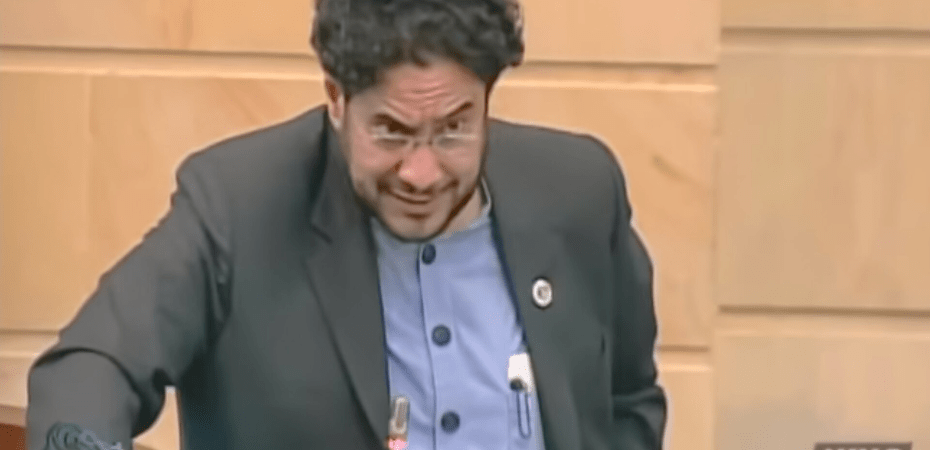
Image: Iván Cepeda https://commons.wikimedia.org/wiki/File:Ivan_Cepeda_Debate.jpg Source: ntervención del senador Iván Cepeda Castro en debate sobre paramilitarismo. Author: Senado Colombia, licensed under the Creative Commons Attribution 3.0 Unported license.


