
We have an opportunity to reassert some of the fundamental principles and values of democratic socialism, argues Mick Antoniw.
A few weeks ago, I was in Makerfield with a large Welsh contingent of Andy Burnham supporters. His by-election success and subsequent meteoric rise should ensure that by next month he is Prime Minister. This speed of change reminds me of one of the scenes from the Python film The Life of Brian. As someone questions whether Brian really is the messiah, John Cleese retorts. “Of course he is the messiah, I should know… I have followed a few.” As a Labour Party member for 52 years I can empathise with this sentiment.
Andy Burnham is not a “messiah”, but he could be the saviour of the soul of the Labour Party. He is a natural leader, modest yet passionate, who can win the hearts and minds of the people and the nations and regions of the UK. His speech on devolution and the decentralisation of power is potentially the most radical from any Labour leader since the Second World War.
He is likely become Prime Minister at a crucial time for the country, for UK Labour but even more so for the future of Welsh Labour and Wales.
His promise of change to the balance of power in the UK offers a vision of hope and belief in the possibility of a better and more equal future. It is Burnham’s version of that great Gordon Brown speech from 2003 when, as Chancellor, he declared that Labour is always best when it is Labour, a sentiment that will resonate with Labour members and much of the Welsh population.
His premiership can be an opportunity to reassert some of the fundamental principles and values of democratic socialism – put simply, Labour values. He has targeted institutionalised inequality as a core weakness in our democracy, the ever increasing disparity in the distribution of wealth and power between the south east of England and the rest of the country.
The evidence is clear that inequality creates division and political instability, it engrains poverty into generation after generation and gnaws away at publicconfidence in civic governance and democracy, opening the door to far right populism and extremism .
Burnham’s speech is a work in progress, but his proposals will potentially have massive implications for Wales. Addressing regional devolution in England is long overdue but it alone cannot resolve the other parts of our constitutional jigsaw. Not only is the UK one of the most over-centralised democracies in Europe, it is also one of the most dysfunctional and one that has now lost the confidence of over 40 percent of the population who no longer believe that voting can change anything or make a difference to their lives. Our democratic health is close to needing life support.
Freedom as we know it is at risk and under threat, and with three of the nations of the UK having elected nationalist governments, so is the long-term future of the United Kingdom.
He is right to talk about a deeper devolution, moving power and decision-making away from parliaments and closer to people and communities, but this can be achieved only through consensus with all four governments and constitutional reform.
“Manchesterism” is commendable. Precisely what it is and how it can be converted into a deeper economic and political philosophy across the UK needs greater debate and explanation. So it is very welcome that he is now engaging with the public. In Wales we have already introduced legislation aiming to achieve many similar objectives, public ownership of part of the rail network and the metro, legislation to re-regulate public transport and in many other areas.
He will need to engage with nationalist governments in Scotland and Wales. They have been democratically elected and have mandates they are entitled to pursue. Wales, unlike Greater Manchester, is a nation not a region. Greater Manchester has a population of 3 million, predominantly concentrated in an area of 500 square miles. Wales has a population of 3 million, spread out over an area of 8,000 square miles. Wales has its own language, cultural and historic identity and those differences clearly impacted in the Senedd elections .
The Senedd has primary legislative responsibility for a greater and wider range of economic and social functions, in particular local government, which is divided into 22 local authorities, some with as small a population as 60,000. Constitutionally the UK Government is committed to respecting devolution and the Sewell convention. Attempting to implement Manchesterism in devolved areas without the consent of the Senedd would not only be impractical but would create a political crisis which would divide Welsh Labour and probably consign it to a generation at least of opposition.
To build consensus, it is necessary to devolve a range of functions from policing and probation, (some of which Manchester already has), youth justice, rail, and the Crown estate, just for starters. You cannot decentralise what is not devolved. Devolution is not decentralisation. They can go hand in hand and should do, but they are not the same. One is an administrative process , the other is a natioal political and administrative constitutional structure.
It is understandable that the emerging policy and how it might be more broadly applied across the United Kingdom is work in progress. Constructing hegemony across the four nations of the UK will be one of the biggest and most important challenges if “Manchesterism” is to be adopted and implemented successfully more broadly across the UK.
Gordon Brown addressed many of these structural, economic and constitutional issues in his report on the constitutional and economic future of the UK, commissioned by Keir Starmer but then unwisely abandoned. He was clear that decision-making should be as close to the people and their communities as possible and that there was no reason Wales should not have equal status to Scotland. Burnham should start the process of change by revisiting the report and adopting the recommendations in full. This would open the door to developing hegemony and consensus across the four nations.
He has an opportunity right from the start to radically reform and modernise the relationship between the nations of the UK by appointing a Minister for the Nations and regions to replace the outdated territorial Offices of Wales and Scotland. This would be in his power from day one as Prime Minister.
He also needs to go further and commit to implementing the recommended abolition of the House of Lords, to be replaced with an elected second chamber of the nations and regions.
It is understandable that he has not proposed reform of the Barnett formula, but this will have to be addressed if decentralisation and devolution are to succeed.
A Burnham government will be unable to rectify all the failures of the past, especially for Wales, but a recognition of future HS2 funding to Wales, devolution of the Crown estate and the devolution of youth justice, probation and policing are all achievable .
These are things he can do as Prime Minister with three years until the next General Election. But there are also important steps he must take as Leader of the Labour Party, to restore internal democracy and the diversity of its politics which were so absent during the recent elections.
In Wales, as in Scotland and across England the results were a disaster. The centre-left coalition of support which kept Welsh Labour in government for 27 years disintegrated. All the evidence shows that there were many reasons for this but at the core was the failure to be seen to be standing up for Wales and a failure to be seen as the main opposition to Reform. So many Labour supporters, often in desperation, transferred their allegiance to Plaid Cymru.
Welsh Labour must also change and have the confidence to become de facto autonomous, in charge of its own rule book, part of the Labour family but always an advocate for Wales and social justice.
Mick Antoniw is the former Labour Senedd member for Pontypridd and a former Counsel General and Minister for the Constitution in the Welsh Government. This is an updated version of an article that appeared in Wales online.
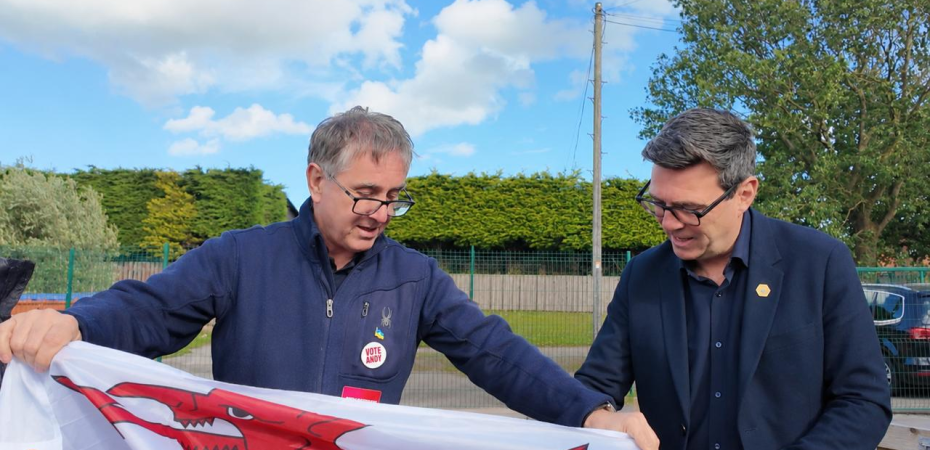
Image: Mick Antoniw with Andy Burnham, c/o author.

