
The UK cannot afford ongoing exposure to such a volatile partner, argues David Jackson.
“I only did half a tank, it’s just ridiculous now,” bemoaned my mum, on the short ride to the train station. She was echoing the frustrations of every British motorist as the price at the pump has soared since February, overwhelmingly driven by the joint attack on Iran by American and Israeli forces. The hostilities have resumed this week, just as many Brits dared hope for some relief, and the war provides a striking example of how our alliance with the state of Israel cannot prevent the latter acting in ways that profoundly compromise British interests.
Like other European middle powers, our interests in the Middle East are quite straightforward: peace and stability, ensuring the free flow of oil, the safety of our assets in the region and forestalling power vacuums in which extremist groups can flourish.
These narrow priorities are not shared by the state of Israel, which pursues a far more aggressive, expansionist agenda, and as the war on Iran illustrated, does so in ways which frequently undercut British interests, and impinge upon the lives of British citizens.
Two states with competing agendas is common in international affairs, and can be resolved by bargaining, compromise, rugged diplomacy, strategic distancing, sanctions or even conflict. However, our close relationship with the state of Israel means political leaders remove many of these options from the diplomatic table, tying us to a bellicose partner as it indulges in risky warmaking, and deploys deeply troubling tactics in the field. As a result, Britain’s position is a weak one, exposed to the negative externalities of Israeli belligerence, but unwilling to deploy any leverage to restrain them. Our alliance with the state of Israel has become a liability.
Reputational costs
It’s not just soaring petrol prices. Disgust at Israel’s destruction of Gaza has radiated around the world, and the state’s standing has plummeted almost universally. Across the Muslim world, Israel is radioactive, and the reputation of those shielding the state suffers with it.
This includes not only the Middle East, where our standing could hardly be lower, but strategically vital states and potentially lucrative trading partners like Malaysia and Indonesia. Democratic leaders in these countries might consider the political costs of doing business with Britain prohibitively high.
The global South has rallied behind the South African case against Israel at the International Court of Justice, including Commonwealth members Bangladesh, Zimbabwe and Namibia alongside significant players in their regions like Brazil and Egypt. Britain’s opposition to this puts us out of step with prevailing opinion across vast swathes of the globe and many of its major power centres, meaning Brexit Britain’s desire to become Global Britain will inevitably take a hit.
Destruction of liberal framework
For decades now, British foreign policy has rested upon the idea that we are defenders of a rules-based international order, centred around international institutions and liberal norms. Iraq, most strikingly, but also disgraceful arms sales to Saudi Arabia and the UAE, left the idea on shaky ground, but the pretence has offered some utility, giving the UK a moral argument to pitch when raw geostrategic interpretations were unsavoury.
When Russia tanks rolled into Ukraine, the UK and its western allies were at least somewhat credibly able to identify the invasion as a violation of norms of sovereignty and international law. With the strategic case for massive arms transfers being rather unpalatable, liberal language was critical in selling the pro-Ukraine effort to war-weary publics, and wavering governments. On climate and trade negotiations too, the language of treaty commitment and multilateral rules has held weight.
There are occasions when the rhetoric has led to kinetic action. British-led humanitarian intervention in Sierra Leone rolled back the brutal Revolutionary United Front and left the state relatively stable. Kosovo provides another example – the NATO air campaign was sufficient to compel Serbian forces to withdraw from the territory, almost certainly sparing the lives of many thousands of ethnic Albanians subject to the Serb assault.
International institutions, once a cornerstone of the liberal order, have repeatedly been undermined, insulted, and most shockingly of all, fired upon by the state of Israel. Britain has used the UN as a forum from which to criticise Russian aggression in Ukraine, impose sanctions on Iran, and pressurise other human rights abusers around the globe.
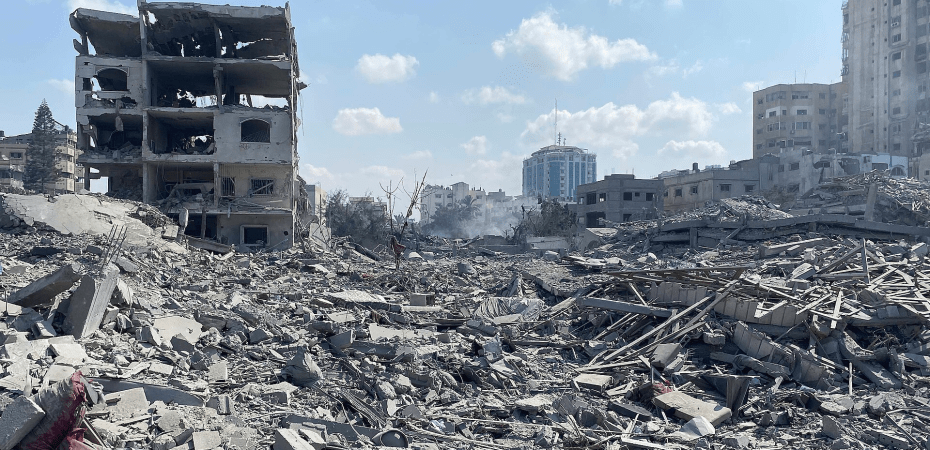
Gaza obliterates this entire structure. In Blair’s Chicago address, which many consider the apex of liberal interventionism, he makes a direct reference to genocide, and the responsibility to act to prevent genocide. Now Britain shields a perpetrator of genocide and supplies it with weapons. While the world watches the unbearable suffering of Gaza’s people, the UK hosts senior Israeli politicians, shares surveillance information with the Israeli government and supplies arms to Israel’s military.
The hypocrisy is too great, the atrocities of our ally too publicly understood and the misery too appalling to credibly deploy liberal humanitarian ideals again. The idea of Britain as an upholder of a rules-based order and vanguard of liberal norms might once have drawn quizzical glances. It now provokes outrage.
Rivals have predictably seized on the opportunity. Russia and Iran frequently reference Gaza to counter British invocation of international law or humanitarian concerns. A central theme for Vladimir Putin for many years and raised again in his On Conducting a Special Military Operation address, has been how Western liberalism is purely posturing, and its selective application simply a front for raw power aggregation.
Gaza legitimises his message. Through association with Israel and its atrocities, Britain is seen as self-serving, violent, and coldly indifferent to human life. Our contempt for the rules we espouse, hostility to the institutions we claim to venerate, and abuse of the values we press onto others has rendered the entire liberal edifice derelict.
Blowback
Domestically, the most serious consequence of our partnership with Israel is the increased risk of terrorism. Al Qaeda and Islamic State have called on their supporters to conduct attacks in response to the conflict, and our security agencies have been warning for some time about Middle Eastern conflicts catalysing radicalisation at home.
We have seen this before. Intelligence chiefs recognised the role the Iraq war played in radicalising the 7/7 attackers. This was textbook blowback – the consequences of flawed, immoral warmaking returning home to devastating effect. Our relationship with Israel exposes British citizens to similar risks.
Alongside the threat to life, already limited resources must be devoted to monitoring and surveillance of these threats, stretching our security budget still thinner, or diverting much-needed cash from other departments.
Domestic strife
Anger has flooded British streets as the scale of human suffering inflicted by Israel has become clear. Nine months after the assault on Gaza began, the London Assembly estimated £43m was spent on policing the marches in the capital. Both sides have raised questions regarding the fairness or effectiveness of the law enforcement operations at these protests, compromising trust in the police as an institution.
Partnership with Israel has roiled our politics and divided our society. The insurgent Green Party won the Gorton and Denton by-election, took control of councils and won mayoral races in 2026. This threat twinned with Reform to its right has led jittery Labour MPs to oust the Prime Minister, just two years after securing a major landslide victory. Such a swift ejection echoes the churn in the Conservative Party leadership, which Labour vowed to end, and undermines public confidence in our democracy’s ability to remain stable and deliver in the long-term.
The UK’s alliance with Israel has created a fault line across broader society. While the majority oppose Israel’s actions and Britain’s backing of them, a minority disagree strongly, and there have been volatile clashes, online, and on the streets. There is a risk of polarisation along ethnic lines, with Jewish communities facing rising antisemitism, and Muslim anxiety at Islamophobic attacks. Within both communities there is the feeling their identities are being politicised and tensions being ratcheted up, and it is clear the actions of a British ally are sowing mistrust and insecurity in our homeland.
Attacks on civil liberties
As the fury has built and civil society started to fracture, the state response has been to crack down on dissenting voices, in an increasingly draconian and heavy-handed manner. Protests and marches have been curtailed, public figures driven out, and political pressure brought to bear on academic institutions and their student bodies. Most alarming has been the deployment of counter-terror legislation, leading to mass arrests simply for an expression of support for the Palestine Action group.
History suggests governments seldom relinquish such powers once established, and the prospect of the repressive structure being handed over to a Reform government is scary, especially as Nigel Farage appears increasingly volatile. That maintenance of our relationship with Israel requires such a level of suppression of democratic expression is deeply concerning, and another important reason why a recalibration is urgently required.
Defenders of the alliance have argued that Israel is a vital military and security partner, on the frontline against hostile states, directly confronting Islamist groups and providing high-quality intelligence on Hezbollah and Hamas. But these Iranian proxies are primarily regional actors with agendas far from the UK homeland, and hostility derives largely from our support for Israel rather than any material conflict. Likewise, while relations with Iran have been far from harmonious, they have deteriorated significantly since Israel attacked the Islamic Republic. What assistance is provided in the counter-terrorism sphere is undercut by the increased risk of Islamist violence that stems from this alliance.
The UK cannot simply wish Israel away nor ignore its existence. But it is long past time to recalibrate, and establish a more standard bilateral relationship, working pragmatically with the state where it advances our interests, but applying strong pressure, when necessary, should its actions undermine our security, prosperity or social cohesion. The UK cannot afford ongoing exposure to a volatile partner, and must rediscover the central diplomatic principle that alliances are subservient to interests, not the reverse.
David Jackson has an MA in Geopolitics and an MSc in International Development. He is a member of High Peak CLP.
Image:
The aftermath of an Israeli airstrike in Gaza City on October 9, 2023, leaving widespread destruction in the Rimal area. https://commons.wikimedia.org/wiki/File:Damage_in_Gaza_Strip_during_the_October_2023_-_29.jpg Source: Correspondence with Wiki Palestine (Q117834684) Author: WAFA (Q2915969) in contract with a local company (APAimages), licensed under the Creative Commons Attribution-Share Alike 3.0 Unported license.


