
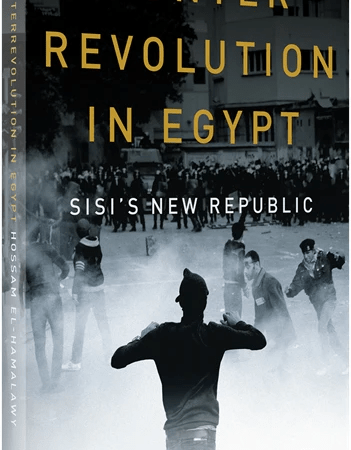
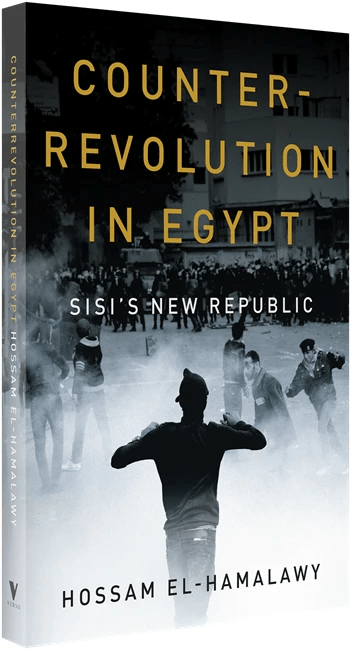
Mike Phipps reviews Counterrevolution in Egypt: Sisi’s New Republic, by Hossam el-Hamalawy, published by Verso.
“On the night of 8 October 2000, I left my university campus in downtown Cairo and drove to Giza… Suddenly, two cars cut across the road, and gunmen in plainclothes dragged me from my car, blindfolded me with the Palestinian scarf I was wearing, and shoved me into the backseat of one of their vehicles. They sped off… to the compound housing the Ministry of Interior and its secret police, the State Security Investigations Service (SS). For four days, I endured a torture odyssey of beatings, sleep deprivation, and verbal abuse, blindfolded and stripped naked, threatened with rape… The detainees shared food and tried to make space in the overcrowded cell… The aim was not intelligence-gathering; the officers knew most were innocent. It was about sending a message: anyone who dared to resist the state would see not only themselves but their entire families, friends, and colleagues, punished. This was Egypt’s ‘War on Terror’ – backed, armed, financed, and enabled by the West.”
So begins Hossam el-Hamalawy’s incisive new book about the current nature of the Egyptian state. His argument: Abdel Fattah el-Sisi’s counter-revolution against, and repression of, the Egyptian Revolution is constructing an entirely new order: “a republic without a social contract, devoid of hegemony, locked in an existential war against its own people, and operating more like a colonial occupier than a national government.”
The road to revolution
Torture, the author tells us, had been regularly used by the Egyptian state, including its police, already before Mubarak’s reign, but it was primarily directed against political dissidents. “Under Mubarak, torture became systemic, plaguing the entire police force and becoming the primary tool they employed in their daily interaction with (nonpolitical) criminal suspects and ordinary citizens. The practice reached such a nightmarish level that it eventually provided the trigger for the 2011 revolution, which ousted Mubarak.”
By this time, torture had spread so much that the police were no longer interested in the basics of forensics or proper investigations. “Instead, crimes were ‘solved’ by torturing suspects until they got a confession, regardless of whether it was genuine or not. Officers even tortured citizens as ‘favours’ for their friends, a trend described by rights campaigners as the ‘privatisation’ of torture.”
The roots of Egypt’s 2011 Revolution lie in the Second Palestinian Intifada in 2000. Mass protests denounced Israe’s atrocities against the Palestinians. They increasingly drew parallels between Mubarak’s security forces and Israeli troops. The US-led invasion of Iraq in March 2003 sparked Egypt’s largest protest in three decades, with battles across Cairo, a brief takeover of Tahrir Square, and Mubarak’s billboards burned. Police responded with mass arrests and torture.
“Three years of mobilisation over regional issues gradually chipped away at the wall of fear,” el-Hamalawy writes. “The Egyptian democracy movement was born.”
2005 saw the biggest wave of strikes in sixty years, many successful. They grew in size and spread across the country. “By late 2010, with nearly every sector protesting, anti–police torture campaigns escalating… and independent media growing, Egypt was a powder keg. When Tunisians toppled their dictator, Egyptians sensed Mubarak’s fall was imminent.”
On January 25th 2011, hundreds of thousands of protesters clashed with Ministry of the Interior forces. SS officers later admitted they had not anticipated such a turnout because the Muslim Brotherhood had not endorsed the calls for protests – but many of their younger members came anyway. Over three days, the police killed over 600 protesters. The demonstrators turned their anger against police stations – over half in Cairo and Alexandria were attacked.
Police morale collapsed and Mubarak had no choice but to call in the military to save his regime. Protesters responded by spraying army tanks with anti-Mubarak slogans. The author himself was involved in running battles with police troops who were now in retreat, although their snipers continued to shoot protesters on January 29th.
For several days, there was a tense stand-off, the army refusing to intervene against the protesters, unless they stormed the presidential palaces, which is exactly what they planned to do. Mubarak was forced to quit: the army took over, promising elections within six months.
Democracy – and counter-revolution
In el-Hamalawy’s view, the generals were probably willing to tolerate an elected government as long as their interests were protected. But many, including Sisi, were deeply hostile to the Muslim Brotherhood – although that didn’t deter the Islamist Mohamed Morsi from appointing him as Minister of Defence following the elections which brought the Brotherhood to power.
The Brotherhood may have belatedly paid lip-service to the Revolution but their media smeared revolutionaries as saboteurs, extremists, thugs and drug addicts and the party organised strikebreaking during labour disputes. Following Morsi’s victory in the presidential election, the Egyptian stock index jumped 6.7 per cent, signalling optimism among many local and foreign investors for a new era of stability and business-friendly governance.
Sisi’s overthrow of the elected president in 2013 occurred not primarily because of any action Morsi had taken against the military, argues el-Hamalawy, nor because of his re-writing of the constitution (which in any case guaranteed the military’s privileges), nor even because Morsi was preventing the army from suppressing Islamist terrorists or supposedly realigning Egypt geopolitically with Islamist forces internationally.
The key reason for Sisi’s coup was Morsi’s failure to end the popular revolt. The military were concerned that from the outset the popular uprising had involved members of the armed forces themselves. Their initial response was to shower the troops with cash: “During the first two months of the 2011 uprising, reserve officers’ salaries doubled.” Pensions rose and extra bonuses were paid. When Sisi took over the military in 2012, he was determined to reinforce discipline.
When the coup came, it unleashed shocking police brutality against the Muslim Brotherhood. But for context, Egypt’s Ministry of the Interior had long operated with murderous impunity. “Between 29 January and 20 February 2011, at least five prisons in four provinces (with no escape attempts) saw police kill over a hundred prisoners and injure hundreds. Despite families’ and rights groups’ complaints, not a single policeman was held accountable.”
As President, Morsi had unleashed police carnage against social protests, even supplementing state forces with Muslim Brotherhood thugs – with deadly results. Such actions isolated Morsi further, shrinking his ability to rule by consent and forcing him to rely on repression. In one incident in January 2013, over 50 citizens were killed when police opened fire on funeral marches, an action Morsi defended.
Yet the police turned on Morsi when he became a liability, partly because they were not willing to continue to be involved in the feud between the increasingly isolated Muslim Brotherhood and their rivals, even as they “continued crushing labour strikes with unprecedented brutality.” The army too was ready to remove Morsi as his inability to control the growing social unrest became palpable. When the coup came, it brought the biggest massacres in Egypt’s modern history, including in a single day the killing of at least 817 protesters in Cairo’s Rabaa Square. The death toll on 14th August 2013 alone nearly matched that of the entire 1990s.
The new state of terror
In power, Sisi did not just unleash ferocious repression: he declared the birth of a new state. The thoroughness and ideological underpinning of the his brutal repression reminds one of Pinochet’s coup in Chile: this was no ordinary overthrow of democracy. Sisi unified the country’s repressive apparatuses, which had previously been fragmented, partly to counter-balance each other. But the main threat was now seen as the people, not any part of the state. The aim was not to manage dissent, but to destroy it – by lethal force. Torture and extra-judicial killings have mushroomed. Even differences of opinion within the military itself are dealt with by assaults, arrests and imprisonments.
Military– economic activities also expanded massively in scale and scope after the coup. By 2019, they were estimated to be worth $200 billion – about two-thirds of GDP. In 2022, the Economist warned investors that “Egypt isn’t open for business”, as “the army grabs whatever it wants’ in a ‘Mafia-style shakedown.” A refusal to hand over one’s business is usually met with fabricated charges.
El-Hamalawy’s conclusion: Sisi’s Republic was “founded on contempt for civilians”, with its administrative institutions and courts corrupted. In 2024, Egypt ranked 135th among 142 countries in the Rule of Law Index. Opposition media has been eradicated, many foreign journalists deported. Soap operas and films glorifying the military and vilifying the revolution and political activists have flooded screens since the coup. Social media users who mock this output are charged with terror offences.
Educational and religious bodies are under strict control. The state also systematically targets women who dare to be visibly nonconforming to social norms. Mass surveillance of public spaces is ubiquitous. Sisi’s “security services micromanage the nation directly in the absence of a ruling party, a functioning parliament, or any empowered civilian institution whatsoever.”
Meanwhile the foreign debt balloons, inflation rages and the government cuts health and education spending. In 2022, Egyptian nationals constituted the highest number of irregular migrants arriving in Europe. And still, anti-regime protests break out, met with brute force and mass arrests.
One wonders: how long can the regime last? And why is it not an international pariah? Yet Egypt receives a staggering $1.4bn in military aid from the US every year, making it one of the top five recipients of US aid. Britain too provides support. In June, Foreign Secretary Yvette Cooper visited the dictatorship, met her opposite number and “discussed ways of deepening co-operation” before announcing “over $15 million of funding to support Egypt’s humanitarian response and economic resilience.” That’s on top of a $400 million infusion in budget support from the UK announced in 2024, aimed at bolstering Egypt’s ailing economy.
Journalist Hossam el-Hamalawy was among the organisers of the 2011 uprising and his book has the feel of something written from the front line. He writes extensively about Egypt’s repressive apparatus here.
Mike Phipps’ book Don’t Stop Thinking About Tomorrow: The Labour Party after Jeremy Corbyn (OR Books, 2022) can be ordered here.

