
Vince Mills calls for some proper accountability and real change at the top of Scottish Labour.
I voted against Andy Burnham when he stood against Jeremy Corbyn in 2015 because in those days Andy was still supporting the general neoliberal direction of Labour as set out by Tony Blair.
“Our challenge is not to go left or right, to focus on one part of the country above another, but to rediscover the beating heart of Labour,” Burnham said in a campaign video. To this end he was very much in favour of a party that spoke to the “aspirations of everyone”, dismissing the mansion tax that was included in Labour’s 2015 election manifesto as “the politics of envy”. In line with the Labour whip, he abstained on the Tory Welfare Reform and Work Act (while Harriet Harman was acting leader) which among other things, sought to cut the welfare budget at the expense of Britain’s poorest.
There were aspects of his campaign which were also more radical, like calling for the progressive re-nationalisation of the railway system. But overall, his was a voice of continuity with Blairism when increasingly the Labour Party and country were crying out for real change and it was the real change candidate, Jeremy Corbyn, who won the leadership.
I write this because like many in the Labour Party and Scottish Labour Party (SLP), I felt the Burnham who appeared as the new Labour Party Leader and Prime Minister last week, really seemed to have got the message. He was going to end the damage that neoliberalism, ushered in by Thatcher and sustained by Tories and Labour alike, had inflicted on the British people. Furthermore, the organisation that has provided a ‘theoretical’ framework for Burnham, Mainstream, published a report, The Productive State that not only critiqued neoliberalism, but offered a credible route to a more equal Britain, even if it did so without acknowledging the inherent inequality of any system based capitalist relations.
Commenting on The Productive State, I wrote in the Morning Star that “Given the time lag between legislation and action on the ground, he [Burnham] needs to mobilise working-class support for such a programme through the unions and grassroots political and community activism.”
Burnham will get no such mobilisation if he does not demonstrate that he is serious about implementing radical change and not just talking about it. The scepticism level of potential supporters of his programme, myself included, rose recently by several percentage points for two reasons. The first was that the team of ministers he picked from top to bottom hardly included a single voice from those in the Party most likely to support an end to neoliberal approaches – the Party’s left.
The second reason was the elevation of Anas Sarwar, leader of the SLP (until he resigned last night), to the Lords and a ministerial position. Only the most naïve could believe that Sarwar was not being compensated for a plot that had obviously gone badly wrong. Clearly what was supposed to have happened last February was that Sarwar, acting as the hitman, announced that Starmer should go. Then the rest of the gang was supposed to crowd in and finish off the fatally wounded Starmer. The pile-on never happened and Sarwar was left a pathetic, isolated figure.
Given that humiliation, it seems Burham owed his lieutenant a favour, arguably a big favour. But the price of that favour is increased cynicism not just in the wider electorate but among the very political and community activists that Burnham needs to enthuse if he is make his programme work.
Things were already bad in Scotland. The unholy trinity of Sarwar, Baillie and Alexander appear to have been spirited away unscathed from the car crash that was Scottish Labour’s electoral campaign. Alexander and Baillie have both kept their jobs and Sarwar has, arguably, been promoted. The 2026 Scottish Parliament elections saw, remember, the worst defeat for the SLP since the reconvention of the Scottish Parliament in 1999.
It is clearer now why the leadership – I use the term loosely – was so adamant about hanging on to the excuse that that failure was all the fault of Starmer. The truth, that a tepid, incoherent, collection of unlikely promises was completely uncompelling for the Scottish electorate would have, at the very least, suggested the blame ought to have been shared. Meanwhile the tepid, incoherent, collection of unlikely promises that comprised the SNP’s offering, made worse by an appalling record in government, was still able to flatten the SLP’s challenge.
Here are the cold facts: since 1999 the SLP has lost 39 seats and 15.3% of the constituency vote and 17.6 of the regional list vote – from 56 seats to 17. There have been four different leaders of the British Labour Party during that time but change of British leadership has, so far, made not a blind bit of difference in arresting this long-term decline. Blaming the British Labour leader for defeats in Scotland just won’t cut it.
The SLP needs new blood, more at the grassroots level than anywhere else, but it is difficult to attract, especially young, members to the SLP with a timid leadership devoid of both the vision and the energy to adopt new approaches and much more democratic practices. It is not just Anas who has to go. So does Jackie Baillie and so does Douglas Alexander. They are all responsible.
We have had enough of excuses and stich-ups. So, if it happens, for example, that Monica Lennon, should she choose to stand, finds that it is impossible because she could not be introduced to the Scottish Parliament in time, we will not be angry, we will be incendiary. And talking about new blood, why should we confine ourselves only to MSPs for the leadership and depute leadership? MPs can stand for the leadership and deputy leadership and councillors can stand for the deputy leadership, so what about Brian Leishman MP? And it was a councillor, Matt Kerr, who made a serious challenge for the deputy leadership against Jackie Baillie in 2020.
As Carol Mochan MSP argued in the Morning Star it’s not too late. The Burnham leadership provides a real opportunity for the renewal of radical politics in Britain and Scotland, but only if we accept the need to dump neoliberalism and offer a programme, at Scottish and British level, that challenges predatory capitalism in favour of social ownership and social equality. Not just offer: deliver.
Vince Mills is a member of the Red Paper Collective.
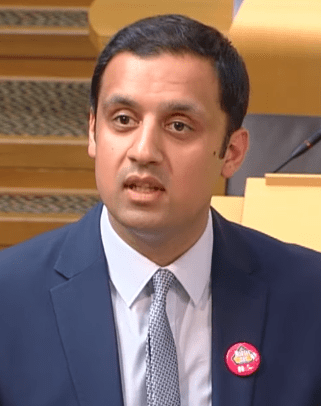
Image: Anas Sarwar https://commons.wikimedia.org/wiki/File:AnasSarwarMSP_%28cropped%29.png Source: YouTube: https://www.youtube.com/watch?v=yj-kOcOKuG0&ab_channel=TheScottishParliament – View/save archived versions on archive.org Author: Scottish Parliament, licensed under the Creative Commons Attribution 3.0 Unported license.


