
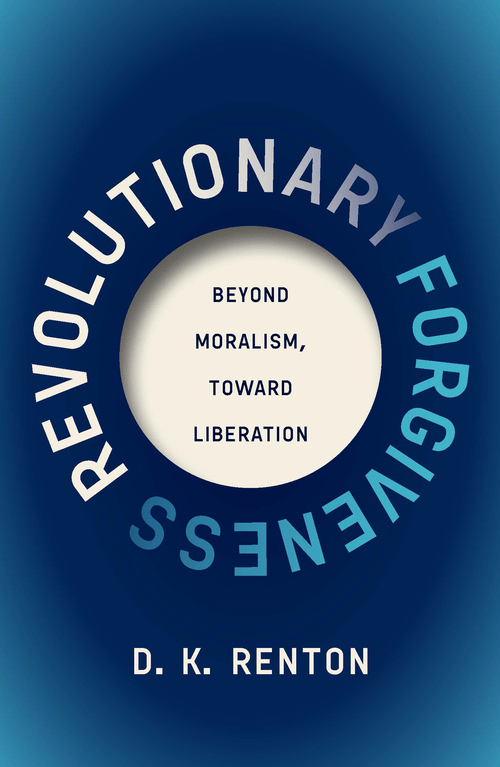
Liz Davies reviews Revolutionary Forgiveness: Beyond Moralism, Toward Liberation, by D.K. Renton, published by Haymarket.
Revolutionary Forgiveness, Beyond Moralism, Toward Liberation is a complicated book. It is highly readable, combining personal experiences, historical accounts and deep engagement with philosophical and political works on forgiveness. Renton’s learning shines through. It was triggered, perhaps, by Renton’s experience during the Socialist Workers Party’s ‘rape crisis’ in 2013 when Renton, along with many other SWP members, stood up to its leadership which was trying to cover up allegations of rape by one of its leading members.
The first chapter contains a brief account of those events in the SWP, then moves on to two cases of appalling abusive treatment by men of the left towards women: Edward Aveling’s exploitation of Eleanor Marx, ending with her death, either suicide or murder, and HG Wells’ coercive control of his wife, Jane Wells, and of his lover, Rebecca West.
It is not news to any woman active on the left that men on the left are not immune from perpetuating the violence against women that pervades our society, and not immune from misogynist views and behaviours. We have all experienced that in our political lives: ranging from the worst crimes of rape or violence to the lesser, non-criminal but certainly abuse of power such as older men preying on younger women activists for sex and women’s voices not being heard. The left cannot entirely escape replicating social relationships that dominate in the mainstream, including patriarchal relations. Just because that is the case, it does not excuse rapists on the left or their comrades’ attempts at cover-up.
But this is not a book about violence against women on the left. That book has yet to be written. Discussing violence against women leads Renton to reflect on how and when victims should forgive wrong-doers. Women survivors of domestic abuse are frequently asked to forgive, not least by their abusers and their abusers’ friends and family.
The most celebrated example of political forgiveness is the Truth and Reconciliation Commission (TRC) in post-apartheid South Africa. This seemed a great beacon of liberal hope. Justice for the survivors was formally enshrined: amnesty could be offered only to those who acknowledged their personal responsibility for crimes; the process was not victors’ justice in that crimes committed by the African National Congress were also investigated, and survivors gave their testimony, so their voices were heard.
But reparations were ungenerous (and reduced by President Thabo Mbeki), there was pressure on victims and survivors to grant forgiveness, and the TRC was operating in the context of the ANC government’s failure to redistribute wealth or redress the economic structure of apartheid. Without substantive social and economic justice, the crimes of apartheid cannot be forgiven.
The story of the TRC is Renton’s exemplar for his main thesis: revolutionary forgiveness can only happen when victims of a social wrong take back power from their oppressors and then choose to forgive them. Sequence is crucial. The oppressed should be compassionate after they have destroyed citadels of the rich and removed those who occupy them. One might say “no justice, no peace”.
Renton’s erudition takes us on a roller-coaster: post-1917 Russia, problems of forgiveness in Les Misérables (which I cannot discuss as I have neither read the book nor seen the musical), nineteenth-century discussions around crime and punishment, and a lengthy exploration of debate around forgiveness for the crimes of the Holocaust. This last leads to the point that the crimes committed against the Jews cannot justify those currently being committed against Palestinians – which seems so obvious that it need not be stated and yet, as the genocide in Gaza unfolds, has had to be stated endlessly, not least in Jewish communities (of which Renton is a member).
Renton says that the development of his thought was in the context of a dialogue with the growing movements for police and prison abolition. If we move toward abolition, our movements must start talking about alternatives to imprisonment and one of those alternatives is forgiveness. We need to understand choices associated with that act and what it means to build social movements that behave with moral purpose and achieve justice.
Radicals so far have failed to think deeply about forgiveness. Renton’s idea of revolutionary forgiveness is a “particular and unruly sort of forgiveness”; not forgiveness as a pre-emptive act, and not prioritising forgiveness over justice. He bitterly attacks the idea that forgiveness, in itself, is a healing process for victims. Instead, instructing victims to forgive can operate as a cruelty of its own, escalating the cruelty of the original injustice. But the left should not reject forgiveness entirely. We should not encourage retribution. Rather, he says, “the poor should respond to their former tormentors with kindness – at the end of a successful revolution even the former oppressors should be free”.
Renton is a prolific author, by my count of over 40 books. He is a barrister, historian and long-standing socialist activist. Full disclosure: he is a personal friend, colleague and comrade. And of course, when he quoted my late partner Mike Marqusee to the effect that what the left is missing is not a programme but a method, I smiled. Read the book. Here we have a method for the left to act with human kindness and generosity of spirit, but not at the expense of justice.
Liz Davies KC is a retired barrister and political activist.

