
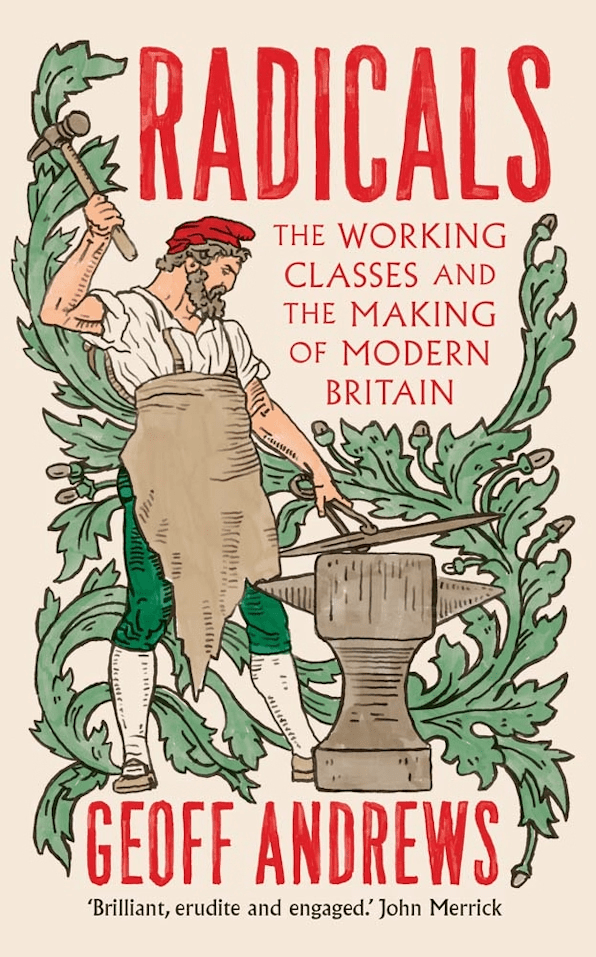
Mike Phipps reviews Radicals: The Working Classes and the Making of Modern Britain, by Geoff Andrews, published by Yale University Press.
One of the salient features of May’s elections – perhaps most sharply expressed in the votes for the Welsh Senedd – was the splintering of Labour’s traditional coalition of traditional working class and progressive middle class voters. But what was the basis of that working class vote?
Geoff Andrews’ book Radicals covers a vast amount of British working class and socialist history, from Chartism to the New Left, via George Orwell and Nye Bevan, and on to the Open University. In his recent New Statesman review of it, playwright David Edgar wrote: “Conventional wisdom has it that Labour’s appeal to the working class is primarily economic – public ownership, redistribution, the welfare state, the Attlee agenda – while its middle class supporters are attracted by its commitment to social and cultural change.”
“Andrews,” he argued, “challenges this binary. He locates the origins of the labour movement not just in the trade unions but in the widespread and myriad networks of self-help organisations that working people created in the 19th century – friendly societies, mutual assistance initiatives, cooperatives – alongside institutions od education.”
This correction to our understanding is of considerable significance. It challenges the view that mass working class consciousness is necessarily a trade union consciousness. Implicitly, it suggests that post-Thatcher falls in trade union membership need not constitute an irrevocable decline in the contribution of the working class to politics. Above all, it confronts the vanguardist conception of leadership, which denies working class people autonomy.
One interesting chapter in Andrews’ book focuses on Robert Tressell’s classic 1914 novel The Ragged Trousered Philanthropists, so often hailed by socialists in their lists of must-read formative texts. Personally, I’ve always been more sceptical of its merit. The novel heavily emphasises the ignorance and indifference to their own exploitation of the working class ‘philanthropists’, suggesting the solution to their problems lies in, as Andrews puts it, “political education and oratory offered by the socialist outsider generally removed from the culture and ethos of the class he seeks to liberate.” This denial of agency seems to conflict with the notion of self-emancipation and favour an elitist approach to working class organisation.
It’s worth adding that there is a further aspect of this novel which jars, which Andrews does not consider. The repeated emphasis on the greed, mean-spiritedness and cruelty of individual representatives of the capitalist class tends to reinforce reformist conclusions: that without these unpleasant qualities, capitalism would be more humane and bearable. The novel seems to downplay the true character of capitalism as a form of institutional exploitation. In the real world, redundancies and immiseration occur, not because of the nastiness of individual exploiters, but through the logic of a system which can behave in no other way. That may not have been Tressell’s intention: he claimed to reject reformism and placed his faith in Socialism – although for him this remained largely an abstraction: “the Golden Light that will be diffused throughout all of the happy world from the rays of the risen sun.”
That mystical version of socialism to which a passive, better-educated working class might aspire can be contrasted with the creative grassroots self-activity that characterised the 1926 General Strike just a decade later. Andrews talks of the rank and file’s “unmatched loyalty to fellow strikers”; and while supine timidity may have characterised the TUC leadership, this cannot be said of the millions of participants.
In the modern era, Andrews is scathing about the facility with which some socialist ‘progressives’ around the Communist Party of Great Britain’s magazine Marxism Today were able to accommodate to the ideas of New Labour, some even becoming its speechwriters. Perhaps that’s partly why the Morning Star panned Andrews’ book. As so often, the justifications for such lurches to the right end up blaming the working class for failing to meet the expectations of those who would lead them.
It’s excellent to set out a wider definition of working class activity than the purely economic or trade union. Andrews inclusion of a section on the Women’s Liberation Movement is especially welcome. But there are some curious omissions, including working class participation in other recent social struggles, for example against war and racism.
For the left, definitions of what it means to be working class have polarised in recent years. Nostalgic emphasis on perhaps peripheral aspects of working class traditional culture has often resulted in a largely male, white conception of the working class, which has underpinned an illusory pursuit for authenticity that misses the dynamic, changing, diverse, multi-ethnic character of the real contemporary working class. To counter this, socialists have emphasised that one’s relationship to the means of production is the central defining element of class. Andrews’ book avoids the former pitfall, while suggesting there might be more room for nuance in the latter conception.
Andrews’ conclusion is pessimistic and I disagree with both his assessment of Corbynism and the activists involved in that movement. While Labour suffered a disastrous defeat in 1983 on a largely Bennite manifesto, many of those ideas – including wider public ownership and measures promoting greater equality – were already popular by the end of the 20th century. The huge Labour majorities of that era did not, however, translate into policies that would fundamentally roll back the ravages of Thatcherism.
When Labour ran on Jeremy Corbyn’s radical manifesto in 2017, it got more votes than in any election since 1997, yet failed to win a majority. Furthermore, the Party won over 3 million more votes than it would under Keir Starmer in 2024. Nor was this merely the reflection of a passive preference between the two main parties: the Corbyn phenomenon attracted a huge increase in Labour membership and unprecedentedly large mass meetings and enthusiasm across the country. This demonstrated not only the popularity of its ideas but the potential for a different kind of force in politics – a potential that was to be systematically undermined by its enemies within the broader movement.
Since then, election after election has indicated a desire by large numbers of working class people to vote for progressive change. This story is not over yet.
Mike Phipps’ book Don’t Stop Thinking About Tomorrow: The Labour Party after Jeremy Corbyn (OR Books, 2022) can be ordered here.

