
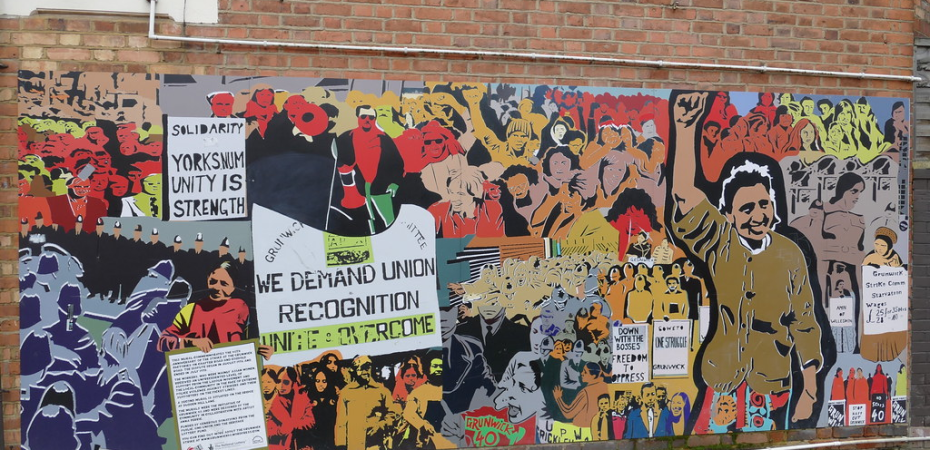
Pete Firmin explores the ongoing significance of a dispute that began fifty years ago this week.
2026 is an important year for the commemoration of significant British class struggles. As well as marking the General Strike of 1926, it is 50 years since the start of the Grunwick strike in NW London.
But why did a strike of a few hundred workers at a small firm in Dollis Hill have national importance? Why was it frequently an item on the national television news? Why did it see more arrests in an industrial dispute than at any time since the General Strike of 1926?
The Grunwick strike was extraordinary because the strike of mainly women of South Asian heritage received widespread support from the trade union movement. Previous strikes by migrant workers, such as at Imperial Typewriters in Leicester and Mansfield Hosiery in Loughborough got no such support but rather the hostility of other workers and little support from the wider movement.
Grunwick was a photographic processing firm in Dollis Hill. In the days before smart phones, cameras contained reels of film which had to be sent away to be turned into photos after taking the pictures, and these were then sent back.
Working conditions were dire, overtime was compulsory and often without warning. Pay was lower than the London average..
There was an attempt in 1973 to unionise Grunwick workers but it failed when they were sacked.
On 20th August 1976, Devshi Bhudia was sacked and three other young men walked out in protest. Jayaben Desai and her son Sunil walked out in protest at this unacceptable treatment by management. Within days other workers joined the picket line. The strikers were advised by the TUC to join APEX, the Association of Professional, Executive, Clerical and Computer Staff which declared the strike official.
From the start, the strikers had the support of Brent Trades Council, whose headquarters were close to the factory. That building became the strike HQ, and it was there a strike committee was first elected on 24th August.
The strikers faced the extreme hostility of Grunwick’s management throughout. They offered to take the strikers back if they dropped the demand for union recognition. When the strikers rejected this, the company sacked them on 1st September. ACAS, the Advisory, Conciliation and Arbitration Service, offered to mediate: management refused.
George Ward, the Anglo-Indian owner of Grunwick, got important support from the National Association For Freedom (NAFF, now the Freedom Association), founded in 1975, and gained public prominence through its anti-trade union campaigns. John Gorst, Tory MP for Hendon North, a pre-Thatcher Thatcherite, also assisted Ward alongside NAFF.
The first demonstration in support of the strikers took place on 10th September, and on the same day Jayaben Desai and another woman were injured by a management car.. Arrests of pickets began in the same month.
In October 1976, APEX referred the dispute to ACAS; however, Grunwick management refused ACAS access to those still working (many of whom were said to favour unionisation). ACAS recommended union recognition, but Grunwick refused.
At the start of November postal workers refused to deliver Grunwick mail, a crucial part of their operation, After court action, the postal workers backed down.
From March 1977, picketing was stepped up and got widespread support across the trade union movement. Strikers picketed the TUC General Council for the withdrawal of essential services (gas, electricity, telephone) to Grunwick, but this was refused, other unions arguing they would need to be indemnified against court action. At its conference, APEX, hardly a militant union, called for the cutting of supplies to Grunwick.
In mid-June a week of action began with a mass picket and 84 arrests in one day. More Grunwick workers came out on strike and Cricklewood postal workers began an unofficial boycott of Grunwick mail. As mass pickets reached 1,500, printers at the Sunday Telegraph refused to print an article critical of the strike. Labour MP Audrey Wise and Yorkshire miners’ leader Arthur Scargill were arrested on the picket line. Busloads of miners had come to support the picket from around the country.
At the end of June, Labour Home Secretary Merlyn Rees praised the police on a visit to the picket line. This was despite widespread support in the Labour Party, both locally and up to the National Executive Committee, for the strike.
In July ’77, the postal workers were suspended, which meant no postal deliveries at all in the London NW2 area. The postal workers’ action was called off at the end of the month only after they were instructed to do so by their union leadership and fined by the union for initially disobeying.
During the postal blockage, NAFF ran `Operation Pony Express’ to get mail from and to Grunwick out.
On 11th July a mass picket and demonstration were supported by 20,000.
Recourse to the law had mixed results for the strikers. A court of enquiry under Lord Scarman was set up at the end of June ‘77, and called in August for union recognition and reinstatement of the strikers. In mid-July the High Court supported the ACAS report calling for recognition, but at the end of July the Appeal Court overturned the High Court decision and declared the ACAS report invalid. In December, the House of Lords, at the time Britain’s highest judicial body, confirmed the decision against ACAS. Throughout, when decisions went against them, Grunwick refused to comply.
Mass pickets of up to 3,000 continued, but at the end of September Roy Grantham, APEX General Secretary, attacked the call for a resumption of mass pickets, and the strike committee were threatened with disciplinary action if they supported them.
Despite this, further mass pickets took place in October and November. On 7th November there were 113 arrests and 243 pickets were injured.
On 21st November ’77, strikers held a hunger strike outside the TUC HQ calling for support.
With Grunwick management adamant they would not allow recognition, the law apparently against them, and a lack of official union support, the strike committee announced the end of the strike on 14th July 1978.
The timeline alone does not give the full flavour of the dispute: the resilience of the strikers, the magnificent solidarity shown by the wider movement, up against police brutality and the obstinacy of a company determined to deny its workers their basic rights, backed up by a ruling class determined to beat down the workers’ movement.
When Thatcher came to power in 1979, she quickly moved to restrict the rights of unions even further, something our leaders have refused to seriously challenge over the intervening decades.
The Grunwick strike showed the immense ability of workers to resist and the power of solidarity across sectoral and, importantly, racial divides. But it also showed how when it comes to the crunch, we can’t rarely rely on our union leaders – or the law – to back us in that fight. We have to be prepared to fight on – and break the law – when they refuse.
Learning more:
There are a wealth of resources about the Grunwick strike available:
Books:
Grunwick: The Workers’ Story, by Jack Dromey and Graham Taylor (Lawrence & Wishart).
Films:
The Great Grunwick Strike 1976-78, Brent Trades Union Council
The Year of the Beaver https://youtu.be/RBJZ9hkHmxo
This year, the 50th anniversary of the start of the strike, there are several commemorative exhibitions, including at the Working Class Museum and Library and at London Metropolitan University.
Over the weekend 17/18 October, Brent Trades Council is organising an event commemorating both the General Strike and the Grunwick Strike and discussing issues facing trades unionists today. For more details contact petefirmin@btinternet.com
Pete Firmin is Vice Chair of Brent Trades Council.
Image: https://openverse.org/image/e51b2bd3-c06c-4bcd-9e01-1107f9cface3?q=grunwick+strike&p=2 “Grunwick Factories Strike Mural by Anna Ferrie and the Community, Chapter Road, Willesden” by Loz Flowers is licensed under CC BY-SA 2.0.
 Labour Hub