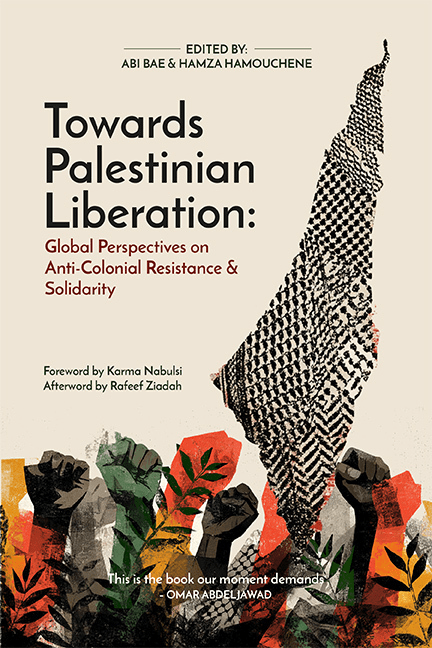
Mike Phipps reviews Towards Palestinian Liberation: Global Perspectives on Anti-Colonial Resistance and Solidarity, edited by Abi Bae and Hamza Hamouchene, published by Daraja Press.
How far and in what ways does the fight for Palestinian freedom relate to other liberation struggles in the world? The editors of this book see the connection as fundamental, believing it is a key part of the history of the Global South. They state: “We cannot understand the genocide in Gaza without understanding the colonial origins of Zionism. The genocide is the outcome of Zionist settler colonialism.”
The link was echoed in the Red Nation’s message to the Free Palestine National March on Washington in November 2023. The Native American activist group said: “We know the entire history and future of Palestine because we have lived it.”
Historically Palestinian liberation activists have seen themselves as part of a broader anti-imperialist struggle, drawing inspiration from Vietnam, Cuba, Algeria, China and beyond. At times, the connections between these struggles have been concrete and practical, as when hundreds of North Africans, conscripted by the French colonial authorities to fight in Indochina, deserted and joined the Viet Minh, a real but little known expression of anti-colonial solidarity.
This solidarity was reciprocated by the United Nations General Assembly when it recognised the Palestine Liberation Organisation as the sole legitimate representative of the Palestinian people and granted it observer status. As Israel’s expansionist activities intensify beyond Palestine to the entire region, this solidarity needs to be renewed and extended today.
This is already happening – particularly South-South solidarity. South Africa’s case against Israel at the International Court of Justice for breaching the Genocide Convention is one such effort. Other Global South countries have cut diplomatic ties with Israel, for example Brazil, severed trade with it, for example Colombia, or banned the use of their ports to transfer goods to it, for example Malaysia. Often, it is popular pressure from below that has pushed such action by states.
But as Abi Bae and Hamza Hamouchene point out, there are limitations to state-led solidarity: South Africa continues to export coal to Israel; Jordan and Egypt continue to facilitate the integration of water and energy infrastructure with Israel; Turkey hosts part of a pipeline from Azerbaijan through which over a quarter of Israel’s oil flows. Real global solidarity has been shown by people across the world, including unions which have blocked shipments to Israel, and successful boycott and divestment campaigns.
In his chapter, Adam Hanieh points out that the way the Israel-Palestine conflict is debated often ignores the wider context of the Middle East. This framing fails “to explain why Western states continue to support Israel so unequivocally. And when this crucial question of Western support is raised, many point to a ‘pro-Israel lobby’ operating in North America and Western Europe as the cause – a false and politically dangerous viewpoint.”
Instead, the unstinting support of the US and leading European states for Israel needs to be seen in a wider context of the Middle East’s central place in our fossil fuel-centred world. As the Middle East became the centre of world oil markets through the 1950s and 1960s, powerful nationalist and left wing movements challenged Western colonialism. The impact of these forces were felt across the region, notably in Egypt and Iran, but also in the Gulf states. It was against this background that Israel emerged as a major bulwark of American interests in the region.
But, he argues, “Israel’s special place in supporting American power is directly connected to its internal character as a settler colony, founded on the ongoing dispossession of the Palestinian population. Settler colonies must continually work to fortify structures of racial oppression, class exploitation, and dispossession. As a result, they are typically highly militarised and violent societies, which tend to be reliant upon external support that allows them to maintain their material privileges in a hostile regional environment.”
Vijay Kolinjivadi and Asmaa Ashraf go further, seeing the combined ecocide and genocide in Gaza as an expression of “eco-apartheid – a violent racialising phenomenon that advances the colonial frontier of land occupation and resource plunder to funnel wealth to a privileged few at the expense of the vast majority of people.” This process is deadly for humanity, but crucial for maintaining the economic system. As political ecologist Kai Heron said, eco-apartheid makes it permissible for certain people to die “so that capitalism may live.”
On this basis, former President Gustavo Petro of Colombia was not exaggerating when he told the COP28 summit: “The unleash[ing] of genocide and barbarism on the Palestinian people is what awaits the exodus of the peoples of the South unleashed by the climate crisis.” And even in the privileged West, the niceties of a liberal rules-based order are already being done away with in order to enforce this global apartheid.
This is a wide-ranging book, with accounts of solidarity with the Palestinian struggle across different continents in the Global South, both at the level of governments and peoples, who see in the Palestinian struggle a reflection of their own oppression. This solidarity matters: as one young Palestinian journalist said: “How this ends will depend on the rest of the world.”
It certainly does. Palestine may have fallen from the headlines somewhat since the so-called ceasefire was proclaimed. But on the ground, there is little sign of any end to Israel’s campaign. On one day alone this month, Drop Site Daily reported Israel’s killing of nine Palestinians, its continued aerial bombardment, its fatal shooting of a ten-year old girl, its seizure of an UNRWA centre in East Jerusalem, its violation of the ceasefire across southern Lebanon, and multiple settler attacks, including against international solidarity activists, alongside military raids in the occupied West Bank. Global solidarity will need to increase even further if this nightmare is to end.
Mike Phipps’ book Don’t Stop Thinking About Tomorrow: The Labour Party after Jeremy Corbyn (OR Books, 2022) can be ordered here.