
Andy Burnham must understand that using the Good Friday Agreement as a means to promote domestic policies is not viable, argues Nadine Finch.
On 27th August 2026, Andy Burnham made his first visit to Northern Ireland, as Prime Minister. He used it to stress that a border poll on Irish unity was “off the table”. The new Secretary of State for Northern Ireland, Chris Bryant, confirmed this in an interview with Ulster TV. He clarified that the Prime Minister “was asked specifically about whether he was going to be discussing a border poll, holding a border poll now, and he was saying that we’re taking that off the table today.”
He also said that he had “sat next to [the Prime Minister] throughout all the conversations [in Northern Ireland] and he made absolutely clear, time and time again, and I’m happy to do it again now, that we stand full square behind every single part of the Good Friday Agreement, including the provisions in relation to a border poll.”
These statements may appear to be contradictory – and they are. The Good Friday Agreement ensured that, for the first time since the partition of Ireland in 1921, political power and equality of access to employment and services did not depend on belonging to the Loyalist community or a particular brand of Christianity. An important part of that Agreement was an acknowledgement that there would come a time when a majority of the people of Northern Ireland would wish to be re-united with the rest of the island of Ireland and determine their own future.
This promise was accepted in good faith by Republicans. They acknowledged that the road to unity would necessarily be a long one, largely because of the North’s history of settler colonialism and the continuing hostility towards Ireland and the Irish language by the most extreme elements of the Loyalist community.
Those who did support a United Ireland took their positions, as elected political representatives in a divided Ireland, seriously and worked conscientiously even when others were hostile to them. Their work in communities on ‘bread and butter’ issues introduced them to a wider range of voters. In areas from North Belfast to Mid Ulster, voters turned to them while some other parties relied on historical loyalty to bring in the votes, as opposed to a commitment to represent their electorate in relation to all aspects of their lives.
This is partly why other parts of the Prime Minister’s remarks displayed a lack of knowledge of Northern Ireland in the recent and distant past. He called on politicians there to focus on issues such as the cost of living and making lives better. Politicians in Northern Ireland, a part of the United Kingdom which clearly voted against Brexit, know only too well its effects. Despite Northern Ireland remaining part of the EU single market for the purposes of the movement of goods, its NHS and services are not meeting the needs of its residents and community projects are no longer able to rely on EU funding.
Brexit had a disproportionate effect on Northern Ireland. Yet the Westminster parliament has continued to starve the Northern Ireland Assembly of much-needed financial resources. This is a significant factor in the growing calls for Irish unity, calls which are now being supported by, amongst others, Protestant farmers and Protestant families, whose children go abroad for university and never return.
The Prime Minister also caused widespread anger by saying that Northern Ireland should focus on bringing people together as best they could. In doing so, he ignored the multitude of work being carried out to reconcile past rifts within communities there. A civil society group, Ireland’s Future, is holding very large meetings throughout the island to discuss whether Irish unity would be of benefit to all. On a smaller scale, Republicans are leading historical walks that focus on the history of Protestants, who campaigned for Irish United. Linda Irvine, the wife of a leading Loyalist politician, continues to develop access to Irish language classes for all.
In addition, the present Labour government has not taken into account the significant demographic changes in Northern Ireland. There has been an influx of European and other migrant workers and refugees. Many young people prioritise social issues over differences in religion and culture. The spirit of internationalism and support for those suffering oppression and genocide is very strong, as it is in the Republic of Ireland.
Sinn Fein is now the largest party in the Northern Ireland Assembly, local councils there and in the Westminster Parliament. (Sinn Fein do not enter the chamber and vote at Westminster, but they are present in the building and attend meetings and discussions in order to represent their electorate.) Michelle O’Neill, from Sinn Fein, holds the post of First Minister of the Northern Ireland Assembly and works closely with Emma Little-Pengelly from the Democratic Ulster Party, who is the Deputy First Minister.
In a recent LucidTalk poll in Northern Ireland, the predicted support for Sinn Fein was 29%, DUP 18%, Alliance Party 18%, Ulster Unionist Party 12%, SDLP 11%, Traditional Unionist Voice 7%, People Before Profit 4% and others 1%. Loyalist voices no longer predominate. They may be very loud but increasingly they are not being listened to by others living in Northern Ireland.
Many protestants are discussing Irish unity now, from leading actors, writers and academics to families meeting in their homes. To provide just two examples; former Unionist, Ben Collins, has written two books about preparing for Irish unity. Sam McBride of the Belfast Telegraph and Fintan O’Toole of the Irish Times have written a book and debated together about Irish unity.
By taking discussions of a border poll off the table, Burnham is only pleasing a minority of views in Northern Ireland. The Good Friday Agreement was designed to ensure that no one group could dominate in political, economic and security spheres. The current DUP leader, Gavin Robinson, has said that the Prime Minister’s views on the border poll were “particularly encouraging” and that they were “putting to bed the nonsense” discussed recently about a border poll. He is a pale reflection of the image of Ian Paisley declaring “no surrender” and his importance should not be inflated by images of the past. It should be analysed by present voting patterns and cross community co-operation.
The relevance of such views should also be put in the context of the majority in Northern Ireland, who do not support the use of the Union Jack for sectarian political purposes or the burning of effigies of Sinn Fein leaders, mosques and refugee boats on bonfires on 12th July. (These bonfires continue centuries later to commemorate the victory in Ireland in the 1690s of a Dutch protestant, who became the king of England.)
The Prime Minister and his Northern Ireland team need to abandon the myth of two warring communities in Northern Ireland, who are not ready for a border poll. The threats of violent disruption, if one is called, are an attempt to ignite conflict. They should be treated as criminal threats, much in the way that the attacks on refugees and asylum seekers in Crumlin Road in June 2026 were seen to be criminal acts. They were and are promoted by people with views based on nostalgia for the ‘glory days’, when one community was permitted by the British state to dominate all others.
The Prime Minister also needs to understand that Northern Ireland is not comparable to an English region. Its history, internationalist outlook and political complexity are very different. Adopting an interpretation of the Good Friday Agreement predominantly designed to promote domestic policies is not a viable approach.
The promises made in the 1998 Good Friday Agreement need to be honoured in full and not delayed for political purposes that benefit the current government.
Article 1 of the Agreement states that the two states (the United Kingdom and the Irish Republic):
- (i) Recognise the legitimacy of whatever choice is freely exercised by a majority of the people of Northern Ireland with regard to its status, whether they prefer to continue to support the Union with Great Britain or a sovereign united Ireland;
- (ii) Recognise that it is for the people of the island of Ireland alone, by agreement between the two parts respectively and without external impediment, to exercise their right of self-determination on the basis of consent, freely and concurrently given, North and South, to bring about a united Ireland, if that is their wish, accepting that this right must be achieved and exercised with and subject to the agreement and consent of a majority of the people of Northern Ireland;
As the Good Friday Agreement is an international agreement, the United Kingdom, and its ministers, are bound by Article 18 of the Vienna Convention on the Law of Treaties to refrain from acts which would defeat the objects and purposes of that treaty. Schedule 1 to the Good Friday Agreement does provides an imperfect mechanism for assessing when a border poll should be heard. It merely states that the Secretary of State may by order direct the holding of a poll for the purposes of section 1 on a date specified in the order. It then adds that the Secretary of State shall exercise this power if at any time it appears likely to him that a majority of those voting would express a wish that Northern Ireland should cease to be part of the United Kingdom and form part of a united Ireland.
The flaws in this process are obvious. A Minister of just one of the states to the Agreement is given the personal power to decide to order a border poll. Furthermore, the basis of the decision is a subjective one and depends on him deciding that it appears to him that there would be a majority of those voting would wish to join a United Ireland. But what it does not state is that the Minister or the Prime Minister can nullify this power by merely state that this part of the Agreement is now “off the table”.
In addition, in international and public law, the mechanism in the Schedule must be read in the spirit of the substantive articles of the Agreement. It is not in the spirit of the Agreement to merely delay a poll for reasons of British political expediency. The calling of the poll is dependent upon the agreement and consent of a majority of the people of Northern Ireland. To comply with the Agreement, the Secretary of State for Northern Ireland (and the Prime Minister) must recognise the very lively and comprehensive discussion on Irish unity happening on the island of Ireland. They must also take it into account before making statements which breach international law.
Nadine Finch is Vice-Chair of Labour Movement for Irish Unity.
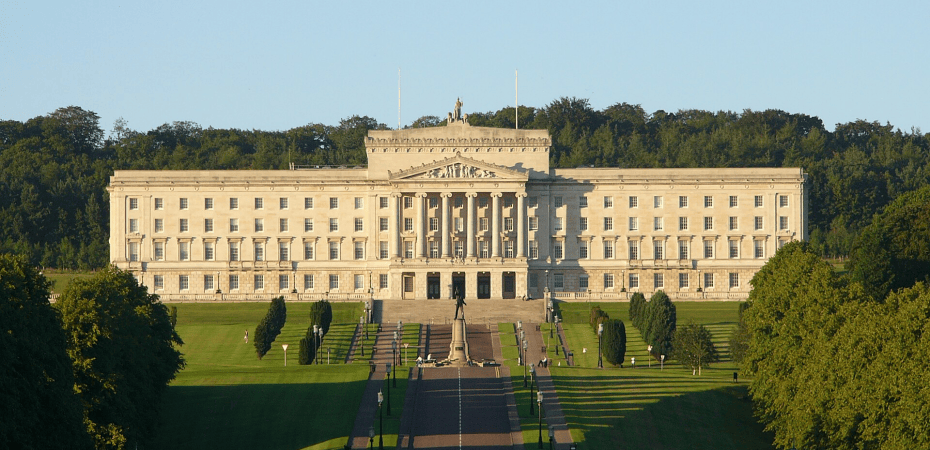
Image: Stormont Parliament https://commons.wikimedia.org/wiki/File:StormontGeneral.jpg Source: https://www.flickr.com/photos/robertpaulyoung/64563230/sizes/l/in/photostream/. Author: https://www.flickr.com/photos/robertpaulyoung/, licensed under the Creative Commons Attribution 2.0 Generic license.
 Labour Hub
