
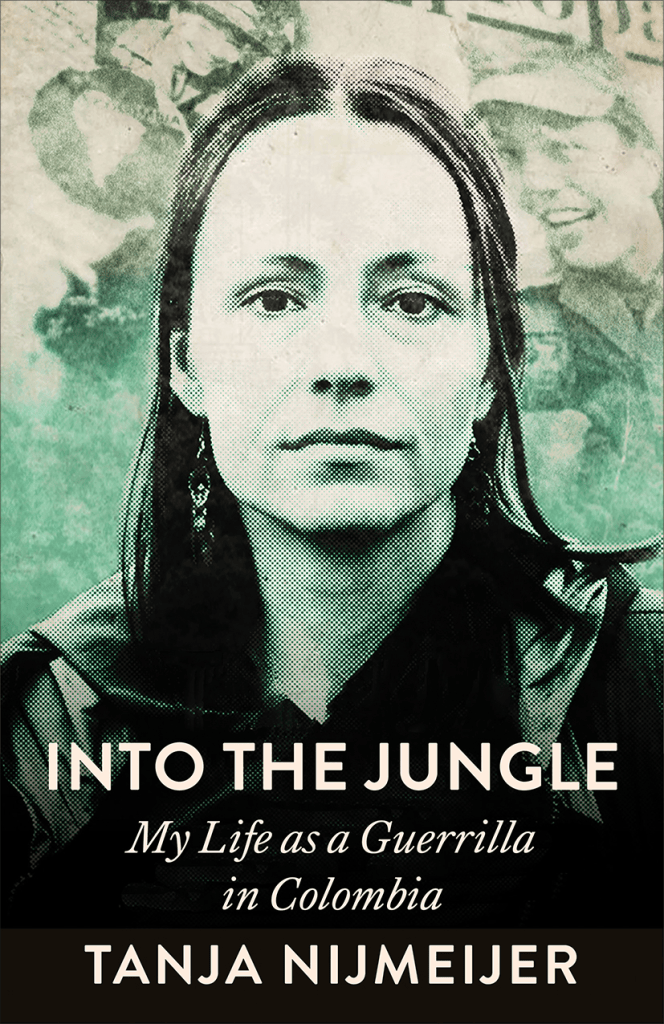
Mike Phipps reviews Into the Jungle: My Life as a Guerrilla in Colombia, by Tanja Nijmeijer, published by Pluto.
If the resolve of a Dutch woman who decided to abandon her comfortable European life to fight in an armed conflict thousands of miles away seems hard to comprehend, this memoir by Tanja Nijmeijer, who joined Colombia’s FARC rebels, widely labelled as ‘terrorists’, might help explain it.
As the Foreword by former Director of Justice for Colombia Mariela Kohon explains, Into the Jungle is “an uncensored testimony of daily life in the FARC… the daily routine, the boredom, the personal, the ridiculous, the fearful, and the heroic… a highly communal life, where concepts of ‘privacy’ or ‘individuality’ are subsumed by a collective existence that starkly contrast with life in capitalist society.”
A political awakening
Born in 1978 in a village in the Netherlands, Tanja Nijmeijer was preternaturally smart, a voracious reader and obsessive diary-keeper. She studied Romance languages and culture at university, spending a year immersing herself in Granda in Spain.
Finding the Netherlands parochial and “stifling” on her return, she went to Pereira in Colombia in 2000 for a year to teach English at a private school for children of the Colombian elite, with little idea of the country’s social inequality or the war between the FARC and the government. The school had special housing for foreign teachers, with a swimming pool, sauna, and doormen. She shared an apartment with a North American girl whose main topic of conversation was the lack of western food and the stupidity of Colombians. Many of the local teachers supported the ruling regime’s repression of the guerrilla movement and were unmoved by the shocking poverty, homelessness and state violence that Tanja saw.
One teacher, however, showed Tanja the poor neighbourhood she had grown up in, where the police routinely rounded up and ‘disciplined’ any young men they caught hanging around and where people still on the street after eleven at night were often shot. It was the start of a political awakening.
She left her job in the private school and began teaching ordinary kids. By this time, she had decided for her thesis to research the situation in El Caguán, a region about the size of Switzerland that the government had ‘ceded’ to the FARC. As she studied the revolutionary ideas of the FARC, “I began to question everything. The foundations on which my life had been built collapsed and I began developing new ideas and new beliefs on the ruins.”
Returning to the Netherlands, she experienced the same sense of drift and unbelonging that many people feel on returning to a rich country after living in a poor one. She found some kindred spirits in the International Socialists, but returned to Colombia in 2001 as part of an international caravan to show solidarity with people in villages now under the complete control of right wing paramilitaries. When they finally got through, after outright hostility from the authorities, villagers came running to embrace them with relief.
The trip strengthened her resolve to return more permanently. She was burning her bridges fast, both with family and even a relationship that became a marriage in Colombia, to work in the FARC for the revolution. And she was dropped in the deep end by her new comrades: her first mission was helping to plant a bomb. More prosaic missions followed before she set off for training with the guerrillas in the highlands.
At this point, I was not only questioning her judgment: I felt there was a strong element of manipulation by the militants she had begun to trust and work with. They suggested she couldn’t operate in the city where her partner lived, but should relocate to the capital, an eight-hour bus ride away, where she had few friends and would be entirely dependent on the guerrillas for support, even survival. Their deliberate assigning her to a violent mission made it evident that there was no way back. While Tanja says her opinion on the use of violence later changed, she’s not particularly critical of some of the other methods the FARC employed.
Guerrilla training
After twenty days of guerrilla training – a combination of political education, operational tactics, guard duty and manual tasks – in the distant mountains, the author returned to Bogotá for more hair-raising missions. With the police arresting her comrades in some numbers, she was instructed to head back to the jungle. She became fully immersed in guerrilla life, committing permanently to the FARC. Much harsher training followed.
About seven months in, Tanja’s camp was raided by government troops: the FARC’s rigorous training ensured they all got away. Further raids led to casualties. Life in the mountains was scarcely stable but Tanja’s commander astonishingly allowed her mother to pay her a visit, an episode that feels almost surreal.
Soon after, Tanja was in her first firefight and experienced the terror of being shelled. Being in a combat unit gave her life a new intensity, but she hit a major low when, in her absence, her camp was raided and the diary she had kept about her life in the FARC – warts and all – disappeared and was later selectively published in the Colombian press to show the guerrillas in a negative light. Years later, to her astonishment, the person responsible for doing so publicly apologised for this unethical decision.
As the war began to change in the military’s favour, Tanja saw several of her comrades killed in army raids. One night-time aerial bombardment was especially chilling, with many casualties. It was after this that the author relocated to the Caribbean Bloc in the north, to join the FARC’s International Commission. This entailed months of marching and a bout of malaria on the way.
Military distortions
Tanja’s courage throughout these years cannot be questioned. But there are many examples historically of organisations whose prioritisation of military activity has distorted their avowedly socialist aims. The unquestioning obedience and discipline required in a military outfit encourages the exercise of unaccountable and sometimes arbitrary power. In other contexts, this has led to so-called revolutionary organisations even executing their own members in large numbers when things go wrong. The author did not see any of this in the FARC, but she was aware of significant civilian fatalities in some of the military operations it carried out.
The organisation’s extreme centralism had other consequences, with the author having to face considerable institutional sexism. Women, for instance, were strictly forbidden from having children which could endanger the community – although she later found this rule was not rigidly enforced across all fronts – but it was women who were instructed to undergo the unpleasant contraceptive injections: men took no responsibility.
By 2011, the FARC itself was reaching the conclusion that its kidnappings and extortions “had exacted a tremendous toll in terms of political and public opinion and that many mistakes had been made by units across the country.” Its main concern was that, “since the ultrarich sat behind a wall of bodyguards on their estates, or in Miami, the ‘somewhat rich’ were extorted instead.” The ethics of extortion itself was not yet being questioned, notes the author.
Peace negotiations
A year later, preparatory talks about peace negotiations began with the Colombian government. Tanja was selected to join FARC commanders on the peace delegation in Cuba. The culture shock was profound: “And just like that, there I was, sitting with a cup of coffee on a low wall outside my new house. Every five minutes I went to check for the rifle that wasn’t there and I felt incredibly on edge.”
The author was unprepared for the huge media interest in her and the hostile press she faced. She volunteered for the FARC communications team, partly out of frustration at how the FARC had refused to bother refuting the lies the mainstream media told about the organisation. She took charge of international communications and was also elected onto the FARC’s negotiating committee.
Away from the jungle, the author got a wider sense of the immense humanitarian cost of what turned out to be an unwinnable war. She also got a broader understanding of the FARC’s all-male command structure and how unwilling its members were to share power with women who had devoted their whole lives to the movement.
When the peace accords were signed in 2016, the author felt they were, to say the least, one-sided, with the FARC giving up its weapons rapidly and getting little in return. Delegates from Northern Ireland who had experienced disarmament themselves had impressed upon them: “Be sure to take your constituency with you.” The author wonders if the FARC leadership had consulted its base adequately.
When the peace deal was put to a national referendum, it was, by a narrow margin, shockingly rejected – a sign that Colombia’s elite, who controlled the military and the media, still wanted the complete annihilation of the FARC. To garner more popular support, the FARC had to make further concessions. By then, the government was openly breaking its side of the agreement – for example, its commitment to build housing for ex-guerrillas.
Here the author makes a crucial observation: the reason why approximately half of all peace processes in the previous decade had failed within the first five years was because all efforts focused on disarmament to the exclusion of other issues.
“The FARC had been disarmed, leaving us with no more leverage against the government. But what about the reforms, I wondered? What about all the things we spent so much time discussing in Havana? What was the point of disarming the guerrilla when all the conflict’s underlying causes still persisted? We no longer had guns now, but had yet to see whether the government would keep its word. So far, it didn’t look good.”
Meanwhile, as the FARC morphed into a political party, it abandoned many of its traditional tenets and began to prioritise new political skills. “I would have been more useful to our cause if I’d gotten an education instead of walking around the jungle with a heavy backpack all that time,” one former guerrilla told the author. “All I have to show for it are two hernias and an explosives course on my resume.”
Tanja too paid a heavy price for her activism. Desperate in her late thirties to get pregnant but unable to do, to return to see her nearest and dearest in the Netherlands, but barred as a ‘terrorist’, she was left watching the political party which the FARC transitioned into perform poorly at the polls and seeing new conflicts flare up involving paramilitaries and drug cartels. In January 2020, she resigned from the party.
Peace process under threat
Where does Colombia’s peace process stand today? Even before taking office on 7th August, far-right president-elect Abelardo De la Espriella announced the closure of several government offices that are vital to peacebuilding and the protection of human rights. “It is further indication of his plans to reverse the progress made in Colombia in recent years and return the country to the repressiveness and militarism of years gone by,” suggested Justice for Colombia. De la Espriella also launched a verbal attack on former FARC commander and peace negotiator Rodrigo Londoño, aka ‘Timochenko’, saying: “This bandit Timochenko deserves to be imprisoned for life. I am going to work towards this.”
De la Espriella’s close association with the military, itself accused by human rights organisations of colluding with paramilitary groups behind massacres, forced displacements and other atrocities, and found by Colombia’s Truth Commission to have carried out serious human rights violations, remains a serious threat to the peace process. Destabilizing this could adversely affect thousands of former FARC guerrillas, almost 500 of whom have been killed since the 2016 peace agreement, as well as their more than eight thousand children born since 2016.
Mike Phipps’ book Don’t Stop Thinking About Tomorrow: The Labour Party after Jeremy Corbyn (OR Books, 2022) can be ordered here.

