
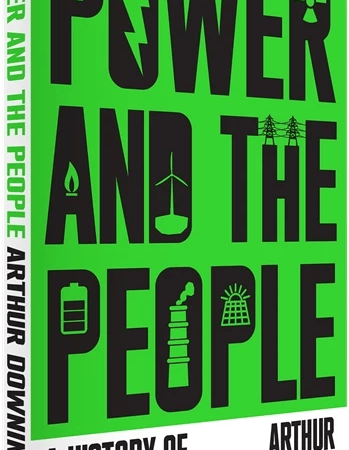
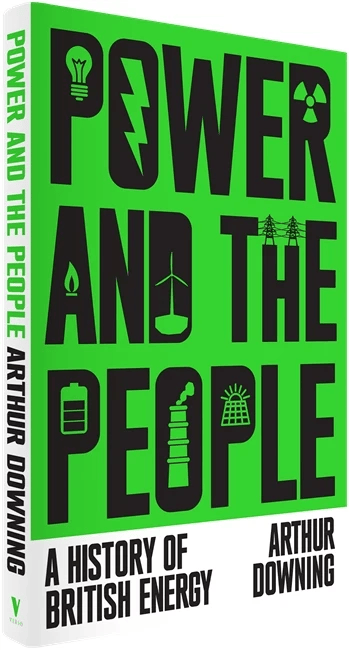
Mike Phipps reviews Power and the People: A History of British Energy, by Arthur Downing, published by Verso.
This is a timely book, appearing as Shell’s and BP’s quarterly profits more than doubled and Centrica added a further £497 million to its adjusted operating profits, taking the total made by British Gas and its successor company to more than £56 billion in operating profits in the forty years since privatisation.
Meanwhile, as the author pointed out recently, Britain has some of the highest electricity prices in the world. Yet “Britain’s political class remains unified in its belief that energy infrastructure must be owned by the private sector.”
The energy crisis resulting from Russia’s 2022 invasion of Ukraine “exposed Britain’s electricity and gas industries for what they are fragile, fragmented, comically complicated and hopelessly dependent on imported fossil fuels,” the author tells us. “Markets, private sector companies and financiers are in control and the state and citizens are at the periphery.” As with the Iran conflict today, the energy companies made vast profits, helped by $40 billion of government subsidies.
But how did we get here? The origins of the crisis in the energy sector can be traced back to privatisation, argues Downing. The first national grid was built in the 1930s at a rate of 500 miles a year, costing £1.9 bn at 2024 prices; a generation later, the “supergrid” cost £2 bn. Today, three private companies are undertaking the ten-year “Great Grid Upgrade”. It will be just 620 miles long and cost £20 bn – fifty times more per mile than the original grid, which was also eight times faster.
Downing traces the history of the industry through its phases of localisation, rationalisation, nationalisation and privatisation. In the last phase, “ far from privatisation leading to a golden age of ‘popular capitalism’ with ordinary Britons owning shares, the energy sector became dominated by foreign ownership.”
Nationalisation was vital, argues Downing, not as an end in itself, but as a means to make the infrastructural and technological advances, such as the natural gas conversion programme, which earlier forms of ownership would or could not make. Contrary to later myths about “bureaucratic monoliths”, the new corporations had considerable regional autonomy and decentralised decision-making. They also proved more efficient in practice than free market ideologues admit.
Downing takes us through the process of privatisation, the early promise of which soon turned sour. Investment levels were persistently low, competition led to oligopolies and by the early 2000s, prices were rising above pre-privatisation levels.
As with rail, some of the bigger beneficiaries of energy privatisation long-term were state-owned European entities, such as France’s EDF. Other major owners were overseas asset managers and billionaires. The belief that British companies could outcompete less efficient state-owned monopolies never materialised.
Private enterprise’s characteristic failure to invest meant that by 2022 housing developers were having to delay construction projects because of the time it would take to connect to the grid, a problem exacerbated by battery storage projects and data centres swallowing up the network’s potential capacity.
The same failure to invest turned Britain from a significant net exporter of the pipes, pylons, turbines, transformers and other elements that make up the energy system into, by the late 1990s, a net importer.
The failure of Britain’s nuclear industry since privatisation was emblematic of the overall dysfunction, as the UK went from being an advanced nuclear nation to having less nuclear capacity than South Carolina. “The only reason Hinkley Point C will (eventually) exist is because the state intervened with subsidies, thus abandoning one of the core principles of the privatised model,” says Downing. The experiences of both hydrogen and carbon capture and storage follow a similar pattern.
The 2022 energy crisis underlined the need for fundamental reform. State intervention became essential, enthusiastically supported by the industry itself as a way to protect its profits – yet the principle of continued private ownership remained sacrosanct.
What now? “Britain has placed so much of its critical national infrastructure in the hands of private companies, banks and asset managers that these institutions now have us at their mercy,” suggests the author. The need for capital investment is urgent, but private investors can get better returns elsewhere for lower risk. Meanwhile bills are likely to remain high as infrastructural projects fail to deliver on time and within budget.
Downing sets out a series of steps that would bring the industry back into public ownership without costing the earth. Decentralisation and public participation will also be essential to counter the backlash now growing against energy transition, which populist politicians claim will bring hikes in the cost of living.
This is at times a technical book but it has the huge advantage of moving beyond generalities about nationalisation and talking concretely about new forms of public ownership in the energy sector. The arguments here are essential for countering the wall of opposition that the private sector will throw up against even the most timid steps a Labour government might take towards state ownership.
Mike Phipps’ book Don’t Stop Thinking About Tomorrow: The Labour Party after Jeremy Corbyn (OR Books, 2022) can be ordered here.

