
By Ben Studd
On 4th October, Brazil votes. President Lula, seeking a fourth term, is neck-and-neck in the polls with Flávio Bolsonaro, son of the imprisoned former president Jair Bolsonaro, and Donald Trump’s chosen candidate. If nobody wins outright, it goes to a runoff on 25th October.
Jair Bolsonaro governed Brazil from 2019 to 2023. His government privatised public assets and cut welfare, hitting the poorest hardest. It gutted environmental enforcement, and Amazon deforestation accelerated as agribusiness and mining interests moved in with impunity. Violence against Indigenous communities defending their land rose. And his presidency ended with his own supporters attempting a coup after he lost the 2022 election. He is now in prison for it. His son Flávio is standing to continue that project, with Trump’s explicit endorsement.
Lula’s record since 2023 tells a different story. Bolsa Família, the child subsidy programme, has been reinstated and expanded to reach around 21 million families. The public health system, run down under Bolsonaro, has been rebuilt. The minimum wage has risen in real terms. And on the world stage, Lula has been one of the few heads of government willing to call Israel’s assault on Gaza a genocide, a statement that got Brazil’s ambassador summoned by Israel and drew a direct rebuke from Netanyahu.
This election is the latest round in a pattern that’s been building across Latin America all year. In January, US forces struck targets in Venezuela and captured President Maduro, flying him to New York for trial; dozens were killed, and the UN and human rights groups condemned the operation as a serious breach of international law.
In June, Abelardo de la Espriella was declared the winner of the presidential election in Colombia – a Trump-endorsed right-wing lawyer with no prior political experience. Meanwhile the US blockade of Cuba has reached siege levels, cutting off the island’s access to energy and medicine and causing enormous suffering. Brazil is the largest economy in the region and the next target. A Bolsonaro win would be a defeat for Brazilian workers, Indigenous peoples and the Amazon, and the biggest prize yet in Trump’s drive to reassert the Monroe Doctrine in Latin America.
Jair Bolsonaro’s presidency ended with an attempted coup when his supporters refused to accept defeat, and there’s no reason to expect different from his son’s movement if he loses, particularly with an emboldened Trump administration behind him. And if Flávio Bolsonaro wins, the likely programme is the same as before – deregulation, deforestation, repression of social movements – pursued with even fewer restraints than last time, given how much ground Trump’s allies have already gained across the region this year.
Whichever way the vote goes on 4th October, progressives in Britain and around the world must be ready to support Brazilian workers and indigenous movements in challenging the far-right and the threat of Trump. In Britain that means supporting the work of Brazil Solidarity Initiative and Brazilian groups calling for eyes on the upcoming election, including through the recently published statement.
- Liverpool event: Viva La Solidaridad! No to Trump’s War on Latin America. Speakers include Gabriel Becerra, Colombian MP (Pacto Historico party), Francisco Dominguez, Venezuela Solidarity Campaign, Julia Felmanas, Brazilian Workers’ Party. Sunday September 27, 1pm, Racquet Club Hotel, 5 Chapel Street, Liverpool, L3 9AG. Register at http://bit.ly/vlsliverpool
- Read and sign a solidarity statement with Brazil here.
Ben Studd is a Brazil Solidarity Initiative volunteer.
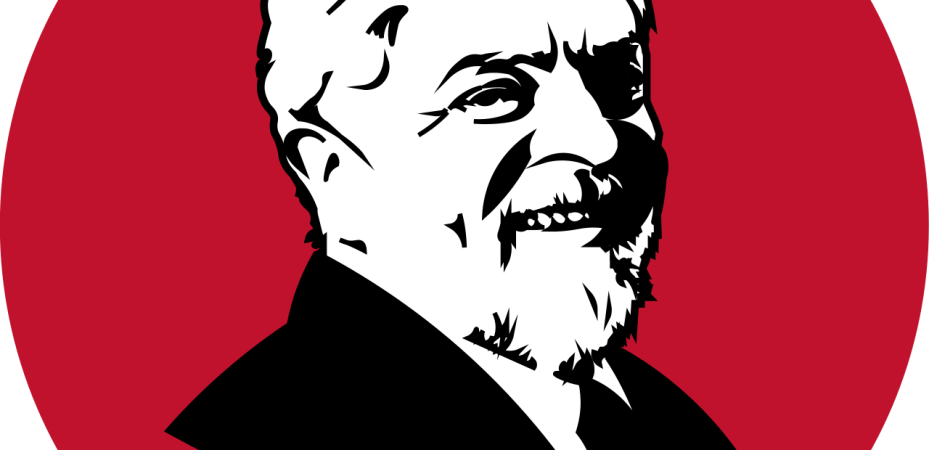
Image: https://commons.wikimedia.org/wiki/File:Lula_icon.svg Author: Didacus2, licensed under the Creative Commons CC0 1.0 Universal Public Domain Dedication.


