
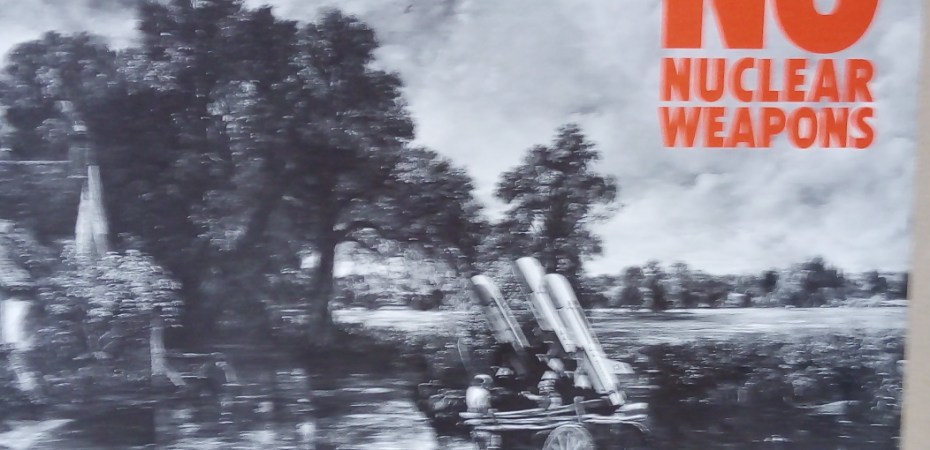
Today is the International Day for the Total Elimination of Nuclear Weapons. We are a very long way from that, argues Carol Turner.
“The threat of nuclear catastrophe is immediate and growing… rising tensions, deepening mistrust, expanding military competition and the modernisation of nuclear arsenals cast a dangerous shadow over our common future.” – UN Secretary-General António Guterres
Just about everyone is aware that military spending is soaring in Britain and worldwide. Did you know the same goes for spending on nuclear weapons? In the past five years, nine nuclear weapons states – the US, China, UK, Russia, France, India, Pakistan, Israel and North Korea – have spent almost half a trillion dollars ‘improving’ their nuclear arsenals. The US leads the pack, as it has for almost 50 years, spending more on nukes than the others combined.
In 2025, UK nuclear weapons spending rose 17% on 2024. Britain overtook Russia to become the world’s third highest nuclear spender, after the US and China. Nuclear weapons now account for around 14% of the Ministry of Defence (MoD) budget. Trident is expected to cost £240 billion over its lifetime; and Britain is expanding its nuclear capability.
At the 2025 Nato Summit, Keir Starmer announced the purchase of 12 nuclear-capable F-35A stealth bombers from the US, at a cost of almost £1bn. Their purchase will allow the Royal Air Force to deliver the US nuclear bombs stored at RAF Lakenheath as part of Nato’s nuclear sharing arrangements. Needless to say, expanding nuclear capability will ratchet up the MoD’s nuclear spending for years to come.
More nukes in Europe
Something else you may not know about nukes is that European rearmament means more nuclear weapons. Under Nato’s nuclear sharing arrangements, six European member states already host US nukes: Britain, Belgium, Germany, Italy, Netherlands and Turkey. French nuclear weapons operate outside Nato control, but the Anglo-French Northwood Declaration signed last year aligns France closer with Nato.
More European states are preparing for nuclear weapons:
- Finland became a full member of Nato in 2024. In June this year, Parliament voted to change its non-alignment policy which precludes Finland from hosting US nukes. Recently, a government official was reported as saying Finland has relinquished responsibility for controlling the movement of nuclear weapons across its territory, in both peacetime and during a crisis.
- Sweden also became a full member of Nato in 2024. Prime Minister Kristersson said it would retain its policy against hosting permanent military bases or nuclear weapons within its borders but, “in a war situation, it is a completely different matter.”
- Lithuania is set to abandon Article 137 of its constitution which prohibits nuclear weapons and foreign bases on its territory at the end of this year. Parliamentarians have said Article 137 is out of date. Defence Minister Kaunas has already indicated willingness to support Nato’s nuclear sharing agreement.
- Belarus joined the nuclear Non-Proliferation Treaty (NPT) in 1993 and returned all Soviet nuclear weapons to Russia. At the end of 2023, after a referendum agreed to remove Belarus’s non-nuclear weapon status, Russia deployed tactical nuclear weapons on Belarussian territory. President Lukashenko warned he would allow Russian nukes back should Nato extend its nuclear sharing arrangement to Poland and Lithuania.
Wanting to call time on nukes is about much more than cost, of course. Spending stats cannot convey the existential damage to people and planet that a nuclear detonation represents.
What no government wants you to know
“A nuclear explosion is like every natural disaster happening at once. No serious humanitarian response is possible. There is no way to help the victims of a nuclear attack.” Not my words, but those of the International Red Cross and Red Crescent in a film about what happens when one nuclear bomb explodes over one city.
In a moment, a ball of fire hotter than the sun evaporates everyone and everything within the epicentre of the explosion. Seconds later a shock wave moving faster than the speed of sound, creates winds like hurricanes and tournedos which people and buildings are unable to withstand. Fires spread and burn everything within hundreds of kilometres – plastic, wood, hair, skin. Millions of people die in agonising pain.
As the fires burn out, black rain falls covering everyone and everything with sticky radioactive dust. Each breath each survivor takes poisons their lungs. The worst affected die in hours. More die slowly in the weeks, months, and years ahead. Atom bomb survivors will live with extensive burns and succumb to cancers; their children will be born with shocking birth defects.
After a nuclear attack, survivors are on their own. There is no water to drink, no transport to evacuate you, no medical supplies, and food quickly runs out. Emergency workers are in danger if they get too close. Nearby hospitals are under-equipped and overwhelmed by the sheer number of patients.
Time to speak truth to power
The UN promotes nuclear disarmament on 26th September every year in recognition of Stanislav Petrov, a Lieutenant Colonel of Soviet Air Defence Forces who was on duty in 1983 when a nuclear early-warning system malfunctioned suggesting the USSR was under attack. Instead of following protocol, which required him to relay the alarm up the chain of command, Petrov decided to wait for corroborating evidence. His decision prevented retaliatory nuclear strikes against the US and Nato allies.
Today, Britain needs some Petrovs of our own – willing to step back and take stock, able to distinguish between belligerence and security, and prepared to speak truth to power. Nuclear weapons do not keep us safe, no matter how many British prime ministers say they do.
Carol Turner is CND Vice-Chair.
Image: c/o Labour Hub.


[…] article first appeared in Labour Hub, 26 September […]