
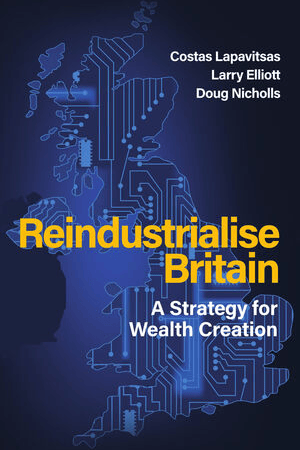
Mike Phipps reviews Reindustrialise Britain: A Strategy for Wealth Creation, by Costas Lapavitsas, Larry Elliott and Doug Nicholls, published by Polity.
Nobody who has looked at Britain’s economic woes in recent years can be unfamiliar with the authors’ diagnosis: “Deregulated markets have led to stagnating living standards, prioritised finance over production and increased reliance on imports.” There is a widespread belief that Britain is ‘broken’ alongside record levels of contempt for the entire political establishment.
The state we’re in
Market-led de-industrialisation and financialisation have been catastrophic for Britain – and other wealthy economies too. As recently as 2004, rich developed nations accounted for 70% of global manufacturing. By the early 2020s, it was 40%.
One result has been greater impoverishment and precarity in the labour market. By 2023, half of Britain’s NHS trusts were providing food banks for their staff. The number of zero-hours contract workers in Britain increased fivefold between 2020 and 2022. By 2026, a third of children were in poverty, more than half from working households. These shameful statistics are made worse by the shocking levels of inequality that now characterise Britain.
Another impact has been widening trade deficits. “We plug the hole with short-term money from abroad and by selling more of our assets and debt to overseas owners,” say the authors. “That means Britain’s standard of living increasingly depends not on what it produces, but on the willingness of foreign investors to keep financing its deficits.”
The 2024 general election showed that voters understood the need for radical, coordinated national action. The early departure of Keir Starmer reflected the intense public hostility to his lack of a plan and continued reliance on market solutions, all while the populist right is growing on the back of Labour’s failings.
The task of enacting such a plan now falls to Andy Burnham. This will require a radical reconfiguration of the way the British state has behaved for the last fifty years – attacking trade unions, privatising public property, relentlessly centralising (90% of UK tax revenue is centrally collected), and forever seeking new ways to cut public expenditure. It has also created a tax system that favours the wealthy and bears heavily on workers and the poor. So Burnham will need not just new policies, but a machinery that is capable of implementing them.
Solutions
The remedy proposed, based on meeting binding climate goals, is a programme of reindustrialisation, increasing manufacturing, with large scale training of workers and public ownership of utilities. The authors reckon on a price tag of £1.41 trillion over ten years, £850 bn of which would be public money. Implementation depends on not just political boldness, they say, but social mobilisation.
Reindustrialising is a question not just of economic revival but of sovereignty. The Covid pandemic underlined that Britain was forced to rely on fragile global supply chains to obtain vital medical equipment, just as Russia’s war on Ukraine highlighted Britain’s energy dependency.
The authors identify six steps necessary to Britain’s economic transformation. To increase UK manufacturing by just 3% of overall GDP, an additional 725,000 workers will be needed, recruited either from the economically inactive, or from other sectors or as part of a planned migration component. Wages will need to rise to attract these workers and training to improve and expand.
Secondly, the necessary injection of public finance must mean public control and ownership. Natural monopolies – particularly energy – are a priority for this.
Thirdly, raising productivity will not happen without a wave of capital investment. Again, this is most obvious in the privatised energy and water sectors, milked by their owners for shareholder dividends, but also in all aspects of Britain’s creaking transport network.
Fourthly, Britain needs a well-capitalised Public Investment Bank, a central policy plank of the Corbyn manifestos, but subsequently abandoned by more right wing Labour leaders. The firepower of UK insurance companies and pension funds also needs harnessing. This won’t happen through the goodwill of these profit-seeking institutions, so the authors outline various government mechanisms to make the savings go where the country needs them.
Fifthly, government will need to protect the fledgling programme of reindustrialisation from international competition via trade regulation. This is more controversial, as the authors acknowledge, provoking the risk of retaliation.
Sixthly and even more controversial, the authors propose capital controls, overturning an almost 50-year policy. The aim would be to make money capital go towards longer-term investments so interest and exchange rates move less violently. Such measures would encounter fierce opposition from the City of London, but, as others have argued, they are a reasonable and effective means to defend a democratically mandated policy against the pressures of international markets.
A great strength of this book is that the authors do not ask you to take on trust the common sense character of their proposals: they set detailed, often modest targets and explain, for example, how the response of the much-hyped bond markets can be neutralised.
But they also emphasise that sustained democratic pressure will be vital to defend their programme against resistance from employers, finance capital and captured state institutions. That pressure “can only come from organised workers capable of collective action” – in other words, strong trade unions are an essential component of these proposals, as part of a broad class-based coalition of support.
Many readers will disagree with the authors’ earlier support for Brexit, particularly in view of what has happened in the last ten years – and not just on the economic front. But that should not be a pretext for declining to engage with the economic arguments set out here, which are practical and realistic and need to be discussed widely and in detail across the movement.
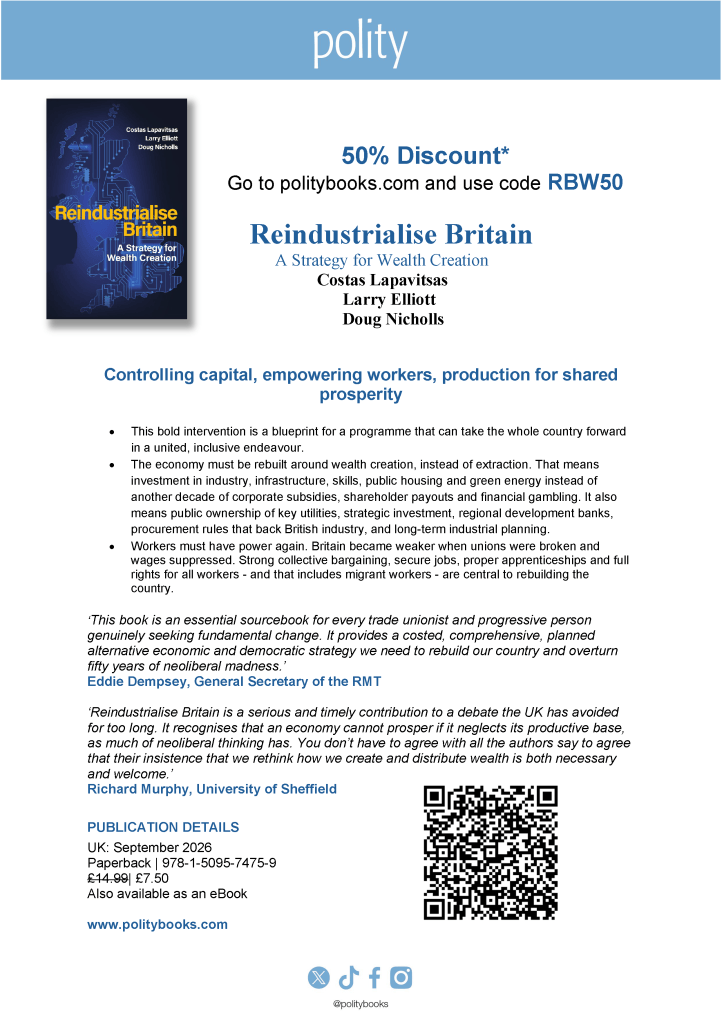
A 50% discount is available to readers – see the flyer below.
Mike Phipps’ book Don’t Stop Thinking About Tomorrow: The Labour Party after Jeremy Corbyn (OR Books, 2022) can be ordered here.

