
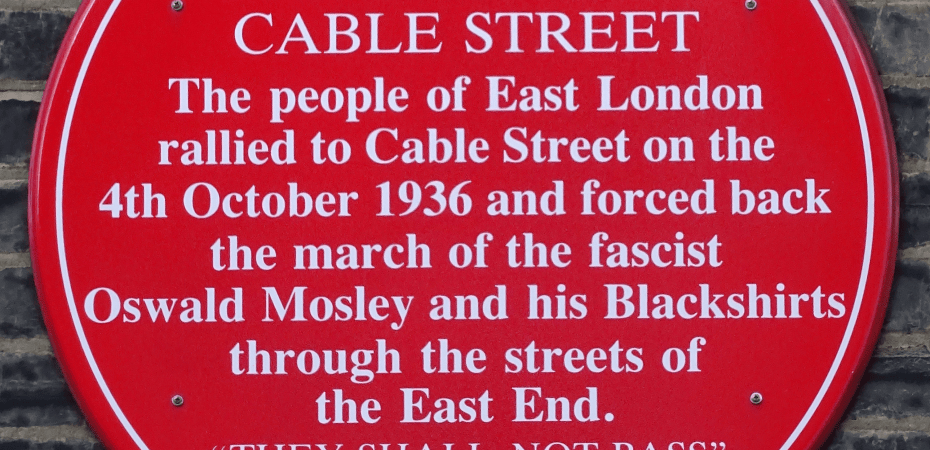
As its 90th anniversary passes, Richard Price reflects on how this historic protest is still being used to advance narrow agendas.
The destiny of many great historical events is to have their rough edges smoothed in order to create a comfortable national story. The Second World War, unlike the first, is safely enshrined as ‘the good war’, when the nation came together under the inspiring leadership of Churchill and defeated fascism. Hindsight and in particular the horrors of the Holocaust have posthumously relegated contemporary opposition to the fringes. Those who opposed the war at the time from various points of the compass – among them the far right of the Tory party, Welsh and Scottish nationalists, pacifists, fascists, Communists (before the invasion of the Soviet Union in June 1941) and Trotskyists – have little to say on the subject these days.
Suffragettes – who carried out arson attacks, smashed windows, sent letter bombs and slashed paintings in pursuit of the vote – have been woven into the story of the ascent of liberty and democracy, and praised by the same ministers who have had hundreds of elderly Gaza protesters arrested and charged under anti-terror legislation.
Something similar has happened to the Battle of Cable Street, which recently had its 90th anniversary. It too is in danger of becoming another national comfort blanket – when the people of the East End united across ethnicities and classes to isolate the bad guy-interlopers and send them packing – and its left wing character erased. Repackaged and domesticated like this, it is now claimed as part of the heritage of the centre and right wing of the Labour Party.
Five years ago, Miriam Mirwitch – then the Jewish Labour Movement’s trade union officer, now a Labour councillor in Waltham Forest – made an ill-starred foray into the history of Cable Street. In a blog post, she claimed that without pressure from “Left-wing Zionists and Jewish socialists”, the organised left would not have been at Cable Street. The purpose of her piece was not to elaborate on the history of anti-fascism in the East End – a subject which she ably demonstrated she knew little about – but to serve as historical ballast to justify the claim that the Labour Party had been overrun by “left antisemites” (who miraculously disappeared once Keir Starmer became Leader).
It is true that the Communist Party instructed the bulk of its members to attend a Young Communist League rally in Trafalgar Square in solidarity with the Spanish Republic on the same day that Mosley planned to march, and not to attempt to stop him. It did come under pressure from its East End members, many of them Jewish, to reverse its position, which it only did publicly on October 2nd, two days before the Britain Union of Fascists’ demonstration. Meanwhile, the Independent Labour Party toured the area with a loudspeaker van, urging workers to prevent Mosley marching and held a large rally in Hackney on the evening of October 3rd that called for an “an overwhelming demonstration against the Fascist march”. Mention should also be made of the Jewish People’s Council against Fascism and Antisemitism, the Ex-Servicemen’s Committee Against Fascism and the Labour League of Youth.
Having wavered, the Communist Party and its East London membership threw itself into organising the resistance. To suggest otherwise is absurd. As for Mirwitch’s “Left wing Zionists”, to whom she ascribes a significant role, David Rosenberg, a leading historian of the Jewish East End, replied: “Mirwitch would love it to be true that Zionists played a key role in 1936. They didn’t. Although Zionists were beginning to make headway in more middle-class Jewish areas in 1930s London, and starting to gather more support within the Board of Deputies (led at that time by upper middle-class non-Zionists and anti-Zionists) they were a marginal force in the overwhelmingly working-class East End.”
On the 90th anniversary of Cable Street, another Labour right winger, Sarah Sackman, MP for Finchley and Golders Green, ventured into print. For her, it was a neighbourly coming together of “Jewish residents, Irish dockers, Somali seamen, trade unionists, independent socialists and communists”. While there is some truth in this, it is surely not accidental that those most responsible for rousing the East End working class are placed at the end of this list. And the main lesson she draws from the events of October 1936 – in addition to proscribing Iran’s Islamic Revolutionary Guards and investing more in local policing – is that we should “champion a new, progressive patriotism”.
This would come as a surprise to those who took part in the Battle of Cable Street. I knew two people who did – a neighbour who lived directly above me on my council estate in the 1980s, and Jack Firestein, who is mentioned in Phil Piratin’s book Our Flag Stays Red. Jack left the Communist Party after events in Hungary in 1956 and became a much loved stalwart of Camden Labour Party. Patriotism, progressive or otherwise, was on neither’s agenda.
Sackman’s reference to policing is particularly ironic, given that Mosley and his Blackshirts were protected by a massive force of at least 10,000 police. So great was the police protection that the vast bulk of fighting that took place was between anti-fascists and the police, rather than with the fascists. And police were responsible for the majority of the injuries sustained on the day. Indeed, the police were positively indulgent to Mosley’s thugs throughout the 1930s, and even continued this when Mosley relaunched his movement after 1945.
Sackman’s credentials as a promoter of inter-community unity are heavily undercut by a letter she co-authored with three other Labour MPs to David Lammy in September 2024 expressing concern following the government’s announcement that it was suspending some arms export licences to Israel. At the point at which they wrote the letter, the United Nations reported that over 41,000 Palestinians had been killed since October 2023, a majority of whom were women and children.
Entirely missing from these attempts to co-opt Cable Street for right wing Labour purposes are two fundamental factors – class and politics. The magnificent response from the East End Jewish working class was in marked contrast to that of the Jewish establishment in the more salubrious parts of the capital.
David Rosenberg in his book Battle For The East End notes that on October 1st 1936 the Jewish Chronicle advised its readers to “keep away from the route of the Blackshirt march and from their meetings… Jews who, however innocently, become involved in any possible disorders, will be actively helping antisemitism and Jew-baiting. Unless you want to help the Jew-baiters, keep away.” For its part, the Board of Deputies was reported in the Evening Standard as follows: “When the original Blackshirt march was announced we distributed numerous bills and had messages read in every synagogue urging Jews to keep off the streets on that Sunday. What more can we do?”
Rosenberg comments: “For the local Jewish community, the battle for the East End highlighted the extent of the gulf between the consciousness of the population on the ground and its West End-based communal leadership.”
Meanwhile, the Labour leadership was toeing a similarly spineless line. I have not found any reference to a single Labour MP attending the protest. Instead, Labour worthies across East London called for the march to be banned, and, failing that, to keep away. These calls weren’t confined to the Labour right wing but were echoed by the sainted George Lansbury, hero of the Poplar Rates Rebellion. Peace for Lansbury was a higher cause than defeating fascism, and history has not been kind to his visits to Hitler and Mussolini 1937 at which he vainly attempted to persuade them of the desirability of peace. In spite of this, many rank and file Labour Party members and trade unionists were present at Cable Street.
This approach to the far right – calling on the government to ban their demonstrations, relying on the police to uphold civil liberties, staying away from confrontation – echoes down to today.
In August 2024, at a time when violent attacks were taking place outside asylum seeker hotels across the country, rumours spread of a far right provocation in Walthamstow in my borough of Waltham Forest. This was no idle threat – in 2012, the English Defence League attempted to march and were stopped by 4,000 residents.
While local socialists and mosques, the Trades Council and rank and file Labour Party members prepared to block their likely route, both Labour-led Waltham Forest Council and local MP Stella Creasy passively passed on police advice to avoid Walthamstow town centre. Ignoring their advice, 10,000 people blocked the main roads leading to the town centre with the result that no far right march took place.
After the event, Creasy praised Walthamstow as “the house of love” on social media, and was heavily criticised for appearing to take credit for an event she had tried to persuade people not to attend.
The Battle of Cable Street humiliated Mosley, but it did not destroy his movement as some accounts suggest. A week later, his supporters carried out a vicious pogrom in Mile End. By no means all of East London rejected him. In the London County Council elections in March 1937, BUF candidates polled 8,000 votes in Bethnal Green, Limehouse and Shoreditch. In July 1939, his “Britain First” rally at Earls Court attracted 20-30,000 people.
The real lessons of Cable Street are not passivity in the face of violent fascist provocation and reliance on the law and the police, but constant vigilance that builds working class unity in action with all those under threat from the far right. Communities under attack that renounce the right of self-defence do so at their peril.
Richard Price is a political activist in Leyton.
Image: “Battle of Cable Street Plaque (Tower Hamlets Environment Trust)” by Spudgun67 is licensed under CC BY-SA 4.0.

