
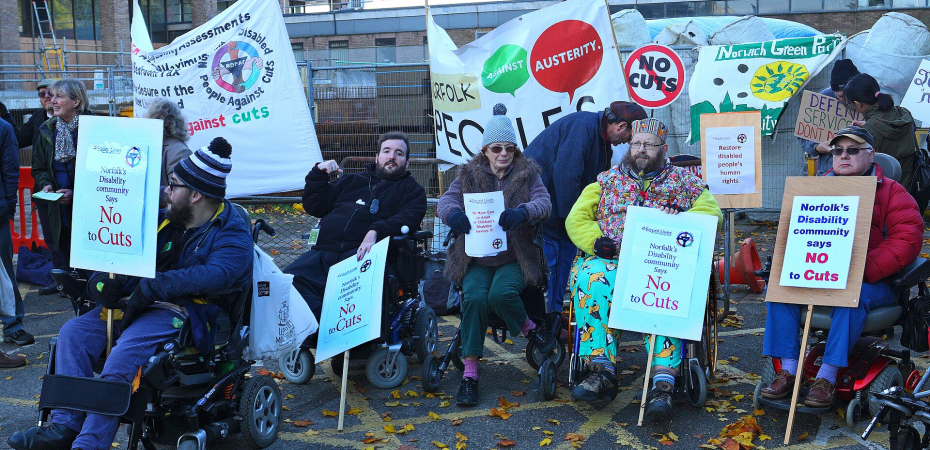
Sandra Wyman looks at the history of social care and is concerned that Andy Burnham’s approach may not be the answer.
Yvette Cooper recently stated: “Fifty years ago Barbara Castle recognised that health and social care must work hand in hand,” and talked about the need for an “integrated system”. Andy Burnham talked about his determination to link the two. This idea continues unchallenged.
Fifty years ago workhouses with their punitive culture were part of many people’s memories: although the workhouses had been closed by 1950, their culture and practices lingered on. Local authority care homes for older people were still often basic and spartan.
Many disabled people were segregated, living in residential homes, considered incapable of living worthwhile lives. An investigation by sociologists into residents at Le Court care home stated that they were living a “social death”, unable to do anything of value to society. Their report was slated by those who later led the disabled people’s movement because it reinforced capitalism’s rationale.
In 1975 a Le Court resident, Paul Hunt, founded the Union of the Physically Impaired Against Segregation, campaigning for disabled people to be supported to live independently. In the 1980s Mike Oliver’s “social model” continued Hunt’s definition of disability as the social oppression of those considered of least use to the capitalist system.
The years that followed saw protests by the disabled people’s Direct Action Network (DAN), the formation of the British Council of Disabled People, plus many other disabled people’s groups and in this century the campaigning organisation Disabled People Against Cuts (DPAC). But still the idea that we are limited, pitiable, and lesser, persists.
Older people are also subjected to being thought of and treated as lesser by many people and organisations.
The current situation
Andy Burnham has made ‘social care’ a priority without being explicit as to what he means by it. There’s general agreement on the need for care to be free at the point of need; improved palliative care; developing good practice in dementia care; support for unpaid carers; better recognition and pay for professional carers and personal assistants (PAs).
He rightly describes current provision as being “in tatters”: but a garment that’s “in tatters” won’t get mended by sticking patches onto it – it’ll just continue to fall apart. The last fifty years have seen a succession of such patches – multiple commissions, sixteen Acts of Parliament, research reports, involvement from voluntary organisations and more besides. The time has come to throw away the old tattered garment and create something new that is genuinely fit for purpose. The language also is an issue – ‘care’ suggests an emotional connection or medical care rather than the professional support or personal assistance many of us need.
Yoking together health and social support needs questioning. While End Social Care Disgrace (ESCAD) raises a genuine concern that medical care will outweigh the need for social care, there are other reasons why it’s vitally important that the needs of older and disabled people are not seen as purely medical.
Seeing NHS and ‘social care’ as belonging together is both a retrograde and a dangerous step, undermining the political understanding of disablement embodied in the social model and taking the focus away from the need to make society inclusive.
There are numerous instances of the damaging effects of treating disability as a medical issue through which bodies and minds need to be altered in order to fit into a society which excludes and disables us. These include: experimental surgical treatments; not investigating patients’ concerns by assuming they result only from age or impairment; use of electro-convulsive therapy without anaesthetics to treat depression; ME treated by graduated exercise therapy which made patients more impaired.
Research by academics from University College London found that stereotyping by health professionals relating to disability and age was more prevalent than other forms and worsened by negative attitudes relating to women, black and Asian, LGBT+ and working class people. There’s also an assumption that disabled and elderly people are less capable of independent thought and that older people are likely to be experiencing dementia, even though statistically less than ten per cent are.
There has always been a radical tendency among disabled people who argue that narratives around ‘care’ reinforce the idea of dependency and undermine self-determination and the right to independent living.
The 1990 NHS and Community Care Act made local authorities responsible for commissioning rather than providing residential care. Most care homes are now privately run and CEOs have extensive powers to make decisions including about medical care. Not all care homes are up to standard and residents have experienced abuse, staff have been exploited, overworked and underpaid, subjected to zero hours contracts, and whistleblowers have been summarily sacked. Migrant workers, sponsored by care homes, are forced to endure poor pay and conditions, with their right to remain threatened if they resist. Even in the best care homes wages are low. The worst offer residents little beyond the basics. It’s been said of some that ‘the only escape is in a wooden box.’
‘Care in the community’ was introduced by Thatcher as a cost-cutting exercise leaving many without the support they needed. This was a million miles away from the original intention which was community-led support services.
Direct payments were intended to give people some control over their support. Needs are agreed with social workers and people are responsible for finding their own carers/PAs, either individually, in which case they are required to act as employers, or through paying for PAs from an agency. Agencies charge up to £38 per hour with PAs receiving as little as £12. Those receiving direct payments must keep accurate accounts and submit them; recipients are often advised to use a separate bank account in order to do this. Currently anyone having a second bank account risks being suspected under the Fraud Act 2026 which specifically includes benefit fraud: this is already happening in some areas. The proportion of income which can be retained before having to contribute to care costs has not been adjusted to account for significant rises in the cost of living: legal action has been taken against some claimants unable to pay their share. Mistakes in record keeping by claimants have also resulted in legal action. Fewer people now make use of direct payments.
Government statements on ‘social care’
Andy Burnham not only believes that social care should be linked more closely with the NHS but also talks of integrating medical and care workers into one system. This fits with his offering people what he calls “personal care”. This is a term which covers the basics only – support with medicating, eating, dressing, washing and toileting – the sort of care that’s provided for livestock. This is the free care suggested for older people, enabling us to stay alive but not supporting us to have lives worth living.
Currently care for disabled people of all ages is not included in any proposed free package and depends on the findings of the Casey Commission which still has to meet and report. So far very short contributions limited to 140 characters have been invited followed by a yes/no/neutral tick-box exercise. Those currently receiving social care may make a longer statement, and invitations to be involved in discussions have been sent to some respondents but it’s not clear how these have been selected or what the next stage is to be.
What is particularly scary about Burnham’s proposals and much of the dialogue around ‘social care’ is how independent living is no longer an issue.
What needs to happen
It needs to be recognised that ageism and disablism are forms of oppression along with misogyny, racism, heterosexism and transphobia.
The Labour Party rulebook and membership card both describe the Party as “a democratic socialist party”. The Party leadership now needs to put its policies where its mouth is.
We need a completely new approach to build a support system that works for those who need it in which older and disabled people’s lived experience is recognised and valued. This should be organised locally rather than in Westminster. Top-down policies where others decide who we are allowed to be won’t provide the support we need. A ‘National Care System’ is not therefore a reasonable way forward.
The expertise of those experiencing ‘social care’ or in need of social support must be recognised. The usual consultation processes are inadequate.
Genuine coproduction, respecting the expertise of those with lived experience, is the most effective way of developing policy. It must be organised not on the basis of ‘this is what we can afford to give you’ but ‘what would be the best way of meeting your needs?’
Those of us needing support, demonised by the right wing press and frequently by the Labour Party itself, deserve better. The triple lock should not be abandoned: the UK state pension is amongst the lowest both in Europe and the G7. Progressive taxation including a wealth tax is a socially just way of providing support for those who need it.
And support for independent living must be prioritised and properly funded. We’ve spent a long time fighting for it!
Sandra Wyman is Leeds NE Disability Officer and an executive member of Labour Women Leading.
Image: Disabled people protesting. https://commons.wikimedia.org/wiki/File:Disabled_people_protesting_outside_Norfolk_County_Hall_against_Norfolk_County_Council_cuts_to_services_(October_2015).jpg Source:
https://www.flickr.com/photos/rogerblackwell/22390785430/. Author: Roger Blackwel, licensed under the Creative Commons Attribution 2.0 Generic license.


