
By Tim Bierley
Last week Israel blocked a delegation of MPs and civil society organisations from entering the illegally occupied West Bank – including Labour MP Clive Lewis and a member of my organisation Global Justice Now.
This wasn’t unusual. Israel has long abused its control of Palestinian borders to limit aid, solidarity and contact with Palestinians. But since the UK and several other countries announced sanctions against Israel’s illegal settlements in September, restrictions on access appear to have intensified. Israel’s downgrading of the UK consulate in East Jerusalem is a case in point. These attempts to squeeze diplomatic and international access to Palestine must be taken seriously, but we should not confuse reduced access with failed policy or declining influence – because Israel’s response suggests it fears the impact of these measures.
The UK government has long considered Israel’s settlements on the West Bank illegal and sometimes rebuked Israel’s worst atrocities, but successive governments have refused to consider sanctions. Instead, they have generally claimed the UK’s best chance of influencing Israel to end attacks on Palestinian life was through backdoor channels, routes grooved through close political and economic ties. This logic persisted even during the most violent months of genocide.
Unsurprisingly though, this approach did nothing to stop genocide, nor deter deepening apartheid. And if Israel is responding defensively now and diplomatic ties are cooling, it is because the UK has finally hit upon a strategy that might have some effect. If properly enforced, Ed Miliband’s ban on imports from illegal settlements will end decades of UK markets being used to launder the proceeds of land theft. His decision to lock in the ban on arms licences to Israel for as long as the occupation stands is the right thing to do, even if significant loopholes still need closing.
In the short term, Miliband made clear that the immediate priority was stopping the planned E1 settlement, a project designed to divide the already fragmented West Bank in two. New sanctions powers allowing the government to target companies that facilitate and profit from settlement activities mean corporations now face a real deterrent to participation.
Stopping E1 is urgent and essential – but Israel has approved over 100 new settlements since 2023 so this must not be the only target. Further, the aim must not be simply to freeze apartheid relations where they are. Sanctions must also aim to dismantle the hundreds of settlements already built – and target the entire infrastructure of the occupation, including of course the ongoing genocide in Gaza. The question must now be: how do we make sure the UK builds a maximally effective sanctions regime?
While it should continue coordinating with partners in the EU, Canada and Australia, the UK is particularly well placed to take action to put pressure on Israel. According to government data, the UK has at least 40 trade partners more significant than Israel. By comparison, Israel has only 4 or 5 more larger export markets than the UK.
The UK should use this leverage to apply sanctions urgently and precisely against the industries that sustain the occupation. Key targets should include the banks that finance it, the surveillance tech companies that contribute to Israel’s strangling of Palestinian movements, and the industries that extract resources and wealth from Palestinian land. The UK must also end dependence on multinational companies that help prop up the occupation, not least those whose leadership appears ideologically aligned to Israel’s project of domination, including US big tech firms like Palantir and Oracle.
If this like sounds like an ambitious package, the UK has gone much further when sanctioning Russia, including banning all new investment in the country, banning the import of key revenue-generating goods and measures to prevent the export of items that are critical for Russia’s manufacturing industry. The broad sweep of measures is designed to ‘encourage’ or deter the state to end its invasion of Ukraine. There is no reason why such broad pressure wouldn’t also be justified to prevent atrocities against Palestinians.
More than two years ago The International Court of Justice made clear that all countries must cut off support for the illegal occupation, including in trade relations. Yet under Keir Starmer, the government used ugly excuses to avoid any shift in trade relations, including handwringing about the economic benefits of the UK’s trade deal with Israel. It was a repulsive approach, suggesting that providing tariff-free trade was somehow more important than acting to end ethnic cleansing and genocide. Moreover, even if we consider only the interests of the British people (tens of thousands of whom have relatives in Palestine), we’d surely be better off in a world in which our leaders do everything they can to stop genocide and ethnic cleansing.
It is of course right to ask the question about what is proportionate and justified, not least because Western sanctions have historically punished whole peoples with disastrous effects for civilians. But the clearer parallels are with Israel’s continued starvation of Gaza and its escalating attempts to collapse the West Bank economy. Israel might not be bombing hospitals weekly at the moment, but it is steadily eroding the conditions for life across Palestine, leading Israeli human rights group B’Tselem to warn it is engaged in an “elimination project”.
Miliband’s move to raise the economic cost of occupation is welcome and the sanctions package appears to be having some effect on Israeli public opinion too. According to a poll released this week, most Israelis now say that the government should change its settlement policy in order to avoid more sanctions. This is important. But we know that for the main groups aiming to form Israel’s next government, dismantling settlements, withdrawing from Gaza, and ending apartheid is off the table. The risk now is that Israel responds with cosmetic tweaks that slow settlement expansion or reduce media focus without meaningfully shifting the dial. So, to help inform and evaluate its sanctions package, the government must have a clear idea what it wants to achieve: and that must be to help end the occupation entirely.
Tim Bierley is Palestine campaigner at Global Justice Now.
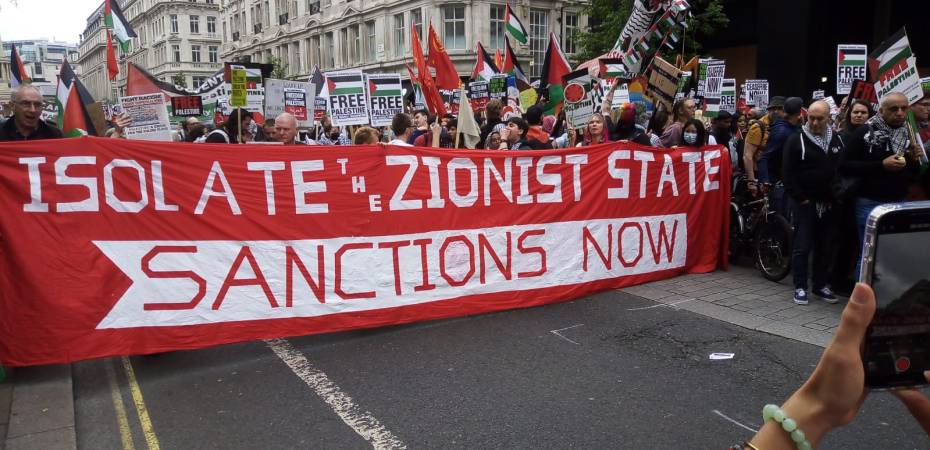
Image: c/o Labour Hub.

