
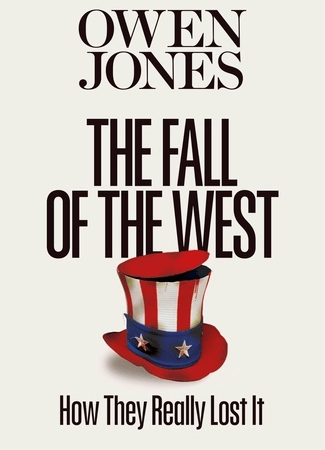
Mike Phipps reviews The Fall of the West: How They Really Lost It, by Owen Jones, published by Allen Lane.
“This book tells a story of Western greed, power and hubris,” Owen Jones says in the Preface to his new book. “It explores how the West has been sent into a tailspin by the elites who, some thirty-five years ago, once proclaimed its final triumph, and how their failure has today produced a global crisis.”
Jones wrote the book to expose “the greatest political con of our age”, namely: “A deliberately inequitable, extractive economic model that stripped millions of security and comfort at home while unleashing blood and chaos abroad, foisted on us as established, unalterable fact.”
Canadian Prime Minister Mark Carney partially exposed this fraud earlier this year in a speech to the World Economic Forum at Davos. He admitted the so-called international rules-based order operated “asymmetrically” and when it suited the West it fell back on old-fashioned US firepower. The problem was that that power was now going rogue, no longer serving the collective interests of the West, which therefore had to face up to the fact that it was living within a lie of its own making.
The hard right has a ready explanation for the West’s decline: mass migration and the erosion of national identity and traditional values by multiculturalism and other ‘wokery’. Such ideas were once marginal, but they are now mainstream, championed by Trump and Farage, among others. But Mark Carney’s moment of clarity is a lot nearer to identifying the real causes of the crisis facing the West, as it relies increasingly on military intervention to shore up its economic control of the world.
Jones sees the roots of the current mess in the market triumphalism that followed the fall of Soviet ‘communism’ in 1991. It’s as good a place to start as any, although the origins lie far deeper, as the author concedes, back in the unequal terms the West imposed on the world as the formal colonial empires gave way to economic neocolonialism.
Afghanistan and Iraq
The end of the Cold War balance of power brought about by the collapse of the Soviet bloc unleashed not just a spirit of Western triumphalism: it opened a short period when the US could intervene militarily across the world with few limitations. The 9/11 atrocities resulted in an unending ‘war on terror’ which would spectacularly backfire with the humiliating withdrawal of the US from Afghanistan under Joe Biden’s presidency. Jones’ narrative drills into how this country, quite unconnected to the 9/11 attacks, became the focus of American aggression, and details its bloody consequences, with interviews with some of its victims.
Jones travelled to Iraq too, visiting, among other assignments, the country’s national museum, which was comprehensively looted under the US-led occupation. But a more complete looting of Iraq took place in the decade following the invasion, when its economy was privatised wholesale to Western corporations, while the occupiers maintained their rule with shocking brutality and by imposing sectarian religious identities as the main organising principle of the new political order.
“It wasn’t just the Iraq and Afghanistan calamities that stripped away Western military and moral supremacy,” argues Jones. “When NATO intervened in Libya in 2011 and overthrew Colonel Gaddafi’s regime, Prime Minister David Cameron promised to learn ‘the lessons of Iraq’. And yet Libya, too, collapsed into civil war and chaos… The ‘lessons of Iraq’ were never learned, because Western elites ensured there was no reckoning.”
International public opinion made up its mind, however. By 2006, polling showed that large majorities of European and Muslim countries alike believed the Iraq War had made the world more dangerous – the biggest threat to world peace. Positive views of the US slumped among both Western allies and the Global South.
Support for Russian authoritarianism
It should be remembered too, when we look at current international tensions today, how the West helped cement Russia’s authoritarian state. Its economic ‘shock therapy’ – an abrupt programme of austerity, mass privatisation and the abolition of price controls – produced the sharpest peacetime economic contraction ever experienced by a major industrialised country. When the Russian parliament began to side with the inevitable popular opposition to these policies in 1993, it was shelled and set ablaze on President Yeltsin’s orders.
Up to 2,000 people may have been killed in the bloodiest political violence Moscow had seen since the October Revolution. Yet US President Clinton congratulated his Russian counterpart for handling the revolt “exactly as you had to.”
Jones is not the first to observe that when democracy comes into conflict with free market ideology, Western leaders repeatedly back the latter – just as they backed Yeltsin in subsequent elections that were far from free and fair, and his cynical war on the Autonomous Republic of Chechnya, which was reduced “to blood-stained rubble”. An estimated ten percent of the Chechen population were slaughtered, but the West supported Russia as long as it danced to the West’s economic tune. As Yeltsin’s successor, Putin, took a similarly authoritarian line, Western leaders queued up to express their support. Today, over four years into Putin’s unprovoked war on Ukraine, the West is once again reaping the fruits of its ideologically driven political choices.
Things fall apart
The Great Financial Crash of 2008 exposed the rotten foundations of the economic system. “The West was felled by its own design. The model no longer delivered rising living standards or security; it had enthroned finance while hollowing out the productive economy beneath it.”
Suddenly, “the frontiers of the state were advanced with breathtaking speed” – to bail out the banks, but not to help the ordinary people whose lives the system had made so precarious. They would be obliged to pay for the gaping hole in the public finances generated by such corporate welfare. Nor were any real lessons learned from the experience by the dominant political elites.
In Europe, countries in the periphery, like Greece, felt the pain particularly keenly, as the EU-IMF-Central Bank ‘troika’ demanded brutal austerity measures that would rescue European creditors. For a while, it looked as though the left wing Syriza party, elected to office precisely to oppose this, might defy the crippling programme of cuts imposed on the country, “so punitive, you might compare them with devastating terms imposed by a vengeful wartime victor on a defeated foe.”
Defiance was indeed suggested by Greece’s Finance Minister Yanis Varoufakis, interviewed by Jones here. It was backed by over 60% of the people in a referendum in 2015. But Prime Minister Tsipras, according to Varoufakis, had already decided to capitulate, and signed up to a third round of austerity on terms far worse than those just rejected by the Greek people.
There is no doubt that the EU’s humiliation of Greece, and the imposition of similar austerity programmes on other member states, made many leftists in the UK – Jones included – sceptical about the EU. But for all the hot air from radical socialists about the benefits of ‘Lexit’, the driving force behind Brexit in the 2016 referendum was a far right agenda focused on demonizing migrants and removing social protections. Yet too few on the left have shown any willingness to learn from their mistakes on this issue.
Elsewhere too, the far right is on the rise, drawing on “the deep well of disillusionment in the West, amid the falling living standards, battered public services, and ever-growing precarity that have characterised the decades since the 2008 financial crash.” Since challenging the scapegoating of migrants would mean questioning the economic model that caused such disillusionment, many centrist and social democratic parties have also succumbed to this toxic narrative. In many countries, Britain included, the immediate danger is less a far right government than centrist parties implementing the far right’s immigration agenda.
The West supports genocide
For all the far right talking points about values and identity, nothing expresses the moral decline of the West so clearly as Israel’s onslaught against the Palestinian people. Even President Trump admitted in February 2025: “a civilisation has been wiped out in Gaza.” “Trump, tellingly, said it in in the passive,” notes Jones. “But of course, the wiping out had been done by Israel – and nobody had stopped it. Worse still the West had enabled it , and continues to enable it.”
Jones’ chapter on this is powerful and scathing, as one would expect from someone who has written and broadcast about the subject more frequently over the past three years perhaps than any other UK journalist. Jones explores how the history of Israel’s oppression of the Palestinians has been supplanted in the Western media by a false narrative of supposed Palestinian Jew-hatred, making Palestinian militants the new Nazis – a dehumanization that has permitted a genocide that Western elites could comfortably endorse.
And not just Western elites, in my view. This contempt for the human rights of Palestinians helps create a climate where everybody’s human rights are devalued. The West’s indifference to the fate of the Palestinians emboldens other powers to commit war crimes, as seen in Putin’s unprovoked onslaught against Ukraine.
Attempts by Western citizens, repelled by their elites’ complicity, to uphold the very values that their governments profess to champion have been met with state violence. Protests in Britain may have escaped the pepper spray and gas used against peaceful marchers elsewhere in Europe, but the Labour government’s absurd designation of Palestine Action as a terrorist group means anyone expressing support for it – and there have been hundreds of arrests of people, mostly elderly, holding signs saying just that – could face up to fourteen years in jail.
Even the International Criminal Court is a target. When it issued arrest warrants against Israel’s genocidal leaders, the Trump administration responded with punitive sanctions against its judges and prosecutors – including freezing their personal bank accounts. It revealed Western willingness “to jettison the so-called ’rules-based’ international order to defend Israel from accountability.”
It’s not over
One might feel that bits of Jones’ pessimistic account are going out of date fairly quickly. The authoritarian Orban was voted out in Hungary. Lula has been re-elected in Brazil. Trump has just taken a hammering in the US mid-terms. Voters are negotiating a path through the thicket of dark money and fake news to find a way past right-populist narratives.
Yet Trump’s response to his party’s big legislative losses this month was to promote to Chief of Staff Stephen Miller, a man who once described the Democratic Party as a “domestic terrorist organisation.” Without listing all the appalling activity of the Trump administration over the last two years, it’s worth underlining that his imposition of tariffs on allies, cuts to overseas aid, threat to invade Greenland, humiliation of Ukraine’s President Zelinsky, denunciation of the EU – “formed in order to crush the United States”, according to Trump – and leaving the rest of the West to absorb the economic shock from the closure of the Strait of Hormuz: all this has left the West more divided and weakened than at any time since World War Two.
But it won’t be any anti-Trump sentiment among the still liberal remnants of the Western elites that save us. As long as they remain wedded to the economic system that has led us to this crisis, we will be stuck in a circular loop where economic insecurity and a lack of political choice produce an authoritarian and racialised backlash. The starting point, argues Jones, must be a rebuilding of civil society from the bottom up and an economics and politics that meets the needs of ordinary people. As this thoughtful work arrives in the bookshops, perhaps the millions taking to the streets across Europe are an expression of exactly that political impulse.
Mike Phipps’ book Don’t Stop Thinking About Tomorrow: The Labour Party after Jeremy Corbyn (OR Books, 2022) can be ordered here.

