
By Leslie Huckfield
The ‘photo op’ juxtaposition of Andy Burnham and Ursula von der Leyen as President of the European Commission has been portrayed in mainstream media as a victory for the UK and Europe. But behind these ‘photo ops’ there are worrying intentions of which the wider labour movement should be aware. If last week’s media coverage had scratched beneath the surface, it would have revealed a widespread and growing opinion that the EU should either turn itself into a fully-fledged federation or disband. Instead, following the Trump/Xi/Putin Shenzhen Trilateral Summit, the EU is in danger of making itself irrelevant.
At its heart, the EU has no stable public administration able to override 27 Member States to distribute fiscal revenues and carry out its ambitious “geopolitical role”, as detailed in its November 2024 “Achievements of the von der Leyen Commission: Stronger Europe in the World”. In reality this document recounts the EU’s Atlanticist subservience.
The EU portrays monetary sovereignty. But, despite its Single Market and Customs Union, it cannot raise fiscal revenues because it does not have any independent authority to tax or raise debt, especially to pay for defence. Its latest January 2025 NextGenerationEU €800bn funding programme includes a power to issue EU debt and to generate significant fiscal funds for defence, energy and other projects. But the legal basis for this funding is Article 122(2) of the 2009 Treaty on the Functioning of the European Union which allows the EU to extend emergency financial assistance when threatened by natural disasters and “exceptional occurrences beyond its control”. In other words, the EU can raise these funds only on a temporary basis in a crisis, to be repaid from Member States’ contributions. So the Commission is using Member States’ own money to raise funds. No wonder that von der Leyen and her Commission lack financial friends.
Under von der Leyen’s EU ‘leadership’, a major war started on the European continent, Europe’s critical energy Nordstream 2 pipeline was blown up by a ‘mystery power’ she refused to investigate and Europe has only expressed “growing concern” against an ongoing genocide in Gaza. Europe’s economy grew much more slowly than the US or China and its voice on the international stage has diminished in relevance through its virtue signals on “European values”. Despite all this, although she sought her 2024 re-election on a platform of “strength and leadership”, much of this is a facade.
Already in the Pipeline from Boris Johnson
Much of what was achieved at last week’s Brussels Summit was due for negotiation under Boris Johnson’s Trade and Cooperation Agreement (TCA) of December 2020.
On Christmas Eve 2020, Article 776 of his UK/EU treaty specified that “The Parties shall jointly review the implementation of this Agreement and supplementing agreements and any matters related thereto five years after the entry into force of this Agreement and every five years thereafter.” As long ago as June 2024, the highly influential German think tank Bertellsman Stiftung in “Eyes on the Prize: Shifts in EU interests require a reassessment of relations with the United Kingdom” advocated going beyond the TCA. Bertellsman included “A further issue to be addressed is the deep-seated asymmetry in goods trade, which is deeply problematic to the UK’s economy.” So Burnham’s ‘deal’ was already projected under Johnson’s Agreement.
Von Der Leyen Needs Political Friends
Beyond her Commission and in the European Parliament, propping up von der Leyen is a traditional ‘grand coalition’ of Christian and Social Democrats across Europe. Since this is disintegrating, for critical votes she needs support from beyond the liberals’ “Renew” Group and right wing Greens (there are two blocks of Greens in the European Parliament).
None of this is a ‘good thing’. Von der Leyen gained Green votes through making promises on a Green New Deal, which she will find difficult to deliver through tough opposition from farmers.
The result of the June 2024 European Parliament Elections confirmed that the combined Christian Democrat (EPP) and Social Democrat (S&D) membership of 324 no longer forms a majority out of its 720 members. They are now challenged by the new Patriots for Europe Group, which was led by the Hungarian Fidesz and France’s National Rally, with 84 members as the third largest group. Alternative fur Deutschland (AfD) now leads a new Europe of Sovereign Nations Group with 25 MEPs, mostly from East Germany. So Patriots and ‘Sovereigntist’ nations, many from Central and Eastern Europe, now have 109 or 15% of EP members. Though UK presence in the EU is initially through its leadership of the defence ‘Coalition of the Willing’, beyond this von der Leyen will be seeking extended political support from Burnham’s Labour.
Funding EU Defence and Security
The EU further welcomes increased UK collaboration since behind its rapidly changing and unstable background, any EU defence spending faces a major problem. Since the 1992 Maastricht Treaty, as updated by the Treaty of Lisbon in 2007, Article 41.2 stresses that the EU Budget cannot be used for defence and security. To circumvent this restriction, various EU ‘work-arounds’ have included ‘off- budget’ instruments, controlled by Member States’ officials in the European Council, paid by Member States’ contributions, and managed by the European Economic Assistance Service staff. Little of this is directly accountable to the European Parliament and is camouflaged within NATO as support for Ukraine against Russia and Vladimir Putin.
With failing economies in France, Germany and Italy, the EU cannot afford to fund NATO defence and security, support for Ukraine, its delayed implementation of Mario Draghi’s Report on European Competitiveness and the Cohesion Fund for less prosperous regions.
There is no overarching European Constitution for any of this, since throughout Europe there is no single view of the European Union, with 27 Member States each having different aspirations. All this offers a slender theoretical or practical basis for the operation of EU institutions, especially for the Council of Ministers and Commission, when these seek to intervene within Member States.
The Treaty of Lisbon in 2007, reframed in 2009 as the Treaty on the Functioning of the European Union (TFEU), represented the high point of Member States’ agreement, since anything even sounding like a European Constitution would have been subject to referenda in France, the Netherlands and Ireland, which had already held referenda to get this far. The UK could also have faced a referendum.
Because of these limitations of the 2007 Treaty, the EU has invented other bodies, including the European External Action Service, the European Defence Agency, European Union Institute for Security Studies and European Political Community. Effectively these external agencies enable EU policy to emerge and progress without democratic oversight or control. When policy emerges into any kind of ‘democratic daylight,’ a ‘grand coalition’ of EU Christian and Social Democrats, encouraged by EU Commission Presidents like Ursula von der Leyen, has previously enabled its more formal adoption as EU policy. No reader should need any guesses whose side Burnham’s Labour might take.
There are numerous precedents for these Treaty ‘work-arounds.’ The European Defence Fund was created in 2016 with its narrative written by a so-called ‘Group of Personalities’, recruited from defence industries and defence think tanks. In similar vein, the European Peace Facility (EPF) was established in March 2021 to finance military operations under EU’s Common Foreign and Security Policy, by reimbursing Member States’ expenses. It had a financial ceiling for 2021-2027 of €5,692 billion. Though now primarily used for supporting Ukraine, the EPF had originally been created as an instrument to maximise EU clout in other regions, especially the Middle East and Africa.
EU funds are allocated to ramp up ammunition production and provide aid to Ukraine through the European Peace Facility. Additionally, the Commission’s 2024 Defence Industrial Strategy (EDIS) aims to boost capacity and intra-European collaboration. Though the European Union and NATO share the goal of increasing readiness, through enhanced coordination between them essential to avoid duplication, events within the European Political Community in Dublin last week at best provided only meagre political cover for all this.
The EU and its Member States will soon have allocated nearly €250 billion to Ukraine in combined military, financial and humanitarian aid, which far exceeds all direct US contributions. In practice European countries are using taxpayers’ money to purchase American weapons systems by writing cheques for Zelensky and Ukraine.
The EPF and other ‘off-budget’ initiatives are mostly driven by NGOs, think tanks and academics, often without the knowledge of their own higher education institutions. These new policymakers now form an ‘EU deep state’ and constantly discuss, promote and disseminate opinions as progress or a ‘good thing’. These operate through bodies like Chatham House, UK in a Changing Europe, the IE Global Policy Centre, the Istituto Affari Internazionali, European Council on Foreign Relations and Bertelsmann Stiftung. Though self-promoted think tank and higher education ‘expertise’ feeds into EU structures to inform EU politics, in reality, its function is to consolidate the constitutionalisation of neoliberalism on which the EU and its institutions are based.
No matching democracy
This ongoing lack of democratic underpinning for EU institutions is important for any understanding of European politics and exposes the precarity of von der Leyen’s Commission. The European Parliament (EP) functions as a consultative assembly rather than as the initiator of any EU legislation – which originates in the Commission. The EP does not propose and is only consulted on legislation. In December 2024, the entire Commission was agreed using a political device where the Presidents of the Council, Commission and Parliament were supported by Christian and Social Democrats and the liberal “Renew” EP Group, which includes Macron’s “En Marche” party. So a brand new EU Commission was installed in its entirety for five years without appropriate scrutiny.
Various EU Treaties effectively constitutionalise an EU version of the ‘Washington Consensus’ of 1981, where the limited role of the state and expanding private sectors are not disputed. In few other nations have the rules of the market been given constitutional status without any matching powers for electoral accountability. It is this interpretation which is increasingly challenged by newer EU Members from Central and Eastern Europe. The Parliament’s political groups function as a conduit for the distribution of various research and administration funds, as a reflection of practice of practice in many national legislatures. To be recognised as an EP Parliamentary Group to receive these funds needs 23 MEPs from seven different Member States. Within these Groups, since it is difficult to persuade all their group members to align their votes, they often cannot bring all their members onside.
The dominance of expertise and technocracy in the EU’s external ad hoc creations has become the language of EU politics. Not only are openings presented for academics and others to position themselves as privileged experts in their own right without democratic oversight and accountability, but all this has prevented a more general debate about European integration and the workings of the EU and NATO.
Von der Leyen’s Support Needs
All this shows that, especially in foreign policy and defence, von der Leyen needs Burnham’s support. Following Trump’s gradual exit from European affairs, the EU can’t even decide who should speak on its behalf. The general opinion is that that Estonian Kaja Kallas as the EU’s “High Representative” is inadequate for her task, so that after the Shenzhen Trilateral Summit with Trump, China and Russia, the EU has appointed no less than seven Member State representatives. To shape the future security architecture of the Europe and the fate of Ukraine, the EU has been completely incapable of nominating a single, authoritative envoy. Instead, European leaders have opted for a hybrid from France, Germany, Italy, Poland and the United Kingdom, together with representatives of EU institutions (probably Björn Seibert for the Commission and Anna-Maria Boura for the Council) and NATO.
So though Burnham told the Commons on Monday he doesn’t want to “keep banging on about Europe” unless the wider labour movement sponsors genuine debate, the EU Commission and other intuitions will just continue their slide into irrelevance.
Leslie Huckfield was MP for Nuneaton from 1967 to 1983, a minister from 1976 to 1979, a Member of the European Parliament from 1984 to 1989 and is now active in the EP Former Members’ Association.
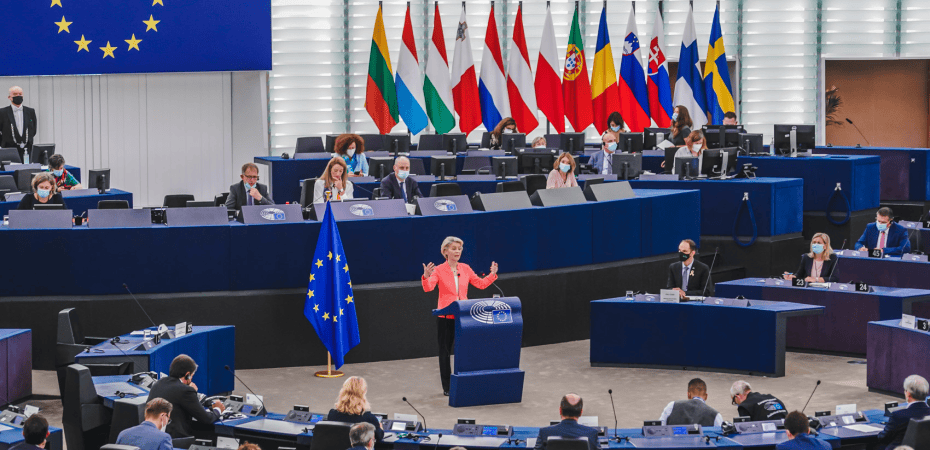
Image: https://commons.wikimedia.org/wiki/File:State_of_the_EU-_MEPs_debate_about_the_EU%E2%80%99s_most_immediate_challenges_-_51580909794.jpg Source: https://www.flickr.com/photos/36612355@N08/51580909794/. Author: European Parliament, licensed under the Creative Commons Attribution 2.0 Generic license.


