
Susan Press looks back on thirty years of political activity in West Yorkshire.
For the last thirty years, the border lands of the Calder Valley have been my home. Hovering halfway between Manchester and Leeds, this place I am about to leave has delivered an interesting few decades of political activity amid its hills, mills and Northern grit.
I moved from Salford to Hebden Bridge in search of a different kind of life on December 20th 1996 as a young freelance combining commuting to Manchester with working from home. Six months later, a fellow journalist, Pete Davies, headed here to write This England, a book about the 1997 General Election. He chose Calder Valley as a key marginal and microcosm of a country where a Labour landslide looked inevitable. He wanted to know why and what the issues were for residents and activists tramping up and down the Pennine hills for their candidate Christine McCafferty.
Years later I would read the book and recognise names and faces. Back in ’97 I didn’t know any of the Party workers and campaigners who feature in the book. What I do remember after a long night stalking the corridors of Manchester Town Hall bagging results for ITN was the optimism of that sunny morning after Blair won his landslide.
Complete strangers grinned inanely at one another as they did their shopping in the quirky streets of Hebden Bridge. We were euphoric. It didn’t last long.
Just a couple of years later this bellwether constituency had a Tory council and progressives in the Upper Valley had voted in umpteen Lib Dem councillors amid disillusionment with New Labour. It was so bad we gave up totally on door knocking due to the abuse.
A small band of us kept the faith at Branch and CLP level and bizarrely, a few of us were actually elected as town councillors in 2003, just a few months after millions had marched to try and stop the war.
Whatever the policy was down in Westminster, Labour began to be respected again because the neighbouring MP for Halifax, the late Alice Mahon, was not only one of the fiercest opponents of war in Iraq but one of the stalwarts of the Socialist Campaign Group. Her friend and colleague, our MP Chris McCafferty, nowhere near as radical, was distanced enough from the Blairites to get re-elected in 2005. This wasn’t at all expected – she told us she had already written her resignation speech, but hung on with a tiny majority.
As the years played out, Calder Valley would carry on bucking the trend, Party activists often being a thorn in the side of Labour’s establishment.
By 2005 our anti-war stance and affiliation to Labour Against The War had already earned us some ‘interest’ from the regional Party, When Blair rocked up for election rallies in more moderate parts of West Yorkshire, quite a few of us were not on the invite list. When Blair announced his imminent departure on September 7th 2006, our growing ‘awkward squad’ went into overdrive.
With the help of leading campaigners like a very young Owen Jones, we enthusiastically supported John McDonnell’s ‘John4Leader’ campaign, holding meetings in Halifax and Hebden Bridge, which attracted bigger audiences than we had seen for years. We also lobbied our MP in vain to lend her nomination to enable a contest with Gordon Brown. His succession was inevitable but the repercussions of this lack of debate would anger thousands of Labour activists and help Jeremy Corbyn win the leadership eight years later.
For several years our constituency was closely associated with the Labour Representation Committee, a socialist pressure group within the Labour Party. I was elected Vice-Chair, travelling down to London regularly and thoroughly enjoying my brief time at the then epicentre of the Labour left. We also selected a left candidate for Parliament . In a foretaste of things to come, she was deselected and eventually replaced by Tony Blair’s mother-in-law.
The subsequent General Election saw a Tory, Craig Whitaker, win Calder Valley. The Cameron/Clegg double act hit everyone hard because a minority Labour government had been the expectation, if not the hope. Coalition government, ironically, led to a revival of Labour’s fortunes locally and nationally. With Ed Miliband as leader, we started to win council seats again – including my own in Todmorden – and dared to hope the next General Election would be different. On Thursday May 7th 2015 that optimism was again shattered – and the aftermath sensational.
Like hundreds of other CLPs we had had enough of compromise and backed Jeremy Corbyn for leader. In 2017, on the day Corbyn visited Hebden Bridge, hundreds jammed the streets and the Town Hall was standing room only. We weren’t even a target seat but almost won in Calder Valley, losing by only 609 votes. Post-Brexit, all that hope had evaporated and though Corbyn was still loved by the left, the majority of Calder Valley voters thought differently. In 2019 the Tory MP increased his majority tenfold.
Things were bleak and Party morale low. So like many others (mea culpa) I backed Keir Starmer for leader on the basis of sheer pragmatism and a mistaken belief he would be somewhere on the spectrum where Ed Miliband had been. We all know now how that one ends.
Our long awaited Labour victory in Calder Valley in 2024 has turned out to be a pyrrhic one – not because our MP has particularly let us down. He works hard and is on the right side on most issues. However, this year the public anger at abandonment of Labour principles lost us votes across the board on everything from winter fuel allowance to welfare cuts, child benefit and the horrific situation in Gaza and the Middle East.
Two years on from 2024, we may still have a Labour MP but the consequences of Morgan McSweeney’s stranglehold on Labour have been catastrophic in this corner of West Yorkshire.
May 2026 was an all -out election and in Calderdale this delivered Reform 34 council seats to Labour’s eight, a loss of 25 seats, with Greens taking all three council seats in Todmorden, where I served as a councillor for eight years from 2014.
In Kirklees, Labour was wiped out completely. In Wigan, Reform gained 24 out of 25 seats up for grabs. What, as Lenin almost said, was to be done?
A couple of weeks after election Armageddon, I was getting the train from Todmorden to Makerfield and pounding the streets for the then Mayor of Greater Manchester in his quest to replace Starmer as PM . On by-election day in June and throughout that inspiring campaign, there were thousands doing the same every day .
Whatever disappointments are to come from the Burnham government, June 18th 2026 was a very good day. As the sun rose at Stubshaw Cross Club HQ and our future PM sank a much deserved pint with his family, hope was off-the-scale high among ecstatic Party staff and activists. .
Just over 100 days into the Burnham premiership, the reality is rather less joyous. It will take years to regain all those 1,500 seats lost in May. In Calder Valley, Reform has a massive majority and fight as it may Labour has no power to change much in the immediate future. So the estate agent’s board is up and it seems as good a time as any to begin a new chapter. I can only wish the very best of luck to all my comrades in Calder Valley who I know will eventually turn the tide back in Labour’s favour as they have done so many times before. And I am more than a little sad I won’t be with them.
Susan Press is a former Labour councillor and member of Calder Valley CLP.
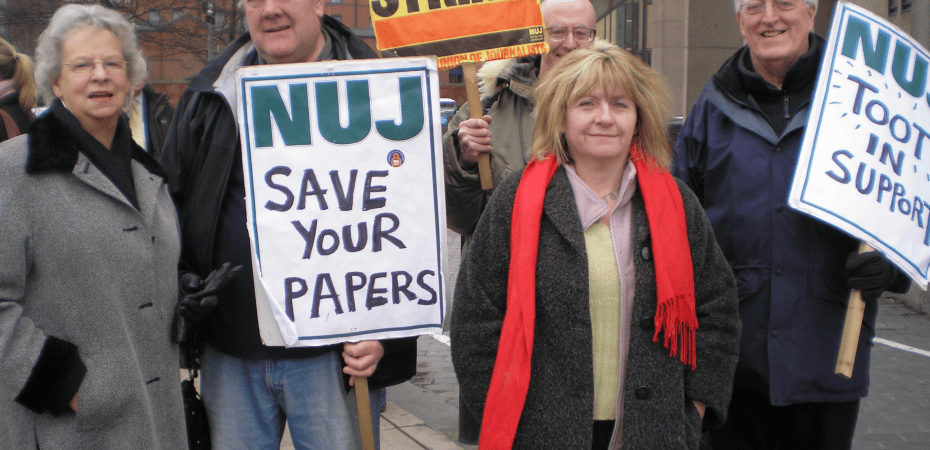
Image: The author and Alice Mahon on the picket line in 2009 at the Yorkshire Evening Post. Photo c/o author.

