
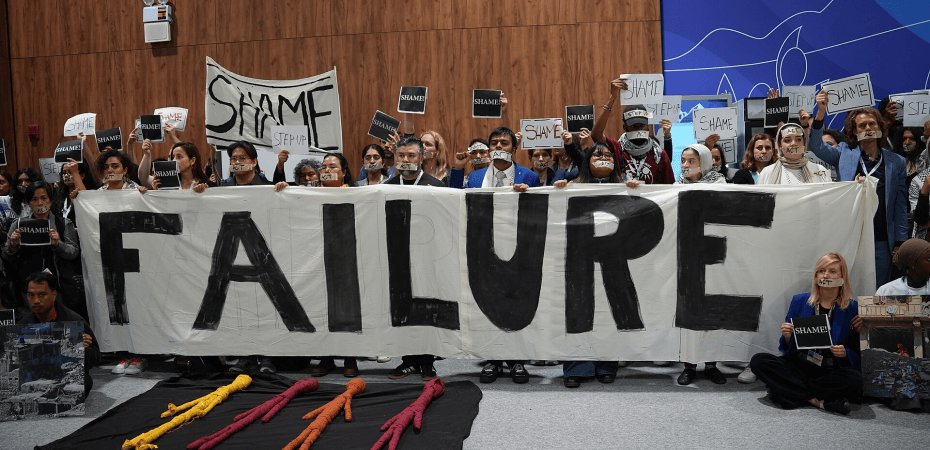
Observers anticipated the failure of COP31, knowing that divisions between the Global South and wealthy industrialised nations had hardened over previous conferences, reports Martin Franklin.
Delegates from countries already experiencing the most severe impacts of climate heating demanded a commitment to the phasing out of fossil fuels, meaningful climate justice and adaptation finance. In contrast, Global North governments and petrostates defended existing economic privileges, promoting unproven technological fixes that would allow continued fossil-fuel production and consumption. Petrostates blocked references to a fossil-fuel phase-out from drafts of the final ‘cover decision’, while climate finance for poorer countries remained a central sticking point. After two days of deadlock, negotiations collapsed without agreement.
Overshoot and Global Instability
COP31 was the ‘overshoot COP’. Average global temperatures now exceed 1.4°C above pre-industrial levels and the Paris Agreement’s goal of limiting warming to 1.5°C is increasingly unattainable. Devastating flooding in Nepal, linked to glacial collapse, is only one illustration of the escalating consequences of climate heating. Countries in the Global North are likewise experiencing increasing extreme weather events causing substantial economic losses, social disruption and loss of life.
Worldwide, climate heating is disrupting agricultural production, threatening food security and contributing to rising food prices and growing economic pressures. Lack of rapid and coordinated international action will lead to deepened social, economic and humanitarian crises across many regions of the world.
The US-Israeli war with Iran and Russia’s continuing invasion of Ukraine is intensifying geopolitical instability creating oil price volatility and wider economic uncertainty, exposing the vulnerabilities associated with continued dependence on fossil fuels.
Public frustration is growing in many countries as living costs rise and governments appear unable or unwilling to address worsening social and economic conditions. Against a backdrop of increasing concentrations of wealth and power, street protests against inequality and political exclusion, like those in France, have grown.
The main issues and disputes contributing to COP31 breakdown
The COP process depends on a framework of international cooperation, on the international legal and political order established after the Second World War that is breaking down. It faces challenges from authoritarian and revisionist states that disregard international law and seek to weaken multilateral institutions. This is a difficult political environment for securing the international cooperation needed to address climate change.
Fossil fuels phase out: Though included in COP28, petrostates excluded mention of a transition away from fossil fuels from subsequent COP agreements. A clear commitment to moving away from fossil fuels has become a red line for many countries.
Rather than cutting CO2 from fossil fuels, Mideast Gulf countries sought to promote the expansion of Carbon Capture Utilisation and Storage (CCUS) arguing that climate actions should focus on cutting emissions and not fossil fuels. CCUS is expensive and not yet commercially viable at scale. Many scientists, policymakers and organisations have warned that the technology must not be used to prolong fossil fuel production.
Climate finance: Global South delegates were outraged by EU climate commissioner Wopke Hoekstra’s dismissal of new financial commitments to countries struggling with climate heating impacts as “dead in the water.” Tasneem Essop, director of Climate Action Network responded angrily – “For us in the Global South, dead in the water is very literal.”
Climate finance is a central issue in international climate negotiations. The concept of climate debt holds that wealthier countries bear greater responsibility for addressing climate change because of their historical and continuing disproportionate contribution to greenhouse gas emissions. This underpins demands for financial transfers to developing countries to assist adaptation to climate impacts and to support transitions to sustainable development.
Developing countries have called for stronger commitments to adaptation finance, including a target of $120 billion annually by 2035, and emphasise the importance of predictable, direct public funding from wealthier nations. Developed countries push for an emphasis on mobilising private investment rather than public finance. Significant disagreements persist over the scale and sources of climate finance, as well as over issues such as loss and damage funding and proposals based on the principle that major polluters should bear a greater share of the costs. Existing pledges remain at best partially fulfilled.
Electrification: The ambition to raise electricity’s share of global energy consumption to 35% by 2035 did not include sustainable carbon-free generation, reflecting concerted efforts to block a reference to a transition away from fossil fuels.
Climate science: IPCC Seventh Assessment (AR7) Delay Dispute: The Intergovernmental Panel on Climate Change (IPCC) tracks progress on reducing greenhouse gas emissions, forming the basis for target setting. The next IPCC report was scheduled for 2028 in time for COP33 but a group of governments, notably Saudi Arabia, Russia and India, objected to the report, arguing that climate science is dominated by developed countries which they say has skewed its findings. Delay is seen to threaten global cooperation on tackling the climate crisis.
Global political elites marginalise climate and COP
Major global players were absent at COP31. The most notable absence was the USA, but the Trump government’s promotion of fossil fuels and denigration of climate action emboldened those resisting progress this year. Ambitions were lowered, for example the EU’s narrow focus on an electrification target. And while the EU and other rich countries expressed outrage over the lack of reference to fossil fuel phase out in the ‘cover decision’ statement, in the negotiations they blocked vital moves on climate justice finance and other progressive measures.
Andy Burnham was the only Group of Seven (G7) leader to address the leaders’ summit. Burnham said the climate consensus has “gone” and pledged “new era of leadership.” Critics argue his government has not shown a promising start to such leadership.
Despite the significant no-shows, COP31 was the largest (and longest) in history; 196 countries plus the EU, attended along with more than 92,000 registered to attendees. There was a significant presence of fossil fuel lobbyists, with a record 700 carbon capture lobbyists.
Adieu to COP and the Paris Agreement?
The failure of COP31 halts progress on the goals of the Paris Agreement. Formal negotiations are now postponed until COP32 in Ethiopia in 2027. In the interim, discussions will continue at the Bonn Climate Change Conference in Germany in June 2027.
Some see COP failure as having limited significance since a global energy transition is continuing to advance. Geopolitical instability, including the war on Iran, is reinforcing a shift towards low-carbon energy technologies. Renewable energy deployment is accelerating and costs are declining whilst the volatility and price shocks in fossil fuel markets strengthen incentives to reduce dependence on them. This is a complacent position since the pace of market-led transition is inadequate in the face of climate breakdown. In response to this trend, fossil fuel capital is seeking to expand into plastics and petrochemicals. In the meantime COP enables fossil fuel interests to slow progress toward sustainability.
Is failure baked into the Paris Agreement? Commentators like George Monbiot argue that COPs are designed to fail. The requirement for consensus allows states aligned with fossil fuel interests to routinely block or dilute meaningful climate action.
COP is one of the few global forums in which nation states, civil society organisations, Indigenous Peoples, United Nations agencies, international organisations, climate scientists, heads of state, and other actors can meet, exchange perspectives, listen to one another, and engage in debate. It provides a platform for protest and advocacy, giving a voice to those with the least political power and encouraging broader civil society mobilisation.
A parallel initiative, the Belém-Antalya Mechanism (BAM), emerged at COP30 in response to frustrations among Indigenous groups, poorer nations and climate justice campaigners. The initiative sought to operationalise a Just Transition Mechanism. However, these ambitions were ultimately frustrated when the proposal was blocked in negotiations.
The failure of COP31 reflects the broader limitations of the current climate governance framework and has stimulated renewed discussion about institutional reform and alternative mechanisms for advancing climate action. Options for reform of COP are beyond the scope of this piece.
“No one is coming to our rescue”
At the start of COP31, Greta Thunberg spoke with her usual passion about human rights and lack of action on climate breakdown. She said the planet “is being killed… It is being killed by the very same people thought to come to our rescue, No one is coming to our rescue.”
Though climate breakdown is intensifying and being directly experienced by millions, the climate crisis is way down the political agenda nationally and globally. As Brazilian President Lula da Silva told fellow world leaders: “Since the start of this year, climate change has disappeared from speeches and documents from our global leadership.”
With a few exceptions, mainstream news coverage of COP31 was buried under celebrity stories. In contrast, the summit’s failure to reach consensus received extensive coverage, providing little opportunity to develop public understanding of climate governance and international climate diplomacy. Thus climate-sceptical narratives gain greater traction. Reform UK’s deputy leader, Richard Tice, dismissed concerns about net zero policies and encouraged people to enjoy the warm weather, despite estimates that England’s 2026 summer heatwaves contributed to approximately 5,200 deaths.
Politicians are failing to fulfil a core democratic responsibility: to protect citizens from harm and to advance the wellbeing of the societies that elect them. Instead, they embrace a growth strategy centred on an AI-driven industrial revolution, aligning themselves with tech oligarchs in pursuit of economic and geopolitical advantage. Trump’s assertion that “Whoever wins superintelligence wins” is a political agenda that prioritises technological supremacy and economic competition over social and environmental safeguards, a convergence of interests between Big Tech and Big Oil. AI and data centres are driving a growth in electricity demand, that renewable energy deployment and grid infrastructure cannot keep up with, creating a reliance on fossil-fuel generation. The expansion of AI reinforces dependence on the energy sources driving the climate crisis.
The UN, institutions like the International Court of Justice and other bodies set up to maintain a rules-based international order are being attacked and undermined. Though limited and ineffectual, they represent the principles of democracy and social justice.
COPs are stages on which the defining political and moral conflicts of our era are played out. Climate justice encompasses questions of social equity, economic development and human rights, and ultimately concerns the kind of world future generations will inherit. Yet the procedural theatre and political manoeuvring that dominate climate conferences obscure the existential significance of the issues under negotiation.
Martin Franklin is a member of the Islington Environment Forum Steering Group.
Image: COP31 – Protests. https://commons.wikimedia.org/wiki/File:COP31_-_Protests_11.jpg Autor: Xuthoria, licensed under the Creative Commons Attribution-Share Alike 4.0 International license.


