In the face of a major Western offensive to normalise Morocco’s occupation, activists need to learn from the Palestine solidarity movement and build big, argues Sally Hobbs.
It’s now 51 years since Polisario, the popular leadership for independence, were driven from the Spanish colony of Western Sahara into the desert by invading Moroccan forces.
Some 175,000 people continue to live in refugee camps in Algeria in 56 degree heat this summer, with floods and fierce winds seasonally. In the occupied land they were forced from, the predictable coloniser’s playbook includes gross human rights violations of Saharawi citizens, job, housing and wealth discrimination, theft of farm and fisheries produce and mineral resources, alongside environmental devastation.
The US, EU and UK acquiescence to the Moroccan proposal for an ‘autonomous’ state owned by Morocco and the UN failure to continue the commitment to a Saharawi people’s democratic process, are now an important imperialist project, driven by the impending opportunities of the coming World Cup, and the dynamics of global geopolitical interests.
Moroccan normalisation of their colonisation runs apace: Ryanair have been running virtually empty flights to the previously deserted fishing port city of Dakhla, promoted as a tourist destination – funded presumably by Morocco, given that Ryanair are not known for keeping unprofitable flight paths open. Coupled with the filming of Christopher Nolan’s epic, Odyssey, in Dakhla with preferential film-friendly sweeteners, the lack of visibility of the occupation is a major issue for the independence movement. In this area, the Irish parliament have been leading the opposition, launching an inquiry into Ryanair’s complicity, with the recent formation of a parliamentary group.
The potential for challenging this normalisation through air time from high profile people has gathered momentum too. In advance of the likely awards season’s focus on Christopher Nolan’s film, a petition and open letter organised by the US Western Sahara support group has been launched. Action to raise awareness among the film community is also being prioritised, particularly to galvanise the support of those who have spoken out in support of Palestine.
Greta Thunberg has gone on record at a viewing of the film Our Home of Wind and Sand, at the Zurich Film Festival meanwhile, to highlight her support for Western Saharan rights and the threats they face from climate change. She has pledged support to next year’s actions in the camps.
At the UN, a Saharawi activist has also been given a platform to speak out on the impact of climate change.
In my area of Greater Manchester and others, solidarity with Western Sahara has been built through practical links like supporting visits for refugee children’s groups in local groups, raising demands through local MPs, visiting the camps, particularly the Sahara Marathon, and arts programmes and publicising their plight. In my experience, three generations of young people have grown up with a close understanding and friendships with Saharawis.
Locally, the Grow Hope Saharawi project, founded by Fatimalu, who stayed here as a child, now with children of her own, astonishingly produces huge amounts of fresh fruit and vegetables in the camps. It’s an oasis attracting birds and pollinators never before seen in that area of desert, and provides a vital health resource for refugees who otherwise eat tinned foods and rice delivered through UN sources.
At the recent, annual fundraising Big Ramble, Fatimalu updated us over the phone on the year’s work, alongside plans to develop greater solidarity work. Four young men from the occupied Western Sahara talked about the experience of life in their country: how impossible it is for a Saharawi to get work, facing constant police harassment, racism and arrest. A common practice is to claim hashish is found on young Saharawis – an offence with a ten year jail term. Many rearrested are imprisoned on life terms.
One young speaker had broken kneecaps and poor eyesight as a result of torture. His family, he said, were known as former politically active people so he was targeted and had tried to remain behind closed doors. One person asked why Asda is selling fruit clearly marked as from Dakhla, his country, yet no Saharawi profits.
In a recent letter to the Financial Times, the former coordinator of the Western Sahara Campaign UK asks whether UK complicity in the war crimes of Morrocco and illegal occupation will end with criminalising those who supported it. A similar question arises: if the UK government sees the sale of West Bank goods and land by Israelis as illegal, why not those of Morrocco in an occupied land? Their plea was that the solidarity movement ramps up to the scale of the problem it faces and that the Saharawi issue becomes as well-known as that of Gaza.
Another critical question now facing Saharawis is the potential for all resistance to be defined – as with Hamas or Hezbollah – as terrorism. If the Western Sahara is no longer deemed an occupied state but one legitimately owned by Morrocco, will national resistance be further criminalised? What is the future for the residents of the camps? Fatimalu has contacted us to say that all men have been called up for military training – her project’s two male gardeners have been exempted – but Polisario as a fighting force would be no match for Moroccan armies. Ther defence of the camps is a real issue. Morrocco has learnt from and continues to have a close relationship with Israel.
The scale of the problem is huge. But what has been learned from international solidarity with Palestine can provide knowledge and potential joint work for anti-imperialists, socialists and internationalists. The urgency is real. It is absolutely critical to ensure that political, government and international pressure is mobilised, in addition to using every opportunity to build public awareness.
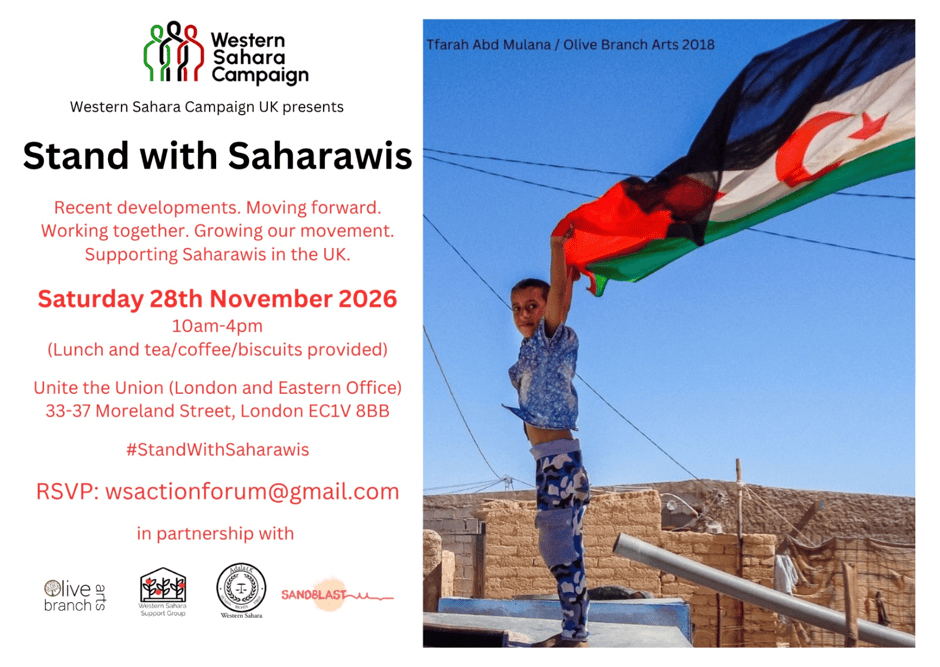
The links to Palestine are already clear to Saharawis and Palestinians. This weekend, the Western Sahara Campaign are holding a conference Stand with Saharawis in London, at Unite the Union, 33-37 Moreland Street – Saturday 10-4 pm. Contact Becca for details. wsactionforum@gmail.com.
An unprecedented series of significant international solidarity conferences and events in 2027 could form the basis of a significant transformation in the focus and approach of the solidarity movement. Events include:
- An Alternative COP is being held February in the camps. The invitation to activists states that climate justice cannot be built without the peoples living on the front lines of the crisis, or without recognising their rights: “From the Sahrawi refugee camps, we invite climate activists, human rights defenders, researchers, legal practitioners and grassroots movements from around the world to come together. Five days to share organising experiences, challenge greenwashing and build international alliances connecting climate justice with human rights and the Sahrawi people’s right to self-determination. This will coincide with the annual Sahara Marathon in the camps so will be a focus for campaigning and building on existing active support.” Get in touch: Copwesternsahara@gmail.com.
- The Saharawi Solidarity Summit 2027: the largest and already well mobilised conference 9th to 11th April in the camps. Details here.
- A larger international conference is expected to be held in Madrid in May.
- In October, a Rainbow Convoy is setting off for the camps, largely organised by young people, including the grandson of the organiser of the first Convoy in 1975 – a BBC film crew accompanied this and the film was shown at the Big Ramble in September. The aim of the 2027 convoy will be public awareness-raising, with filmmakers and social media support and delivery of much needed practical support such as medicines, equipment and technical help.
In the UK, letters to MPs and a petition presented to Downing St last week are a small but important step in raising tangible demands for the UK government to cease complicity. The campaign and widespread awareness of genocide and ethnic cleansing in Palestine has created an environment in which no parliamentarian can pretend to be unaware. The same is needed for the Saharawi people, and the demands for Saharawi statehood, democracy and rights must be built into the action.
Sally Hobbs is a Palestine supporter and activist in Manchester.