
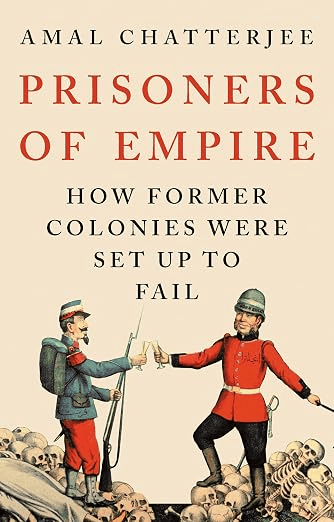
Mike Phipps reviews Prisoners of Empire: How Former Colonies Were Set Up to Fail, by Amal Chatterjee, published by Hurst.
Why do so many former colonies ‘fail’? This new book by Amal Chatterjee reminds us that narratives about local corruption, political immaturity and ethnic strife conceal the full story.
Direct colonial control of many countries in the Global South may have gone, but the neocolonial arrangements of concentrated land ownership and the extraction of raw materials continue, skewing local economies away from satisfying domestic markets. For all the minerals and agricultural constituents they export, these economies rarely produce finished products, so the huge profits made on them are banked elsewhere.
Why pay tax?
So far, so standard. But beyond the glaring inequalities, Chatterjee drills down into less obvious methods by which the richer countries fleece the poorer ones. I was surprised to learn, for example, that more than half of global corporate tax evasion is enabled by just four countries: the UK, including its Overseas Territories and Crown Dependencies, the Netherlands, Luxembourg and Switzerland.
“Between 2009 and 2013, for instance,” the author tells us, “the Congolese subsidiary of Swiss-based mining multinational Glencore, Kamoto Copper Company (KCC), ran a paper loss of hundreds of millions of dollars per year, while its Canadian-registered subsidiary, Katanga Mining Limited, made over $400 million. The adjustment of the profit, moving it abroad, meant that Congo missed out on approximately $150 million in tax revenues.”
In one year alone, thanks to such arrangements, Kenya is estimated to have lost over $1.1 billion in tax. Global Justice estimate that in 2023 alone, Africa lost $89 billion in tax revenue. As a result, Africa’s overall tax take of 16% is less than half of the 33% average in OECD countries.
Debt and contracts
Add to this indebtedness, often imposed at the onset of colonial ‘independence’. All the Caribbean nations, for instance, invariably built with slavery and indentured labour, were ascribed debt instead of being paid reparations for centuries of unpaid labour and abuse – unlike the slaveholders who were handsomely compensated. France goes even further by controlling the currency of many of its former colonies – the franc, long since scrapped in France itself – facilitating the free movement of capital and ensuring French Treasury control of all accounts and terms.
A further strand of post-colonial financial control is aid, both economic, or developmental, and humanitarian. Currently about a fifth of all aid is tied to contracts to buy the donor country’s goods and services. “It’s an unbalanced, unequal relationship and too often results in the recipient sinking deeper into debt or dependency,” notes the author.
Institutional hangovers
The public sector ethos of neo-colonial states is also a hangover from the days of colonial administration, designed to uphold authoritarian regimes and prizing loyalty to the government of the day above democratic accountability. Similarly, the hostile attitude of colonial rulers to educating the subjugated – “unnecessary, expensive and dangerous” – persists today in many supposedly independent countries. In Senegal, for example, though the overall literacy rate is now approximately 50–60%, up from practically nothing at independence in the 1960s, it is still desperately low – and heavily skewed towards urban children, with barely a third of children in rural areas attending school.
Independent countries continue to live with inherited racial categories imposed on them by their colonisers. Apartheid South Africa developed the most notorious system of racial segregation, but elsewhere the colonial method of racial privileging has had genocidal effects in the post-colonial era, as In Rwanda in 1994. Chatterjee also discusses the creation of ‘martial identities’, which left post-colonial regimes with resource-hungry armies and a propensity to military rule, dominated by a few powerful men, easily corrupted by multinational corporations. Their tendency towards extreme violence is another feature of the colonial legacy.
There is no iron law that post-colonial countries have to take this road. In the Congo, in order for Mobutu, the archetypal corrupt dictator, who ruled for over thirty years, to seize power, it was necessary for the anti-colonial leader and first prime minister Patrice Lumumba to be assassinated on the authority of Western powers.
Each country is different
Chatterjee explores in detail a number of regions. The French Sahel – ten countries that a UN report once declared to have the potential to be “one of the richest regions in the world” – remains under the domination of France. At independence, France imposed its terms: the African franc; ‘debt’ for being colonised; the continued presence of French troops and military bases; and, crucially, access to markets and lucrative minerals. These conditions have locked the whole region into grinding poverty.
The Philippines endured colonial rule from 1542 until 1946. The last coloniser, the US, skewed the political and economic system in their own interests, as a global provider of service labour. Over 10 million Filipinos, 10% of the population, work abroad in all manner of services, and another half a million make up nearly a quarter of all seafarers in the world.
The author sees a direct colonial thread of continuity in contemporary India too. Hindutva, the right-wing, ethno-nationalist political ideology embraced by the ruling party, is a colonial legacy, he asserts. Even Hindi, the language now being promoted at the expense of all other local dialects in north India, was a colonial project dating from early 19th century British rule.
While several indicators of human development have improved considerably since independence, the colonial structure of cheap labour, with a buffer class enabling eye-watering wealth for a tiny number, endures. Over 60% of the population of Mumbai, the richest city in India, generating 13% of its GDP, live in slums. “For all its bravado and its inflated sense of its status,” argues Chatterjee, ”India still functions as it did under colonial rule, enriching the few at the expense of the majority and anything else, be it social cohesion or the environment.”
Sri Lanka too still struggles with its colonial inheritance, in particular the British promotion of a ‘martial’ identity for the Sinhalese and an affinity for education among Tamils – a racial trope that has fuelled tensions to an extreme degree in the post-colonial era.
Colonialism has shaped not just the colonised countries but the colonisers too, wealthy societies dependent on the system’s most enduing legacy: extractive capitalism. Many depend on migrant labour to function, while still ‘othering’ them on racial grounds, following traditional colonial methods.
Chatterjee’s brief surveys of individual countries might lay him open to charges of over-simplification. Just twenty pages on the Americas looks especially superficial. And whether all the ills he catalogues – in particular, the antagonistic racial identities many new states were bequeathed – were invented by colonial powers or merely perpetuated by them from existing arrangements may be open to question. Nonetheless, this is a thought-provoking and accessible introduction to the subject – with Chatterjee ending on a positive note, as he considers the impressive achievements of many poorer societies despite their colonial legacy.
Mike Phipps’ book Don’t Stop Thinking About Tomorrow: The Labour Party after Jeremy Corbyn (OR Books, 2022) can be ordered here.

