
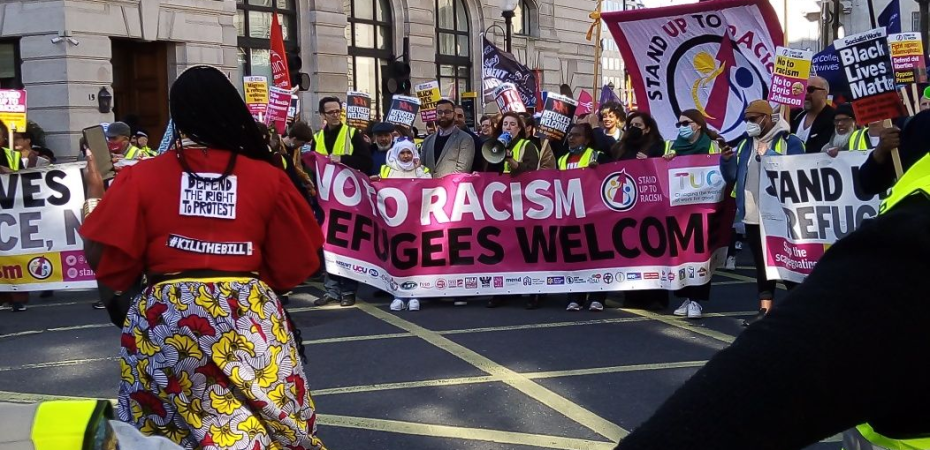
Pamela Fitzpatrick looks at how politicians have cynically exploited the plight of asylum seekers for their own purposes
Over the last two decades, Harrow has become home to a large Afghan community. Unsurprisingly, therefore, the tragedy that has been unfolding in Afghanistan has been a matter of concern for local people. That concern has been compounded by the very poor response by the UK Government and the growing hostility to those seeking asylum in the UK.
When the Afghan government fell to the Taliban in August 2021 the UK government announced it would introduce a bespoke arrangement for Afghan refugees. The Foreign Secretary at the time, Dominic Raab, rolled out that now well-worn mantra of politicians that Britain was a “big-hearted nation” which had “always been a country that has provided safe haven for those fleeing persecution”.
However, this is not a picture of the asylum system that most people fleeing persecution will recognise. Even a cursory glance at our history shows that the UK has rarely been a welcoming place for asylum seekers. Successive Governments have frequently sought to exclude those fleeing persecution and a complicit media has colluded in portraying them as criminals and bogus.
The resurgence of the Taliban of course did not just happen suddenly in August 2021: the Taliban never really left. Immigration lawyers have been representing Afghan nationals fleeing persecution from the Taliban for the last two decades. But their claims were frequently met with hostility and a culture of disbelief, and the Government has returned thousands of people to Afghanistan who faced further torture or even death.
Nonetheless the announcement by the Government to provide a bespoke scheme did raise hopes. The arrangements were to take the form of two settlement schemes: the Afghan Relocations and Assistance Policy (ARAP) and the Afghan Citizens Resettlement Scheme (ACRS).
The ARAP was intended for Afghan citizens who worked for, or alongside, the UK Government in Afghanistan in exposed or meaningful roles. The ACRS scheme was introduced for those who stood up for values such as democracy, women’s rights, and the rule of law. The ACRS was also intended for vulnerable people, including women, girls, and members of minority groups at risk because of their ethnicity, religious belief or sexuality.
The schemes were in recognition that those who had assisted the UK Government may now be a target for the Taliban. The intention was that anyone who was resettled through either scheme could be relocated to the UK with their immediate family and would receive indefinite leave to remain (ILR) in the UK. This would allow them to work, find housing and claim benefits if necessary.
However, the arrangements for those desperate to flee Afghanistan have been subject to widespread criticism and inevitable comparison to the support the Government has provided to people fleeing from the war in the Ukraine. According to the Home Office, over 180,000 visas had been granted to people fleeing from the Ukrainian War by September 2022. This contrasts with only 12,527 people being granted indefinite leave to remain across both ARAP and ACRS.
Over the same period the number of Afghan nationals arriving in the UK on small boats has increased substantially. Nearly 9,000 Afghans arrived by boat in 2022, with 3,834 arriving in the in the last three months of 2022. This contrasts with 1,437 Afghans arriving by boat in 2021, 494 in 2020, 69 in 2019 and just three in 2018. We have no way of knowing how many people set off but did not survive that perilous journey.
To address some of these concerns, a public meeting was organised by Harrow Law Centre, a local charity which provides legal advice and representation to asylum seekers and people who have been trafficked. The meeting included speakers from the United Nations High Commission for Refugees, Afghan community leaders and solicitors from Leigh Day and Harrow Law Centre. All spoke of the failings of the two schemes, with people often wrongly refused help.
The most compelling evidence came from members of the audience who explained how they had been forced to leave Afghanistan, their journey to the UK and their experience of the asylum system. Some spoke of the pain of being parted from their family, of leaving their homes, losing their jobs, not being present at the birth of their child, not knowing if their loved ones would be safe.
But this trauma had been made so much worse by their treatment in the UK. They had helped the UK government in Afghanistan and could not understand why they were treated as though they were criminals. Every day the media made clear that they were not wanted. One person asked why they were treated so differently to those Ukrainian nationals coming to the UK. The question was rhetorical because everyone in the room knew the answer.
By coincidence, the meeting took place on the same day the Government published its controversial Illegal Migration Bill. The Bill is arguably the most draconian and inhumane attack on asylum seekers since the Immigration and Asylum Act 1999. The Bill is so bad that the Home Secretary herself cannot say that it complies with the UK’s Human Rights obligations.
The Bill applies to anyone that enters the UK without permission to do so. This will include people crossing the channel on small boats as well as those who travel with a false passport or those who hide in the back of a lorry. The Government dismisses these people as criminals because it says they are entering the UK unlawfully. Yet the UN Refugee Convention states that asylum seekers cannot be penalised for entering a country illegally to claim asylum.
The Bill places considerable power in the hands of the Home Secretary. It disapplies the requirement for courts to interpret legislation compatibly with human rights provisions. It provides for the Home Secretary to remove a person arriving ‘unlawfully’ regardless of whether they have sought asylum or have been trafficked into the UK. It prevents anyone arriving ‘unlawfully’ from ever having their asylum claim considered. If despite this they are allowed to remain in the UK they will be prevented from ever getting British Citizenship as will any children born subsequently. There will be no right of appeal and no scope for a court to intervene.
With the language used by much of the media and many politicians, the public could be forgiven for mistakenly believing that the UK takes more than its fair share of refugees. Nothing could be further from the truth. Over 85% of the world’s refugees are taken in by neighbouring much poorer countries. Even amongst European countries we take far fewer refugees than for example Germany or France. Where asylum seekers do come to the UK it is usually because they have a connection to the UK or have come under one of the Government schemes such as those currently for Afghanistan and Ukraine.
The Government asserts the Bill is a necessary measure to curb the large number of bogus asylum seekers crossing the channel in small boats and the criminal gangs facilitating their travel. Sadly, once again the most vulnerable are being used as a political tool by politicians.
The reality is that for most people fleeing persecution or war there is no ‘lawful’ way to enter the UK. Even when on the rare occasions that special arrangement such as the ARAP and ARCS are introduced, they often fall far short of what is necessary. Consequently, those fleeing persecution have little choice but to make the perilous journey on boats across the channel.
Many of the Afghan nationals who have been forced to make the perilous journey across the seas or in the back of a lorry do not reach safety and will have died. Others may have been captured along the journey by traffickers and forced into slavery.
For those that do reach the shores of the UK their treatment on arrival is nothing short of shameful. They are not allowed to work or claim any social security benefits and do not qualify for help with housing by the Local Authority. In order to receive asylum support (currently paid at £40.85 per week) they must agree to be dispersed away from the southeast of the UK.
The accommodation they are placed in is generally of very poor quality, not the luxury hotels referred to by politicians and media. They can be moved at short notice hundreds of miles away from their solicitor or support network. Isolated and afraid, they may now find that baying mobs assemble outside their accommodation.
Although they may have been imprisoned, tortured or raped, no support is provided to them: instead they are treated as criminals, as bogus and unwanted by the British public. We now hear that the Government intends to house asylum seekers in disused military bases. The bases most likely are unused because they are generally not fit for human habitation.
Contrast this to the welcome that those fleeing the war in the Ukraine are offered. They are treated as guests, they have hosts who take them into their own homes. The media portrays their stories with some degree of accuracy, and they are treated as being welcomed by a generous British public.
If the Government genuinely wanted to deal with the ‘problem’ of the small boats, it could do several things immediately. It could repeal the carriers’ liability legislation which fines airline and other carriers who may inadvertently transport a person without permission to enter the UK. It could establish legal methods of settlement for those coming from the main countries where asylum seekers come from. It could establish a system where asylum claims are dealt with speedily. It could allow those awaiting a decision on their asylum claim to work if they are able, to claim social security benefits if needed and to live in ordinary accommodation rather than Home Office-provided accommodation.
Most importantly however, politicians of all parties could start to tell the truth about people who claim asylum or who are trafficked. They could inform the public that the majority are genuine, they did not want to leave their homes but have been forced to do so. They could explain that those coming to the UK are small in numbers compared to those hosted in other countries and that those who do come to the UK usually do so because of their links to us.
They could challenge the false claims in the media and take action against those inciting racial hatred. They could speak of the bravery of those who have had to flee their country and of the contribution that most refugees make to the UK. They could try to show leadership and quell the growing racism rather than fuel it. But instead we see a race to the bottom with politicians cynically using asylum seekers as a political tool.
A report by the Council of Europe nearly a quarter of a century ago attributed blame for the rise in racism in the UK to politicians and increasingly restrictive asylum and immigration laws. The report states:
“Many politicians have contributed to, or at least not adequately prevented public debate taking on an increasingly intolerant line, with at times racist and xenophobic overtones.”
Sadly successive Governments have not heeded this advice. The language used by Government has been extended to lawyers representing asylum seekers with inevitable consequences. In September 2020 a man walked into a solicitors firm in Harrow armed with a knife, handcuffs, a Confederate flag and a Nazi flag. He launched a violent, racist attack on staff and allegedly threatened to kill an immigration solicitor. Only days before the incident, the then Home Secretary Priti Patel had stated she was dismayed at the legal profession and its ‘lefty lawyers’ preventing her from deporting asylum seekers.
The Law Firm involved wrote to the Law Society asking it to intervene, stating that the position as it stands is untenable, dangerous and cannot be allowed to persist and that the Government must ensure that no further lives are endangered as a result of the Home Secretary’s untruthful and deliberately inflammatory rhetoric.
Yet, barely a month after the knife attack, the Home Secretary again referred to “do-gooders” and “lefty lawyers” claiming at the Conservative Party Conference that those who represent asylum seekers were “defending the indefensible”. Two days later, Prime Minister Boris Johnson in his keynote speech joined in stating the entire criminal justice system was “being hamstrung by lefty human rights lawyers.”
The dehumanising of people who have committed no crime, the threats to send asylum seekers to camps in the UK or abroad, instructing courts to disapply human rights rules, legislating to prevent the courts from intervening in Government actions, angry mobs shouting abuse at asylum seekers, violent attacks on immigration solicitors – we should be in no doubt that what we are witnessing in the UK today is the seeds of fascism being sown. With very little opposition.
Pamela Fitzpatrick is Director of Harrow Law Centre and was a Labour Councillor in the Borough for eight years and Labour Prospective Parliamentary Candidate for Harrow East in 2019.
Image: c/o Mike Phipps

