
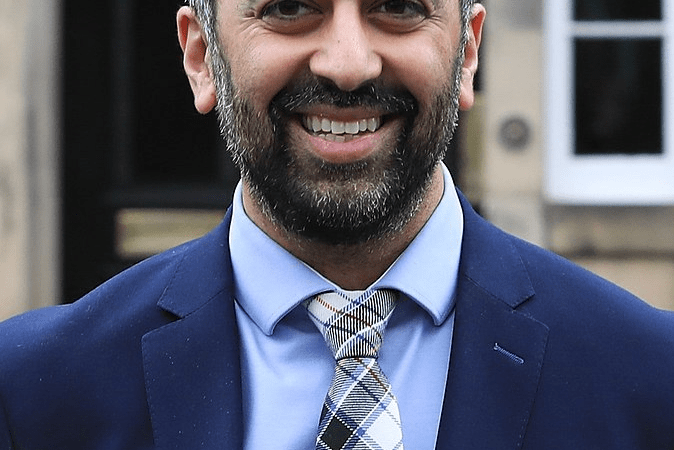
Stephen Low explores what Humza Yousaf’s election as SNP leader portends
Humza Yousaf replacing Nicola Sturgeon is less “all changed, changed utterly” and more “meet the new boss, same as the old boss“. Lacking any sort of strategy to deliver Scottish independence, the SNP have little to offer but performance. As it might have been put in Braveheart: “They may take our lives. But they will never take…our photo-ops.”
In this regard Humza Yousaf has hit the ground running. In what was usually written up as chutzpah, Yousaf quoted Labour’s John Smith in his victory speech on becoming SNP leader. It was though, possibly unintentionally, far more revealing than that.
“All we ask,” a straight faced Humza said, “is the opportunity to serve.” That this could be said, far less listened to, without provoking laughter says something about the nature of politics in Scotland, but not anything good. Because of course Humza is not seeking “an opportunity to serve”. His party is beginning the second half of their second decade as the Scottish Government, and he has been drawing a ministerial salary for the last eleven years. Opportunity has done a good deal more than knock for the SNP.
It’s the comparison with the Labour Party of John Smith that ought to have produced the sniggers though. The overlap between Smith’s mild social democratic politics and the palliative neoliberalism of the SNP in government is not huge. The reality is New Labour have had no more devoted pupils than the SNP.
Compare and contrast these statements if you will: “The evidence now demonstrates that economic efficiency and social justice are not at odds but go hand in hand.” “Our approach to economic policy is based on the principle that delivering sustainable growth and addressing long-standing inequalities are reinforcing – and not competing – objectives.” One is First Minister Nicola Sturgeon in 2015, the other is New Labour red tory (to use contemporary Scottish labels) Gordon Brown. In February of that year Nicola also went on to declare that, “No one should get a free ride on the benefits system” – and endorsed the fashionable, in right wing circles, idea of a benefit cap.
The SNP’s track record in Government isn’t without its successes but it isn’t lacking in failures either. The SNP are masters of the big announcement. Ensuring policies are delivered effectively? Not so much. The gap between what is promised and what is delivered is often stark and it has been getting wider.
It’s been a feature of their entire time in government. Alex Salmond boasted that the SNP had put “1,000 extra police on Scotland’s streets.” The reality was more prosaic. Failing to fund the programme meant that police staff were laid off in huge numbers to pay for the initiative and the bobbies found themselves pounding a keyboard rather than the beat.
In further education, just after the financial crisis, it was announced there would be a job, training opportunity or college place for every school leaver. Colleges were not funded sufficiently to cope with demand so the accommodation of school leavers came at the expense of returners to learning, library opening hours and creche provision.
It is a pattern that has continued throughout their long time in office. Thus, much was made of every child in Scotland being given a library ticket – while all across Scotland libraries have been closing. Free bus travel starts aged sixty in Scotland, with free travel for children introduced recently. The bus network however is left in the hands of parasitic monopolies who have been reducing services while taking ever greater subsidies.
An idea of just where the balance between presentation and reality figures in SNP thinking can be seen by what happened regarding exam results during Covid. In Scotland, as elsewhere, pupils’ results were estimated. The mechanism used by the Scottish Qualifications Agency used a formula which changed teachers’ estimates and penalised pupils from schools serving poorer areas. On being presented with the results, recently stepped down Deputy First Minister John Swinney told those responsible to make the results look different.
In the ensuing furore – which included pupils and parents demonstrating on the streets, the SNP resolutely denied there was any problem – right up until the point a no confidence motion in John Swinney was tabled in Parliament. Only at this point did the Scottish Government agree to use the teachers’ estimates.
This lack of concern for detail is increasingly a feature of the legislation the SNP bring to Parliament. The Gender Recognition Reform Act is the most recent controversy (and some at least of that is down to the Scottish Government ignoring advice) but it is hardly the first.
In recent years, The SNP have pushed legislation through Holyrood that has either been struck down by the Supreme Court (‘Named Person’ and the UN Convention on the Rights of the Child Bill), been so poorly drafted that making it work is taking years (the 2021 Hate Crime Act – scheduled for introduction 2024). Or just so embarrassing, it’s been left on the shelf entirely (the Railway Policing Act 2018).
This process has reached what we have to hope is its nadir with the National Care Service Bill. This aims to transfer statutory responsibility, not just for social care but also social work and community health, from local government, and where necessary the NHS, to new quangos – Care Boards. These will deliver services by procuring and contracting from the private, voluntary or public sector. The only transfer of ownership envisaged in the proposals is out of the public sector.
The impact on local government will be catastrophic. The memorandum issued with the Bill is costed on the basis of 75 000 staff transferring out of employment by Scottish local authorities, with an estimated one-third of current council spending going to the new quangos. Care Board members will be answerable only to ministers in Edinburgh, not their local populations.
The legislation is roundly condemned as a shambles. Even parliamentary committees chaired by SNP MSPs have criticised the proposals. The legislation is now being delayed for a few months. Even the author of the measures, the then Cabinet Secretary for Health and Social Care, Humza Yousaf has conceded the measures need further work.
Meanwhile a ministerial “opportunity to serve” has been handed to Humza’s parliamentary supporters. Past failure to deliver, or indeed past delivery of failure has been no barrier to advancement. The resemblance between today’s SNP and New Labour is considerable – but it’s the New Labour of 2007 not 1997. They are a party with little by way of ideas or seemingly any sense of strategy.
Whether the self-inflicted damage of the last few weeks has any lasting effect remains to be seen. No one though – including by the looks of things some of its own members – expects great things of this government. No one should be surprised if the next SNP conference finishes not with a rendition of Flower of Scotland but a chorus of “We’re here, because we’re here, because we’re here…”
Stephen Low is a member of Glasgow Southside CLP. He is a former member of Labour’s Scottish Executive and part of the Red Paper Collective
Image: First Minister Humza Yousaf . Source: https://www.flickr.com/photos/scottishgovernment/52784069858/in/photostream. Author: Scottish Government, licensed under the Creative Commons Attribution 2.0 Generic license.

