
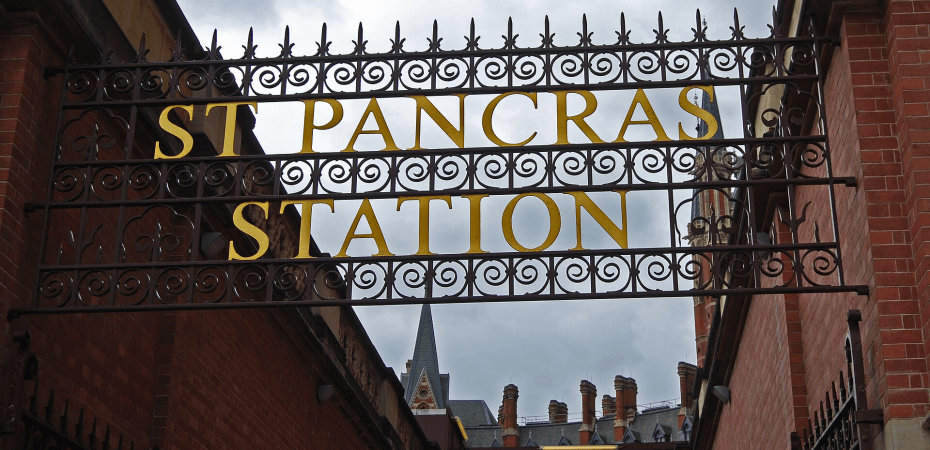
On Monday May 4th, Camden Trades Council will commemorate the centenary of Britain’s General Strike with the unveiling of a red plaque at 67 Camden Road, London NW1, the then home of St Pancras Trades Council – and Labour Party. Here Sarah Friday, Camden Trades Council Secretary, explores the impact of the 1926 Strike in St Pancras. A Labour Hub long read.
St Pancras Trades Council played a role of national significance during the general strike, since in 1926 most heavy goods were transported by rail and St Pancras Trades Council covered the stations and railway yards of Euston, St Pancras and Kings Cross stations, the London termini of three of the ‘Big Four’ railway companies.
On 3rd May 1926, St Pancras Trades Council formed a Council of Action – a strike committee -which was in permanent session during the nine days of the general strike. It was militant and well organised. The general strike in St Pancras was solidly supported from beginning to end.
St Pancras Trades Council published the St Pancras Bulletin, a daily newsletter, which was sold and publicly distributed on each day of the general strike. The St Pancras Bulletin is a remarkable record of the strike activity because its coverage went far beyond the guidelines issued by the Trades Union Congress (TUC) leadership, that Trades Councils should only publish centrally produced publicity containing official TUC statements. In the aftermath of the general strike, the TUC banned several St Pancras Strike Committee officials over items published in the St Pancras Bulletin.
St Pancras Council of Action also established a Workers Defence Corps to provide protection for strikers and pickets and to maintain order.
From midnight on 3rd May 1926, the TUC General Council called for a withdrawal of labour in transport, electricity, gas, docks, heavy chemicals, building and printing industries involving approximately 1.75 million workers in solidarity with the miners.
The mine owners had served notice on over a million miners that they would be locked out of work from 30th April 1926 unless they accepted an end to national pay agreements and increased shift lengths underground from seven to eight hours amounting to a 13.5 per cent pay cut. The Miners’ Federation rejected these terms with the rallying cry, “Not a penny off the pay, not a minute on the day”.
In all, around 2 million workers joined the general strike during the nine days from 4th to 12th May 1926 in a magnificent display of solidarity with the miners.
But on 12th May 1926 – Day Nine of the general strike – the TUC General Council went to 10 Downing Street to meet Prime Minister, Stanley Baldwin and informed him they were calling off the strike without agreement on the miners’ demands, or to prevent the victimisation of striking workers. Many strikers were victimised by their employers when they eventually returned to work with pay cuts, demotion and selective re-engagement.
The miners were left isolated, locked out and fought on alone for seven more months. There was fury among many workers in St Pancras at the betrayal of the miners and the whole working class by TUC leaders. Attempts were made to keep the strike going.
Saklatvala arrested
On 3rd May1926, the Metropolitan police arrested Shapurji Saklatvala at his home at St Alban’s Villas, Highgate (in St Albans Road, opposite Parliament Hill Fields). The 52-year old Communist MP for North Battersea who was active in St Pancras Labour Party and Trades Council, had given a fiery speech at the May Day Hyde Park rally, which the police considered to be an act of sedition. Saklatvala told the May Day rally, “We tell the Government that the young men in the Forces are more of our own class and whether Joyson Hicks likes it or not, whether he calls it ‘Sedition’ or not, to soothe the financiers, his friends, we have a duty towards these men, to say to them that they must lay down their arms.”
St Pancras Trades Council reported Saklatvala’s arrest in “Points for Trade Unionists” in the first St Pancras Strike Bulletin published on 4th May 1926: “The bosses act now… They do not wait. Saklatvala MP, was arrested this morning at 12 o’clock. WORKERS RALLY: This is your fight.”
Saklatvala was imprisoned for two months after refusing to be bound over for 12 months – sparking discussions about whether it was legal to arrest an MP while the House of Commons was sitting.
TUC announces the general strike
On 1st May 1926, while trade unionists attended the massive rally in Hyde Park, a Special Conference of Trade Union National Executives called by the TUC at the Memorial Hall in Farringdon voted to declare a general strike from 3rd May in support of the miners who had been locked out by the mine owners.
Following the May Day rally in Hyde Park, demonstrators marched almost three miles across London’s west end to Farringdon Street to lobby the TUC Conference. Peter Zinkin’s job as a march steward was to ride up and down on his bike and inform the march leaders of any gaps in the procession, wrote: “There was great excitement as more and more people joined the march as it proceeded on its way. As we approached the Memorial Hall in Farringdon Street where the trade union executives were meeting we heard that they had decided to call the Strike. We cheered ourselves hoarse as we passed the hall in exultant enthusiasm, confident that the unity displayed that day would be repeated in the nearing battle and so carry us forward to victory. Little did we know what the future had in store.”
On 3rd May 1926, a special meeting of St Pancras Trades Council Executive Committee with local strike committees agreed to form St Pancras Council of Action for the duration of the general strike.
Emile Burns, a member of the Communist Party who worked for the Labour Research Department, was appointed as Publicity Secretary of St Pancras Trades Council during the strike. Emile Burns described St Pancras Council of Action as “highly effective”. The Council of Action met daily throughout the nine days of the general strike in almost permanent session at St Pancras Labour Party and Trades Council offices at 67 Camden Road, which was the strike headquarters. St Pancras Council of Action was one of the few which negotiated an agreement with the Co-operative Society to supply goods on credit for the strikers’ family’s canteen organised by St Pancras Council of Action Women’s Committee.
Workers Defence / Workers Vigilance Corps
St Pancras Trades Council established a Workers’ Defence Corps. The St Pancras Bulletin on 6th May 1926 urged workers to “sign up to their Vigilance Corps” and ensure their strike committees were represented in the Corps.
The Government had issued a statement in The British Gazette (the government’s own newspaper) “for all ranks of the armed forces to take any action needed to aid Civil Powers [and] will receive the full support of the Government.”
The St Pancras Bulletin described this as a direct incitement to Army Officers to utilise “fascist methods” to squash the strike. They wrote, “do not let anyone scare you, take action as a disciplined party”. We are many, they are few.”
The St Pancras Bulletin was printed, distributed and sold every day of the general strike from 67 Camden Road, as well as from other locations such as 65 Chalton Street, Somers Town (headquarters of South East St Pancras Labour Party).
In the second St Pancras Bulletin on 5th May, the editor explained that it had achieved “a remarkable sale, so much so that they have not been able to meet demand.”
Emile Burns, Publicity Secretary of St Pancras Trades Council described local strike bulletins as being “of the greatest importance” and reported there were “queues of eager distributors”.
The St Pancras strike bulletin appeared from 4th to 12th May 1926, sometimes twice a day. Each edition ran to between four and five thousand copies, costing half a penny. The strike bulletin carried updates on strike action, information on strike meetings, encouraged solidarity with the strikers and explained the reasons for and importance of the strike action. With Fleet Street on strike, capitalist newspapers appeared only in a truncated form if at all. This made Trades Council strike bulletins a very important source of news.
To plug the gap in news management during the strike, the Government published a broadsheet The British Gazette, while the TUC published The British Worker. The TUC’s news sheet emphasised passivity, urging strikers to keep calm, stay off the streets and play organised games such as football.
To counter the passivity of the TUC bulletin, the Communist Party authors of the St Pancras Bulletin (Emile Burns, Frank Jackson and Kay Beauchamp) deliberately ignored the TUC’s diktat that Trades Council bulletins should contain only centrally issued publicity. They were punished for this after the strike when the TUC formally expelled St Pancras Council of Action.
The importance of the bulletins in providing information for striking workers was not underestimated by the Government who initiated a national crackdown of trades councils copying and printing facilities – including that of St Pancras Trades Council when police raided their strike HQ at 67 Camden Road on 10th May 1926.
The Strike begins
Tuesday 4th May 1926 was the first full day of the general strike.
St Pancras Bulletin, No.1, (4th May 1926), was a call to arms and a rally for support for the strike. It focused on the reason for the strike and the relevance of the strike demands for workers in St Pancras.
It carried the title, “All behind the miners!” The opening paragraph explained the TUC General Council appealed to all organised workers to rally in support of the miners – in what was their fight against wage cuts and lengthening of hours (an hour extra on the working day for a period of three years) as demanded by the mine owners and the Tory Government. The bulletin explained that if the mine owners got their way they would be working longer hours than any other European miner – and because the cost of living was higher than before World War One, earnings would buy less. “How would you like it?” the bulletin asked. If the Government were allowed to get away with this – other workers would be next. Readers were urged to “Remember you are organised workers, not a mob.”
Peter Zinkin, delegate to St Pancras Trades Council, wrote in his memoirs, “Even the most optimistic were surprised by the solidarity with which the strike started. There was almost 100% response from St Pancras railwaymen, and this was of the greatest importance. St Pancras was a major rail centre with three main line termini, Euston, St Pancras and King’s Cross with very large goods and marshalling yards.”
Frank Jackson was interviewed in 1973 for STRIKE, A Live History, 1887 – 1971, about his memories of the general strike as a retired rank and file building worker. “I was organiser for the St Pancras Trades Council, and in St Pancras the strike was absolutely complete. When they tried to move the buses, we lined them all up, pulled out the distributor wires and hauled the blacklegs out of the cabs.”
Police raid St Pancras Council of Action at 67 Camden Road
During the strike the Government suppressed independent news reporting with a national crackdown on Trades Councils’/Councils’ of Action copying and printing facilities. On 10th May 1926, police carried out a midnight raid at 67 Camden Road, seizing a typewriter, some St Pancras Trades Council headed letter paper, a Roneo duplicator machine used to reproduce the St Pancras Bulletin. Police arrested Jack Smith, the 21-year-old secretary of St Pancras Trades Council, a member of the National Amalgamated Furnishing Trades’ Association (NAFTA).
Jack Smith was charged with issuing seditious material in that day’s St Pancras Bulletin in relation to the reporting of an incident that had taken place on Harmood Street, which the police claimed was inaccurate. Smith appeared at Marylebone Magistrates Court, where bail was offered on the proviso that he refrained from political activities during the strike. He refused and was fined £10 by the magistrates. The fine was paid on his behalf, meaning he could rejoin strike activity.
The joke was on them
Frank Jackson explained how he was one step ahead of the police. Concerned the police would raid No. 67 to suppress the strike bulletin, the Council of Action accepted an offer of an almost new Gestetner duplicator from Edgar Lansbury (son of George Lansbury, the Labour MP for Bow and Bromley). The Gestetner machine was transported at night to Peter Zinkin’s home, where it remained for about five days copying the strike bulletin, before being removed when it was thought that Zinkin’s home was being watched by police.
Frank Jackson described the raid on 67 Camden Road: “Workers watched with glee as police carried out what they thought were duplicating machines… but were in fact, simply machines covered with heavy bricks”; the offices were then moved to a “fellow’s house: it backed up on the police station, but they never thought of looking there.”
St Pancras Council of Action Women’s Committee
St Pancras Council of Action established a Women’s Group in St Pancras. Its work included organising special relief work and other actives. It met every day of the general strike at the Old Turkish Baths, Kentish Town Road, Camden from 10am.
Kay Beachamp, was elected chairman of the women’s group, and described how it got started.
“They set it up the day the General Strike started practically. And we called a meeting of the women you know, in about 24 hours. We had about forty or fifty women there… a well-attended meeting, we elected the committee, and I was elected chairman, and a Co-op woman…. was elected as secretary. And we set to work. We were going to open soup kitchens. We got in touch with the Co-op, negotiated with them, looking for halls and so on.”
Frank Jackson wrote, “We had a united committee with all the women on it. The Trades Council fitted up a canteen, where meals were organised for the pickets and tea fights for the kids. The women organised the lot.”
In July 1926,after the general strike had ended the St Pancras Women’s Committee and the Plebs League put on a performance at the Memorial Hall of ‘Singing Jailbirds’ a new play published in 1924 by American socialist writer, Upton Sinclair.
Incident outside of the Britannia pub (on the corner of Camden High Street and Parkway, NW1)
St Pancras bulletin, No.8, (2nd edition) reported:“We have had well authenticated reports of the incidents at the Britannia yesterday, and regard the methods used by the authorities as unnecessarily and provocative.This particularly refers to the incidents with women and children. It is clear that workers must take steps to organise to defend themselves against such action.”
Peter Zinkin, a delegate to the Trades Council describes the scene at this junction during the strike: “At the main traffic crossings at the Camden Town Tube Station, where five major roads converged, very large crowds of men and women throughout the day lined the pavements booing the drivers of the infrequent blackleg transport, watching the efforts of those trying to turn them back. From time to time, groups of men were to be seen gathered round a halted blackleg bus or lorry working away to immobilise it. The police were unable to do anything to stop them. With similar activity all over the country the Government forces were stretched to the upmost limits, they could not find enough police to support the people’s mass pickets. The few police that there were at Camden Town and had been there for long hours, mounted and on foot, and after four or five days’ repeated baton charges against the mass of the people, have become so tired they could barely manage to lift their batons, or for the mounties to use the sandbags attached to their saddles. They were being ignored. It was an astonishing sight.”
The betrayal
Wednesday 12th May 1926was the final day of the strike. The notification calling off the strike was issued at 13.00 hours when the BBC announced that 10 Downing Street and the TUC had officially declared the termination of the strike.
The strike came to an end without any agreement conceding the miners’ demands and without any arrangements for an organised return to work or guarantees against victimisation of strikers.
Employers immediately sought to take advantage of the sell-out. In St Pancras many railwaymen were refused their jobs, causing much anger.
In 1976 on the 50-year anniversary of the strike, Camden Pensioners’ leader, Ted Barham recounted his memories of the general strike as an 18-year old local activist: “the end of the strike came as a shock… The people I was with were aghast when the news came through. We didn’t believe it.” He added, “I went to with my father to Unity House (NUR HQ) on Euston Road, to find out if it were really true.”
“Some strikers were so angered that they got out after it had been called off.” Railway workers and others tore up their union cards in disgust at moderates who had involved them in loss of pay and suffering for nothing.
Frank Jackson was convinced that the strike would have succeeded if it had gone on, and it would have been outside of the control of the TUC and the Government. He explained that it wasn’t the greatest defeat of the working class – but the greatest betrayal.
Jackson said that as soon as the strike was over the first thing the right wing did was to bump the trades councils. He explained, “I was delegate from the St Pancras Trades Council to the Labour Party Conference and they turfed me out of that. Among the rank and file we had no faith in the trade union leadership, but we didn’t have a real suspicion there would be a sell-out and never made any move to counter-act what the officials were doing. The rank and file did not have a real objective in front of them, what to do if they won the strike.”
What happened next
St Pancras Trades Council delegate, Peter Zinkin wrote that on Thursday 13th May 1926, the numbers on strike were higher in St Pancras than on 12th May. This meant that many of the threats of victimisation were dropped – although the attempts to continue the strike despite the TUC agreement failed.
But there were repercussions: a local paper reported that the train company L&NER were to reduce staff. At Kings Cross notices were posted that men who remained loyal to the company would be given employment preference.
After the strike
St Pancras Trades Council agreed to continue production of the St Pancras Bulletin. In the bulletins after the strike, the editors began to come to terms with what had happened and to learn lessons from it.
In relation to local organisation, they write that that the one thing that arises out the strike, clear and unchallenged, is the importance of the Trades Council as a central controlling body.
In a powerful article entitled “Ten days that shock Britain”, St Pancras Bulletin of 22nd May wrote that the filter of darkness since the evening of May 12th was finally lifting, when in the words of George Lansbury, the “Victory which solidary had undoubtedly won was expressed in the terms of most abject defeat.”
They wrote that the local feeling was that the rank and file had an absolute and definite desire to “sever the chains that had so long bound them” – and that this was also a national feeling.
They summed up the article: “This is only the first skirmish. The fight is yet to come”.
This article is an edited version of a longer article by Sarah Friday, Camden Trades Council Secretary, which is on the history page of Camden Trades Council website.
RMT General Secretary Eddie Dempsey and former NEU joint General Secretary Kevin Courtney, now chair of the Together Alliance, will speak at the unveiling of a commemorative red plaque at 67 Camden Road, London NW1 at 10.30am on Monday May 4th.
An exhibition of St Pancras Trades Council strike bulletins and photos will be on display in the Upstairs Function Room, Cock Tavern, 23 Phoenix Road, Somers Town, NW1 1HB, from April 26th-May 31st.
Image: https://commons.wikimedia.org/wiki/File:St_Pancras_railway_station_Sign.JPG Author: MaryG90, licensed under the Creative Commons Attribution-Share Alike 3.0 Unported license.


