
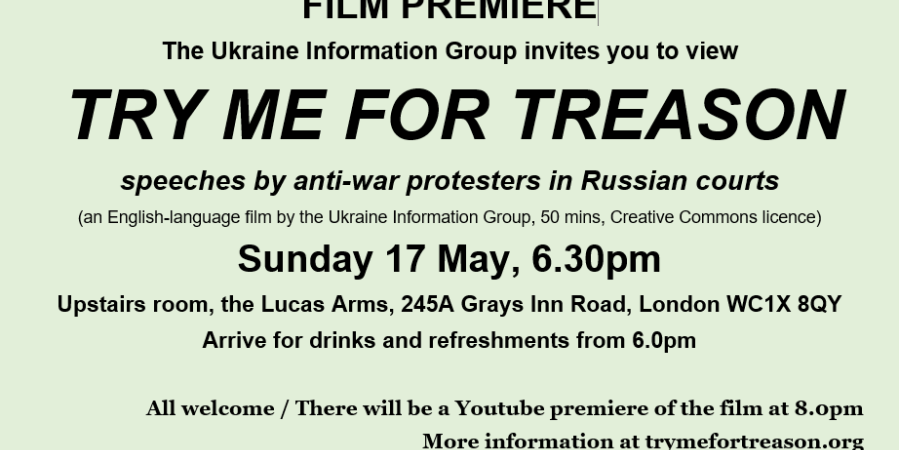
Dave Mitchelmore reviews Try Me for Treason, a 50-minute film, in English, featuring speeches made by anti-war protesters in Russian courts.
This film showcases recent testimony given in Russian courts by both Russian and Ukrainian opponents of Putin’s invasion of Ukraine. Speaking out in this way has become one of the few and most effective ways that opponents of the war have left to them.
Since the Russian invasion in 2022, it has become nigh on impossible to speak out publicly or attend demonstrations against the ‘special military operation’. The four protagonists the film features spent many hours agonising on how to best use their long cherished ‘last word’ that the juryless Russian court system allows them in summing up their opposition to the charges they face. In some instances, the sentences handed down were increased because of the defiant line these brave comrades decided to adopt, a risk that they were fully aware of.
Try Me for Treason adopts a crisp and effective method of presenting each oppositionist as an example of making best use of the opportunity to present the defence of their actions. The film sets the scene using two actors. The bulk of the film then centres on each of the four prisoners being represented by a single actor who reads extracts from the transcript of their final statement to the court. Each actor is ‘overlooked’ by a photo of ‘themselves’ whilst delivering their remarks to the court.
A mounting wave of oppression and violence seen in Russia since the early 2000s has accelerated since the invasion and this is the context in which these brave individuals challenged the might of the Russian state. The number of political prisoners in Russia have risen from around fifty in 2015 to more than 3,000 currently.
We meet Bogdan, a poet and artist from Crimea, serving a 15 year sentence. His ‘terrorist’ crime was daubing a public building with the colours of the Ukrainian flag and other graffiti-styled protests. Bogdan has demanded – and achieved – being stripped of his Russian citizenship. His only regret is that imprisonment has deprived his grandmother of her only carer. He speaks of a clear conscience as more important than being a “dumb beast” which he feels is tantamount to collaboration. His last statement in court was a rap performed in Ukrainian! He discontinued a hunger strike shortly after his court appearance.
Darya has similarly been accused, following her public protest against symbols of oppression in Russia. Having defaced military vehicles displaying the letter Z and V, she followed this up with damage to friendship symbols twinning St Petersburg with Mariupol following the heavy bombardment of the Ukrainian port city. She was debarred from studying medicine and charged with discrediting the army. Darya is Russian, but like her Ukrainian comrades, explains Ukraine’s current plight by situating it within the centuries-old tyranny it has experienced under Muscovy/USSR/Russian oppression. Her defiance speaks to her sense of the inevitability of the eventual triumph of Ukraine over this continuous brutality.
Igor’s ‘crimes’ included painting the Ukrainian flag on his face and throwing a Molotov cocktail to no avail at a prison building. What distinguishes his experiences of detention is the systematic and degrading torture that he had to endure before his case came to court. Igor drew strength from the overwhelming amount of support he received in prison from correspondence not only from within Russia but from all around the world. What stood out for Igor in the support he received is the detailed reference to those that have gone before him who tenaciously refused to succumb to the brutal conditions of prolonged imprisonment in Soviet Russia.
The final testimony comes from Andrei, charged with trying to organise a militarised opposition to Putin’s war machine and discrediting the armed forces. In the course of not denying his actions, Andrei applauds all acts of resistance to the war by stating that Ukraine is simply a victim of aggression. The title of this film draws on the stand Andrei took opposing Russia’s war against Ukraine. He taunts, even incites, Russia to indict him on this ultimate challenge to the sovereignty of a state. Andrei sets this demand in the context of ‘self-preservation’ of his conscience. He questions the sanity of the state in its current actions and in not taking up his injunction to try him for treason.
This film eloquently sets out the overwhelming need to continue and extend our support for Ukraine in a lively and very compelling manner. It’s an essential watch for both the committed and others not currently supporting the bravery of the Ukrainian people.
Dave Mitchelmore is a Kent-based political activist. He regularly carries the “From Ukraine to Palestine, Occupation is a Crime” banner on protests against Israel’s occupation of and war on Palestine.
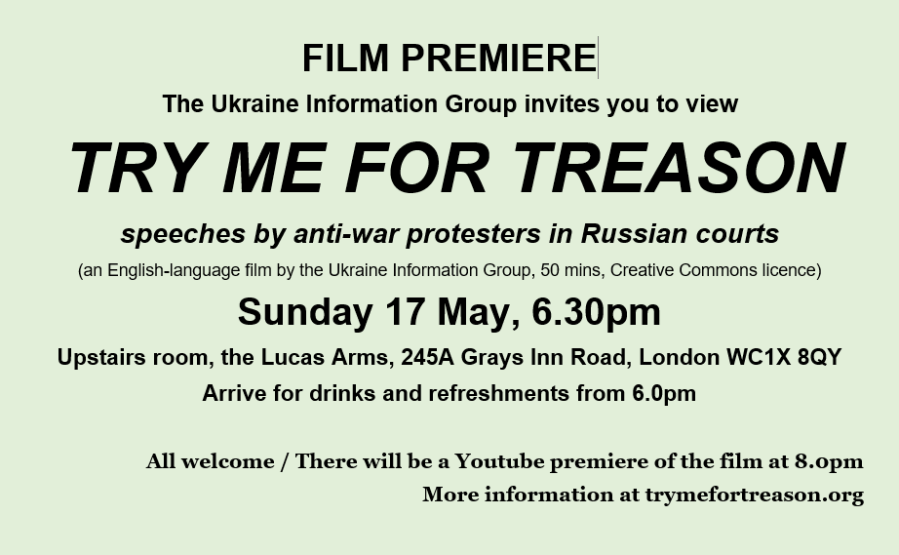
The Youtube premiere of Try Me for Treason will be broadcast on Sunday 17th May at 20.00 UK time. To participate and view the trailer, see here.
 Labour Hub
[…] this week’s bulletin: Ukrainians on the Global Sumud Flotilla/ Try Me for Treason film/ New report on the freedom of movement of civilians in the occupied territories/ More evidence of […]