
By David Jackson
Donald Trump’s threat to withdraw US troops from Germany is far from an isolated provocation. Since the US began its war on Iran, the President has engaged in a sustained rhetorical assault on NATO and its members, launching broadsides at Italy, the UK and Spain, and has questioned the utility of NATO itself. While the alliance may endure, its future is more uncertain than ever, and the Trump presidency has exposed Europe’s vulnerability to American coercion, following decades of dependence.
This is a particular problem for Britain. For a long time, our elites have believed that American power is wedded to shared liberal values: democracy, international law and universal human rights – and have worked to embed that idea into our policymaking, institutions and political identity. Now that these assumptions are coming under stress, the UK stands exposed to American unilateralism.
Labour and Starmer are particularly susceptible to this flawed thinking. Under his leadership, Labour has elevated NATO membership from a tool of statecraft to survive in a dangerous world, to settled orthodoxy: a test of personal gravitas and moral rectitude, and a permanent Rubicon which must never be crossed.
Clement Attlee’s decision to take the UK into NATO is cited alongside the foundation of the NHS and modern welfare state as Labour’s proudest achievements, and as evidence for Labour’s Atlanticist tradition. But this is a misreading of the history. Attlee, and his foreign secretary Ernest Bevin, were committed realists, and reacting to a specific set of post-war circumstances, not acting out of ideological devotion to liberal values, or reverence for American power.
Entry to NATO was a pragmatic step, a strategic instrument to anchor European security against the real, proximate threat of Soviet forces, massed across the continent; it was a means for an exhausted Britain to survive a moment of genuine peril. Alongside NATO, the UK under Attlee’s premiership was amongst the first Western powers to recognise communist China, maintaining relations with a vital trading partner despite tensions over Malaya, and protecting its colony in Hong Kong.
Furthermore, the Attlee government maintained some trade links and diplomatic channels with the Soviet Union, departing from US efforts to isolate the USSR, and resisted American pressure for large-scale Jewish migration into Palestine. Together, these measures reflected Attlee’s and Bevin’s realism, ensuring Britain retained autonomy, leverage and options should its primary ally across the Atlantic prove unreliable.
This stands in stark contrast to Labour’s contemporary approach. Today’s Labour emphasises the alliance’s permanence: NATO represents a rigid bedrock of Britain’s security policy; “non-negotiable”, as Starmer declared in 2022, and an “unshakable commitment” according to its 2024 manifesto. Pro-Labour commentators mock alternative arrangements as unserious and, indeed, dangerous.
Alongside this stress on continuity, current Labour figures moralise the debate, framing NATO membership through a liberal lens: shared values, human rights, democracy, and collective responsibility. Rather than the temporary, power-balancing pragmatism of Attlee and Bevin, Starmer elevates NATO to a righteous venture, casting it as a vehicle for the defence of liberal norms, and a liberal world order.
These tendencies have transformed Labour’s thinking about NATO for the worse, from strategic calculation to article of political faith. Support for the alliance now represents seriousness and virtue, while opposition, or even doubt about Britain’s membership, has become an ethical flaw; the domain of the marginal, reckless or even suspect.
Consequently, Labour is boxed in by its own rhetoric at a time when strategic flexibility is required. It is time to return to classic diplomacy: hedging bets, constructing fallback options and power balancing. This will require an altogether more realistic approach than Labour currently articulates. Should rumours of a change in leadership come to fruition, the newcomer will have an opportunity to reset, and make an important correction to the policy and politics of foreign affairs.
David Jackson has an MA in Geopolitics and an MSc in International Development. He is a member of High Peak CLP.
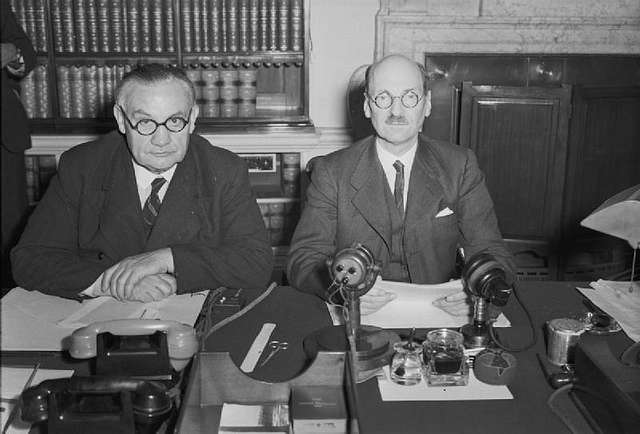
Image: Ernest Bevin and Clement Attlee https://picryl.com/media/bevin-attlee-h-42138-6f8f90 Licence: Public Domain Mark 1.0 Universal PDM 1.0 Deed

