
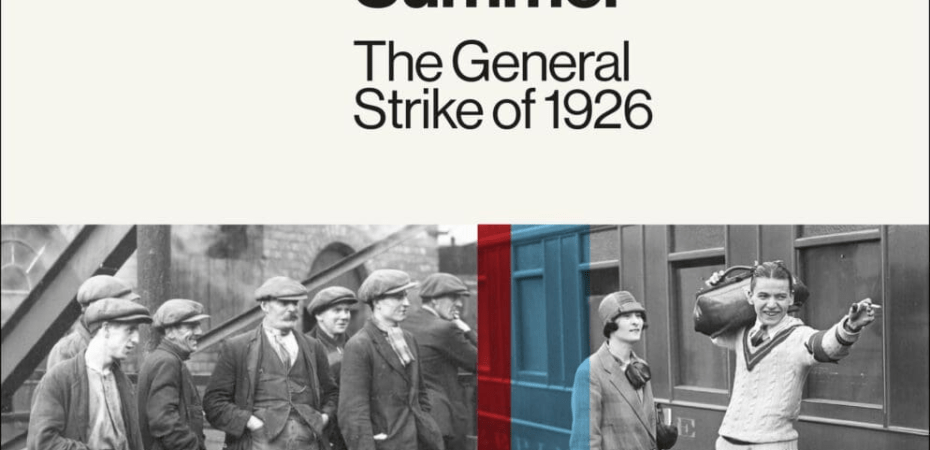
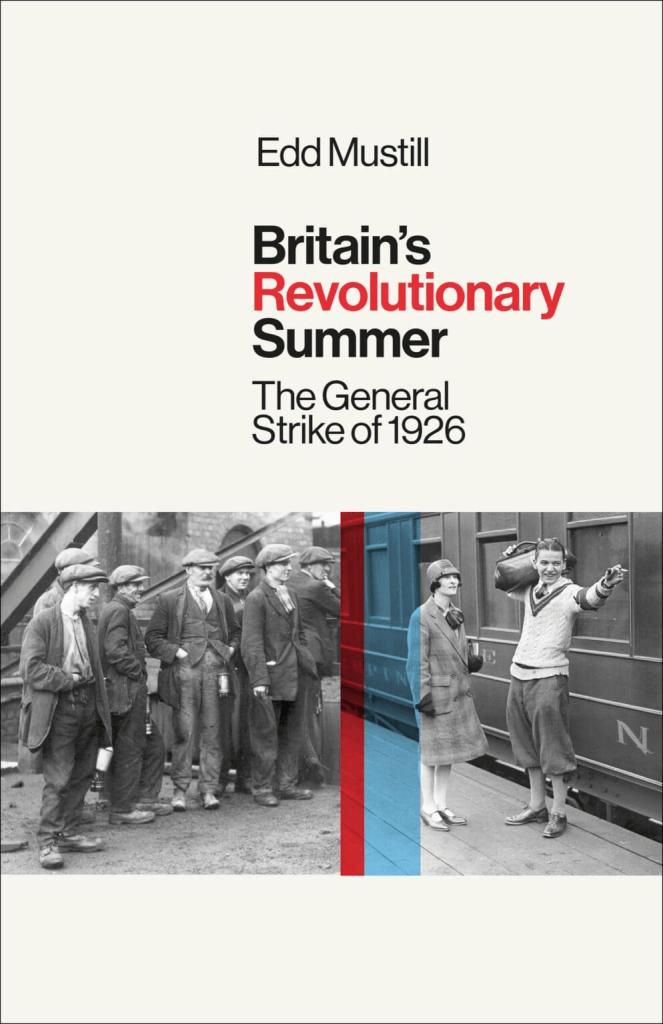
On the centenary of the start of Britain’s General Strike, Mike Phipps reviews Britain’s Revolutionary Summer: The General Strike of 1926, by Edd Mustill, published by One World.
How do we view the great General Strike of 1926 a hundred years on? Rarely is it recalled as a revolutionary moment, argues Edd Mustill, in this new history, but “for many who lived through it, the strike appeared as the culmination of a great class struggle.” His book aims to reclaim the strike from what the historian EP Thomson called “the enormous condescension of posterity.”
Centrality of coal
Mustill sets the scene by looking at the rise of mass trade unionism and the influence of socialism within it – in 1918 even police officers went on strike after one of their members was victimised. Add to this the backdrop of the Russian revolution – in 1919, over 50,000 soldiers refused to embark for France to fight against Soviet Russia.
The book emphasises the centrality of coal to the British Empire. From 1880 to 1914, annual output almost doubled, but at a human cost of more than 1,000 miners killed at work every year – and for every death there were 100 non-fatal injuries. The nature of the work and coal’s economic importance helped generate a powerful trade union whose strikes which were often met with great state brutality.
World War One saw a form of pseudo-nationalisation of the industry, where the mines were left formally in private hands but the government regulated wages and conditions and controlled prices and profits. The war proved that national terms and conditions – indeed state control – wee eminently possible. But the post-war government returned the industry to full private ownership, leading to savage wage cuts. After three months’ strike action and no support from other unions, the miners were forced back to work on the employers’ terms in 1921 – ‘Black Friday’.
When the owners demanded further wage cuts in 1925, the TUC issued a forceful statement and organised a meeting between miners’, transport workers’ and sailors’ unions to prevent the movement of ‘blackleg’ coal. The government persuaded the miners to back down – for a year, while yet another Royal Commission took evidence. Its findings, the Samuel Report, sold a staggering 100,000 copies, but was ultimately a fudge that left both sides reiterating their unbridgeable positions. With negotiations deadlocked, the owners unilaterally posted new wage rates – effectively a lockout. “We now know this practice as ‘fire and rehire’,” observes Mustill.
Wider union backing for the miners carried a price: the TUC may have called a ‘national strike’ – but it took control of the negotiation process and determined which workers were called out and when.
A solid strike
Once underway, the strike was more solid than envisaged. Railways and ports were paralysed and many other unions interpreted the TUC’s instructions in a way that allowed them to join the strike. By the 1920s, workers had learned the value of discipline and unity. The strike began overwhelmingly peacefully, although in Blackwall, East London, strikers set up impromptu road blocks to inspect the loads carried by lorries and to deter cars carrying commuters.
The character of the strike as a class struggle is underlined by the fact that it was primarily the local business community, via Rotary Clubs and Chambers of Commerce, that organised teams of volunteers to break the strike. Because of their inexperience and a refusal by many trade unionised workers to work with them, most of these were idle throughout the strike.
To win the propaganda war, the government published a daily British Gazette, which under Winston Churchill’s editorship, took a confrontational line and enthused about labour relations in fascist Italy. The TUC General Council responded with the British Worker, demand for which far outran supply. BBC head John Reith opposed outright government control of the broadcaster, but acceded to every government demand made of it during the strike. This included denying requests from both the Labour Leader of the Opposition and the Archbishop of Canterbury to make national radio broadcasts.
Popular history has recorded examples of fraternization between strikers and police, such as friendly football matches, but this also reflected an inability of the state to use the police for effective repression. The recruitment of special constables to attack picket lines ensured that they were treated with much more hostility by the strikers.
The use of the army to protect key locations and freight movement led to further confrontation. There were pitched battles between miners and police in parts of Scotland and military convoys had to be laid on to protect road transports. Naval stokers were also deployed to shovel coal at power stations hit by the strike.
The strike was run by the TUC, via a range of subcommittees, many meeting around the clock. Moderate leaders were nervous about their role, keen to rein in radical elements and local initiative. Yet local strike bulletins proliferated and most trades councils set up strike committees and Councils of Action to organise the strike which also sat in continuous session. As Jeff Slee pointed out in a recent article on this site: “Employers had to go to these committees to ask for permission if they wanted to move goods such as coal or foodstuffs. In a very real way this strike led to alternative working-class organs of state power at local level.”
Picketing and other more inventive attempts to stop strikebreaking grew rapidly, not always peaceful. In Swindon, mock funerals, complete with coffins, were held for strikebreakers. In Middlesborough, lorries were chained to railway lines. “In west London, Chiswick Bus Depot was practically besieged in the first days of the strike and attempts to run buses invariably resulted in smashed windows.” In Northumberland, the Flying Scotsman passenger train was derailed, fortunately with no serious injuries. In Yorkshire, 1,000 miners stopped road traffic from moving: mounted police were deployed and scores were arrested.
Far from there being any drift back to work, more workers wanted to join in this far from total general strike, calling on their leaders to authorise action, particularly in engineering and shipbuilding. Four days in, the TUC’s Electricity Advisory Committee ruled that all electric power workers should be called out at any power station where management did not stop industrial power. “By the weekend of 8th May,” writes Mustill, trade unionists had every reason, from their perspective, to be confident of victory. The response to the strike call had been like nothing anyone had ever seen.”
The government had underestimated the solidity of the strike and Britain – London especially – now stood on the edge of a food crisis. To access London’s docks, on May 7th, an armed battalion was deployed and set up machine gun posts. Those in government seeking a show of force were getting the upper hand. Labour-run local authorities threatened to cut off the supply of power that preserved food in dockside warehouses. Essex ports where petrol was unloaded were now blockaded too. When special constables reportedly drove their cars into pickets, an incensed crowd marched five miles to cut the telephone line to the depot.
The state’s escalation provoked major clashes outside London – in Edinburgh, Newcastle, Hull and elsewhere. Trade unionists’ homes were raided. On Monday May 10th, all twenty of Birmingham’s strike committee were arrested, including two city councillors and four justices of the peace. The government created a paramilitary Civil Constabulary Reserve to facilitate its repression.
Meanwhile, the leadership of the seafarers’ union, who opposed the strike was suspending its officials who supported it and pursuing its militant members through the courts. The High Court took the opportunity to declare the whole strike illegal.
The TUC caves in
This judgment did not faze the rank and file but it allowed the more craven elements of the TUC General Council, like railworkers’ leader JH Thomas, who had been seeking a pretext to end the strike, to renege on the united front agreed at the outset and abandon the miners.
On the morning of May 12th, the General Council went to meet Conservative Prime Minister Stanley Baldwin at Downing Street. When they arrived, they were kept waiting and told no meeting was possible unless they swore to end the strike. They duly complied. “We have committed suicide,” Transport and General Workers Union leader Ernest Bevin later told his colleagues. “Thousands of members will be victimised as the result of this day’s work.”
He was proved right. To save face, the General Council claimed the government had made real concessions. They had not. Worse, many employers refused to take back strikers or tore up previously negotiated agreements. Anger was such that there were actually more people on strike on May 13th, the day after the strike was officially called off. But the difficulties of keeping the action going from below, and less humiliating settlements on the railways and docks, led to a general return to work.
The miners now fought on alone, with only moral and financial support from the wider movement. Several months later, they were forced back to work on the bosses’ terms. Mustill caustically contrasts the fate of victimised workers with the illustrious careers that members of the General Council went on to enjoy.
Socialists today are often accused of ascribing every defeat they suffer to internal treachery. But the General Strike of 1926 was a real case of betrayal. Its defeat not only led to a harsh new anti-union law and benefit cuts: it strengthened the social partnership mentality of the Labour Party’s right wing against those favouring direct action and workers’ control. It also tainted the latter, in the eyes of subsequent historians, as exceptional, un-British.
But the cosy narrative that genial, volunteering Brits managed to muddle through the biggest act of class struggle the country has ever known is belied by the facts. Mustill’s engrossing history of the strike – “an act of both extreme selflessness and extreme self-interest” – should go some way to correcting people’s understanding of these events.
Mike Phipps’ book Don’t Stop Thinking About Tomorrow: The Labour Party after Jeremy Corbyn (OR Books, 2022) can be ordered here.
General Strike commemorations:
1926 General Strike Centenary Open Day
The People’s History Museum in Manchester is hosting a special open day to mark the centenary of the 1926 General Strike on 9th May 2026. Historians, activists, trade unionists, and heritage professionals will explore the 1926 General Strike through a range of papers and panels, and highlight rare archival material. For full details see here.


[…] Without pre-empting any more of my talk, these are some of the themes I will be exploring in an on-line meeting on Leyton and the General Strike on Sunday May 10th at 2.30 pm. Also speaking will be Edd Mustill, author of the recently published book Britain’s Revolutionary Summer: The General Strike of 1926, reviewed on Labour Hub here. […]