
As public scrutiny of the UK’s courts declines, the third report of the Bail Observation Project marks some key changes to immigration bail hearings. As the government imprisons more migrants, applying for bail remains a key way for individuals to challenge their detention. Bill MacKeith reports.
Immigration detention in the UK
The UK operates one of the largest immigration detention systems in Europe and, unlike most other countries, has no time limit on detention. Over 20,000 people are held under immigration law in the UK each year. Nearly all centres are run for private profit. For over thirty years, campaigners across the country have been calling for the government to end its brutal detention regime.
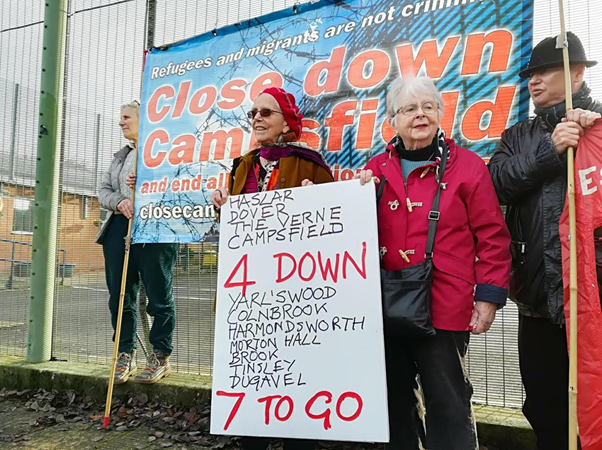
Detention increased dramatically under New Labour. A growing movement against detention, from people detained and their supporters from grassroots to parliamentarians, resulted in an ‘immigration detention reform’ being introduced by the Conservatives in 2016; fewer people were detained and four detention centres closed. Boris Johnson reversed this with the plan for Rwanda deportation flights and reopening and expansion of centres at Campsfield (near Oxford) and Haslar (Portsmouth). The incoming Labour government dropped the Rwanda flights but doubled down on expansion of detention.
For people subject to the brutality of immigration without time limit, criminal charge, or judicial oversight, the right to apply for bail can be a life saver. But can it be exercised effectively?
The Bail Observation Project
In the early 2000s, members of the Campaign to Close Campsfield visited people in the immigration detention centre near Oxford, and supported them as sureties (now Financial Condition Supporters) in bail hearings. What they observed made them so concerned that they decided to demand improvements, but they lacked hard data to back up their contentions. The result was in 2010 to set up the Bail Observation Project to scrutinise the working of the First Tier of the Immigration and Asylum Tribunal (AIT).
Twenty local people were trained by Steve Symonds then of the Immigration Law Practitioners Association (ILPA) and a questionnaire was developed with the help of Bail for Immigration Detainees (BID). Over the next five years, BOP volunteers observed 330 bail hearings and published two reports.
One of our key recommendations was and remains for more judicial oversight, including a hearing before a judge within 24 or 48 hours of the original decision to detain.
BOP was invited to join the stakeholder group of the AIT First Tier, in which it participated for some eight years alongside ILPA, BID and others, until the group was abolished.
After a struggle, some of our recommendations were secured:
- The judges’ reasons for refusal of a bail application are now typewritten. Previously they were often handwritten and illegible.
- From 2017/18 an audio recording of the entirety of proceedings became available to the principal parties.
- Training of judges was improved.
From its inception in 2010, BOP members were active in the Judicial Oversight Working Group of the Detention Forum, which comprises some 50 organisations and calls for an end to immigration detention. The Forum’s demands on judicial oversight of immigration detention overlapped with those put forward by BOP, and with those included in amendments to immigration legislation in parliament prepared by Detention Action. Despite progress in gathering support among parliamentarians, the amendments were not accepted or carried forward.
The latest report: Still a struggle for justice
In 2014, BOP organisers decided to broaden the practice of subjecting the courts to greater public scrutiny. They approached university law faculties, and as a result, academics at four universities (City, Cardiff, Glasgow, Oxford) collaborated with the Project to train some 100 law students to observe some 200 bail hearings and write up reports. Our third report, Immigration bail: Still a struggle for justice – Hearings observed 2016-23, is based on the work of those student observers and some others.
In the report, we highlight some recent observations. The first of these is that the voice of the applicant is often absent in the hearing room. In principle this is a problem although a lawyer, if present, can represent it.
To give an example of the experience of a person seeking bail, last November, Maggie Moyo, an organiser for the Campaign group These Walls Must Fall, spoke at the 48th demonstration outside Derwentside (formerly Hassockfield) detention centre for women in County Durham. She spoke of her own bail hearings, where it was difficult for her to speak as a woman facing a judge, Home Office presenting officer, interpreter and lawyer who were all men. This was especially difficult for her, when asked to speak of her experience of rape and being trafficked, and when the failure to look a person in authority in the eye – which for her was an accepted attitude in the face of authority – is judged as indicating an ‘unreliable witness’.
Legal representation at a hearing makes a big difference to the chance of success – our 2013 report found that an bail applicant with legal representation had a 500% greater chance of a successful outcome. But legal advice was often not available: a 2025 survey by BID found that just 38% of respondents had legal representation. And in many cases, even if legal advice is available, it is not of a sufficient standard to meet the needs of the client.
The latest BOP report’s section on automatic bail hearingsshows that these are 10 times more likely to be unsuccessful than other bail hearings, with lack of legal representation being a chief reason. They only take place after a person has been already detained for four months, which is too long. Time-served prisoners (‘foreign national offenders’) are excluded.
For detention to be justified, deportation (or ’removal’) is supposed to be happening in the relatively near future. In 2019, City University students reported that the Home Office only argued that removal was imminent in only 10 of 55 cases observed. It would seem that the judges have not taken any notice of this low rate.
Interpreting is so important and so often inadequate. The decline in interpreting services after privatisation has been well documented and we support the Professional Interpreters for Justice 2024 manifesto demand for a mandatory regulator. This is a case where public provision of the service is required.
Without public access to proceedings,our mission cannot be accomplished. Many groups and authorities have warned about the lack of public access to and scrutiny of courts of justice. Despite the welcome statement in 2024 by England and Wales Chief Justice Sue Carr, that ‘justice will not only be done, but will be seen to be done’, the County Court system was reported to be ‘failing’ and ‘dysfunctional’ last year.
Recent developments
More than 95% of bail hearings are now online. This is arguably convenient for all parties (except the judge who is in court) as it eliminates long journeys.
But we see it differently. Our first two reports showed that if the person seeking bail appeared in person, they had a better chance of a success. We also believe that in general, a proper judicial hearing requires all parties to be present in the same physical space able to observe and eyeball one another.
Our latest report illustrates how online hearings exacerbate difficulties in hearing, interpretation, understanding, and communication in general, to say nothing of technical issues, and alienation from proceedings. (This is, however, notwithstanding the benefits of appearing at a distance for vulnerable parties such as children or victims of sexual assault.)
The rate of success in bail applications appears to have increased from around 25% in our 2011 and 2013 reports to around 50%. This is the figure both for all hearings nationally in 2023 and for all the hearings we observed in 2016-23. Nationally for 2023, if withdrawals are excluded, that figure approaches 70%. We can and should speculate about the causes for this, as it would be good to know what they are so we can reinforce them.
My own view is that the training of judges may have improved. During Covid-19, the detention regime was relaxed for medical reasons and the success rates for bail applications went sky-high before reverting. The improvement appears to have occurred despite the negative impact of hearings being held remotely.
It is very good to see the appearance of new court-watching groups organised by Transform Justice for London magistrates’ courts and by others in the Family Courts. But with the near disappearance of local newspaper journalists to cover the work of the courts, the need for public scrutiny is greater than ever.
Individuals and groups interested in taking forward the work of the Bail Observation Project are invited to email bmackeith@gmail.com. Current active groups are at Queen Mary, University of London, Oxford University and Glasgow University.
Bill MacKeith was a founder member of Campaign to Close Campsfield (1993-2018) and Coalition to Close Campsfield (2025- ). As president, he got the backing of Oxford Trades Union Council in 1993 when Campsfield detention centre opened. He has worked locally, nationally and internationally to help build the movement to end immigration detention, and has helped organise the Bail Observation Project since it started in 2010.
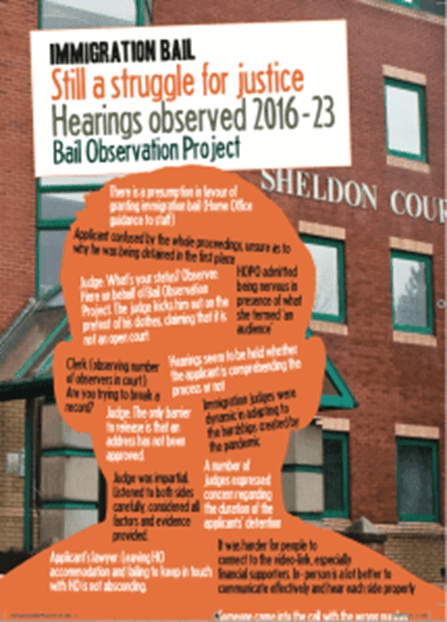
Still a Struggle for Justice: Immigration Bail Hearings Observed, 2016-23, by Bill MacKeith, Bridget Walker, Dr Anna Lindley and Dr Clara Della Croce.
Main image: Coalition to Close Campsfield.

