
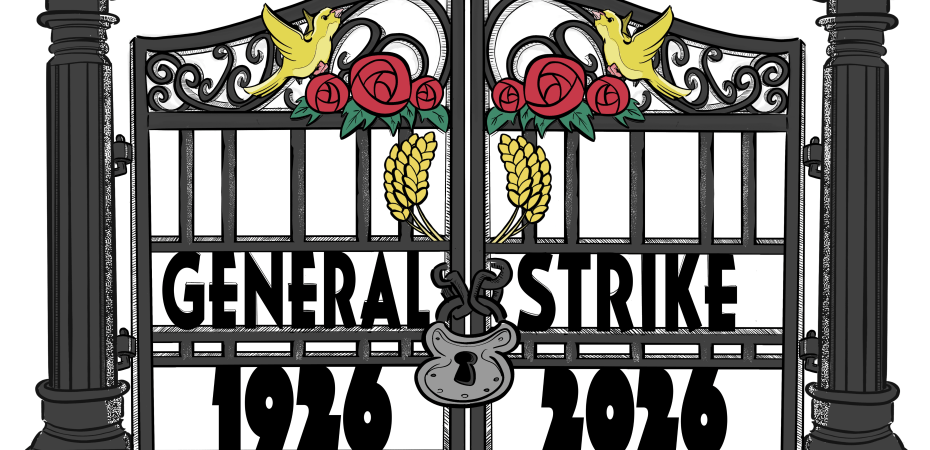
This week marks the centenary of the 1926 General Strike. Barbara Humphries looks at how it was organised in West London.
By the 1920s, parts of the London Boroughs of Ealing and Hillingdon had become industrial areas. This was due to the Great Western Railway which had been built in the 19th century. Southall and Acton had railway works whose workforce became the backbone of the labour movement. The GWR attracted factories along its side, both in Southall and neighbouring Hayes. These included a margarine factory and AEC which made buses for London transport. In Hayes, EMI made electrical equipment. These factories had relocated from inner London due to cheap land prices in the area.
World War 1 had boosted industrialisation with munitions factories in Park Royal on the borders of Acton and Brent, and alongside the railway in Hayes. After the war these sites became devoted to civilian production such as brewing and cocoa processing. Factories such as Napiers opened on Acton Vale. The 1920s saw hundreds of factories in Acton, including Walls.
What had been a rural area at the turn of the century with orchards and brickworks catering for the London market became one of the heaviest industrialised part of Europe. Workers moved to this area to work. Some came from other parts of London, but others came from the distressed areas of high unemployment, such as South Wales, the North of England and Scotland. Many had a coal mining background and they brought their politics with them.
There had been a labour movement presence in the area for some time. This included branches of trades unions, such as the National Union of Railwaymen, the Railway Women’s Guild, but also the Labour Party, the Independent Labour Party and the Co-operative Movement. By 1945 the area had changed politically forever. Road transport had also developed with tram depots in Acton and Hanwell. Their workers were recruited into the Transport and Workers Union, which was to become the second largest union in the area.
However, side by side with these pockets of industrialisation sat commuter towns such as Ealing, the queen of suburbs, home to city gents and retired civil servants. They were determined keep the working class out of the borough.
Solid support
When the General Strike broke out in May 1926, workers in Hayes, Acton, Hanwell and Southall were amongst the first to be called out. According to all accounts, they were a hundred percent solid. Both the railwaymen and the bus workers had been in earlier disputes at the end of the War.
Trades councils were to become the backbone of the strike at a local level. They became councils of action, organising picket lines, demonstrations, soup kitchens and entertainment. There were very few violent incidents, although Syd Bidwell, a GWR worker who went on to become the local Labour MP from 1966 to 1992, remembers a bus in Southall driven by volunteers, probably with police on board, being pushed right over.
Syd remembered the strike, as his father, a building worker, was on the Southall strike committee. Joan Parr in Acton remembers her father being on strike. She and her mother joined marches, booed at scab bus drivers and helped set up a soup kitchen. The councils of action tried to take over the distribution of food and other essential supplies, but the government was resistant.
On one occasion, armoured vehicles were sent into the London docks to secure food supplies. These would have received permits from the local trades council as they were essential supplies, but the government refused.
Propaganda was the responsibility of the trades councils, as with the newspapers on strike and the BBC on the government’s side, there was little information about how the strike was progressing. The TUC tried to rectify this by publishing the Workers’ Gazette to counter the British Gazette published by the government.
The TUC had hoped for an improved offer from the government, but none was forthcoming. The government had prepared for months for the strike, recruiting volunteers who signed up with the Organisation for the Maintenance of Supplies. It was more prepared than the TUC. TUC leaders were afraid that more revolutionary elements in the trades unions would take control. A.J. Cook, the leader of the Mineworkers Federation of Great Britain stuck with his line of no cuts in pay or longer hours. He addressed workers all over the country, including in Acton Town Hall. He was a member of the National Minority Movement, which contained members of the Communist Party, many of whose members were imprisoned before the General Strike and not released until it was over.
Leaders of the Labour Party like Ramsay MacDonald were not in support of the strike and hoped that the government would win. He thought that it was more important to get a Labour government elected. However, at a local level, Labour and trades union councils were one and the same body. So while Labour MPs were denouncing the strike, Labour Party members at a local level were running it In Hanwell, Party members addressed meetings of bus drivers.
Meanwhile in Ealing
In the old borough of Ealing, volunteers were recruited to break the strike. They drove cars and vans to get people to work and to distribute supplies. However, it was debateable whether they were able to drive trains and buses effectively. They had little time for any training – and who was willing to train them?
Accounts of the strike in Ealing, from the standpoint of the strike-breakers, say that many of them had the time of their lives. Joe Sherman who was the secretary of the Ealing Trades Council, however, was very upbeat about the strike. He said: “Believe it or not everything stopped. We had a taxi put at our disposal. I used to ride around in a taxi cab by permission of the Ealing Strike Committee. I had a letter from the borough surveyor, Hicks, asking whether the strike committee would give permission to deliver two tons of coal to the Ealing Memorial Hospital. It showed how strong we were. Fortunately we had the Labour Hall open. We had about 1,000 people there every day. We had a demonstration on Ealing Common. There must have been 50,000 people. You could not have seen the grass for the number of people. We had the most effectively organised strike committee.”
Aftermath
When the strike was called off after nine days. The Ealing Strike Committee was as shocked as the rest of the trades union movement. There were more workers on strike than at the beginning. The miners were left with no concessions, and many who came out in support of them were victimised and did not get their jobs back.
The GWR was noted for being most vindictive. Members of the NUR were made to sign a document saying that they would not take action again. The union lost members and did not recover until the end of the decade.
The miners were locked out until the end of the year. Local trades unionists collected food and clothing. Some, according to Joe Sherman, took in miners’ children or offered holidays for them. The government, sensing victory, passed the Trades Dispute in 1927. This made sympathy strikes illegal, as they are today, made it illegal for civil servants to join a union, and made ‘contracting in’ compulsory for trades unions supporting the Labour Party (rather than the easier to operate ‘contracting out’). The Labour Party lost thousands of pounds in affiliations, but this Act was not repealed until 1945.
In the General Election of 1929 Labour won its highest number of seats in Parliament so far, but with no overall majority it was forced into coalition with the Liberals. Labour won the Acton seat for the first time electing Joseph Shillaker. Mass meetings were held in Acton. It came close also to winning the Uxbridge parliamentary division, which contained Hayes and Southall.
The General Strike had divided Britain, as it had Ealing and Hillingdon. For the trades unions it had been a defeat, but a victory in solidarity.
Dr Barbara Humphries is a socialist activist in West London. She wrote her PhD on “The Origins and Development of the Labour Movement in West London 1918-1970.”
Image c/o Unite.

