Mick Antoniw reports from war-ravaged Kyiv on the annual Congress of the Independent Trade Union of the Miners of Ukraine.
Kyiv is under consistent attack by Russia. Each week there is a massive attack of drones and missiles. Many are shot down, some get through and the debris from others causes death and injury.
Despite this life goes on, meetings take place and there is an ironic and strange normalcy after every attack.
Last week was the annual Congress of the Independent Trade Union of the Miners of Ukraine (NGPU).
The Congress was planned for three days but due to a massive destructive attack on Kyiv, it was reduced to one day. Miners’ delegates travelled to Kyiv from the unoccupied Donbas in the East of Ukraine, Donetsk region, Pavlograd, Dnipro and Kryvy Rih and from the Western coalfield around Chervonohrad.
What was once a proud industry of hundreds of coalmines has been reduced to fifteen. Many were in the occupied Donbas area, which has been deliberately destroyed by Russian artillery and missiles, with trade union leaders arrested, tortured and killed. There are no free trade unions in the Russian-occupied areas.
What has not been destroyed in occupied areas is now put to the service of the Russian state along with grain, agricultural products and raw materials.
In Ukrainian-held Donbas, mines continue to operate under the most difficult conditions, not just coal but also iron ore mines and other open cast raw material extraction. Again, these are under regular attack.
Despite all this, the Congress plans ahead. On its agenda is support for members on the front line, the delivery of vehicles, medical and humanitarian aid, then planning ahead for a future after the defeat of Russia. There is no equivocation, they know they will win. Many thousands of their members serve in units on the front line. Many are Russian-speaking, due to decades of Russification. It makes no difference, they are proud Ukrainians and they are fighting, as they say, Russian fascism. They see what happens in the occupied areas. Many still have family and friends there. They are aware of the persecution taking place and the abduction of children, and they will not give in.
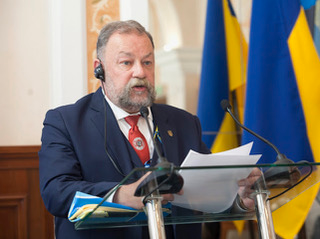
Attending the Conference were representatives of human rights and international labour organisations and trade unions. Among them was Chris Kitchen, General Secretary of the National Union of Mineworkers, who answered the call for support from Day One. He spoke of the long history of links between Ukrainian and UK miners, of the establishment of the coal and steel industry in Donbas by Welsh engineer John Hughes and supported by Welsh miners.
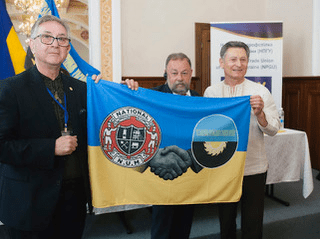
He recounted how Ukrainian miners had supported UK miners during the 1984/85 strike with food and money and how they were now repaying that debt through international solidarity. Through Ukraine Solidarity and other organisations, vehicles and supplies are delivered to front line defenders, many of whom are trade union members. He presented the Union with a flag of solidarity between the two unions and the miners and former miners of both countries.
The Congress went into closed session. Despite the war, there are serious concerns over changes to the Ukrainian Labour Code. There are proposals which would restrict workers’ rights, proposals for privatisation which add to the concerns for the future of the industry once the war is over. Michael Volynetz, their President and former miner, is also a member of the Ukrainian Rada where he represents the interests of his union. Government ministers attended and addressed the Congress and spoke of the challenges facing the country. Membership of the European Union is seen as vital.
The weather was warm. Winter is over. The past months saw people living through temperatures as low as minus 30 degrees centigrade as Russian missiles targeted power stations, to freeze the population into submission. They failed, but the misery caused is acute particularly for the old and disabled.
As we left, it was peaceful in the capital. The next night saw 600 hundred drones and missiles including inter-ballistic missiles rain down on Kyiv. The targets were civilian and social. The newly refurbished Chornobil museum was hit and destroyed, the museum of fine art, a shopping centre, flats and residences – not a single military target. This is civilian terrorism on a mass scale. It causes terror but fails to subdue.
The fact that the Congress took place at all is a testament to Ukrainian workers’ resilience and determination to win. As Chris Kitchen said in his address: in war it is always the workers who pay the price and it must be they who benefit from the victory.
As for the NUM attendance at the Conference, the international solidarity raises morale. It was so important to be there, to be seen there and to be telling our friends and comrades in Ukraine that they are not alone.
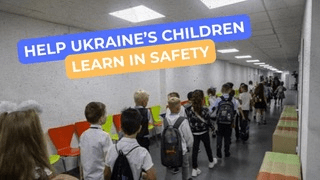
The solidarity continues. Ukraine Solidarity is raising funds to provide support to children in the mining town of Pavlograd who are taught in underground safe areas, as well as supporting the mines rescue workers and first responders who attend the aftermath of missile and drone attacks.
NUM and trade union members continue to provide vehicles and essential aid to the front line. Increasingly UK trade unions are developing links with their Ukrainian trade union brothers and sisters with a growing understanding that this is a war against a new Russian fascism which has links across the far right in America and Europe.
Putin has no interest in peace. Trump has embraced Putin, oligarch to oligarch as they both enrich themselves, their families and their cohorts.
Ukraine has many challenges, the first is survival, the second is the preservation of its democracy and the third will be reconstruction. The Union is determined that workers’ rights and standards of living will be at the forefront of this reconstruction and for that they need the international solidarity of the UK and international trade union movement.
You can support the campaign of Ukraine Solidarity to help the children of Pavlograd by using this link.
Mick Antoniw is a former member of the Welsh Parliament/ Senedd and a trade union member who is standing for the Welsh seat on Labour’s National Executive Committee. He is a founder member of Ukraine Solidarity and Senedd4Ukraine.
Main image: The author (left) with the flag of solidarity. Inset: Chris Kitchen, General Secretary of the NUM, addresses the Congress. All photos c/o author.

