
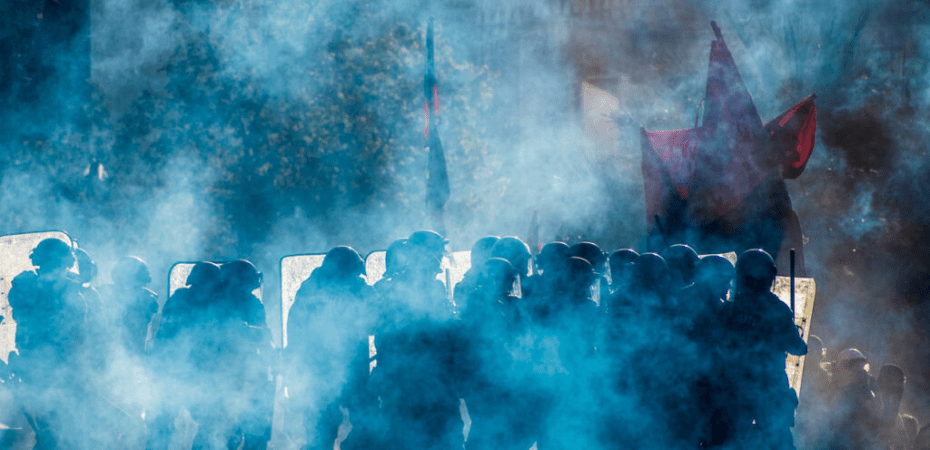
Claudia Turbet-Delof explains the background to the current mass protests rocking Bolivia.
This short piece will tell you what the mainstream media and much of the international press are choosing to not show the world: images of state violence against peaceful marches of campesinos, miners, teachers, older people and Indigenous communities demanding the resignation of President Rodrigo Paz.
Their demands respond to the deep economic crisis and attacks on constitutional rights the Bolivian people are experiencing since Paz came to power six months ago. Instead, many headlines — including seemingly progressive media — focus first on isolated clashes or ‘violence against police,’ reproducing the same narrative promoted by right-wing media and foreign interests seeking to delegitimise popular resistance.
To understand why hundreds of thousands are mobilising across Bolivia, it is necessary to understand the historical importance of Bolivia’s Political Constitution of the Plurinational State.
A Plurinational State, land reform and basic rights
The Plurinational Constitution was born through one of the most participatory democratic processes in Bolivia’s history. Convened in 2006, the Constituent Assembly represented a historic shift in power for those traditionally excluded from political life — bringing together Indigenous peoples, social movements, unions, communities, workers and rural populations from across the country — giving them, for the first time, a direct role in reshaping the Bolivian state, to rewrite the nation’s future.
After 16 months of participatory debate, the new constitution was approved by popular referendum in January 2009 and officially promulgated by Evo Morales on February 7th, 2009, transforming Bolivia from a colonial republic into the Plurinational State of Bolivia.
For many Bolivians, the constitution is not simply a legal document. It is one of the greatest achievements of grassroots democratic struggle in Latin America. It recognised Indigenous peoples, collective rights, community democracy and sovereignty over land and natural resources.
Among the most important constitutional rights and relevant to the current situation in Bolivia are:
- The collective rights of Indigenous nations and peoples over their ancestral territories;
- The right of communities to prior consultation before natural resources are extracted from their lands;
- State sovereignty over Bolivia’s natural resources, including lithium, gas and minerals;
- Protection against the privatisation and concentration of land;
- Agrarian reform, redistributing land to campesino and Indigenous communities;
- Recognition of the Wiphala and Indigenous identities as central to the Bolivian state;
- The right to protest, organise and mobilise politically without persecution;
- Economic protections prioritising collective wellbeing over corporate profit;
- Constitutional recognition that Bolivia’s resources belong to the Bolivian people, not foreign corporations.
Bolivia’s constitution also established that multinational corporations could not simply extract wealth freely from the country. Articles 349 and 351 make clear that Bolivia’s natural resources are the collective property of the Bolivian people and must serve the public interest, not unrestricted corporate profit or foreign extraction.
The political principle underpinning the constitution became clear: no multinational company should take more wealth from Bolivia than it leaves behind for its people.
One of the constitution’s most transformative achievements has been the agrarian reform. Large estates obtained through fraud, political privilege or historical dispossession were challenged, and land redistribution processes gave Indigenous and campesino communities legal ownership over territories they had worked for generations without rights or protections.
It is estimated that since 2006, when Evo Morales became President of Bolivia, over 35 million hectares of land has been redistributed, with more than 20 million hectares transferred directly to Indigenous peoples and campesino communities, shifting much of the country’s rural land away from large estate owners and into collective and community hands, benefitting communities and small producers, with Indigenous women receiving a majority of land titles.
Crucially, these reforms protected land from speculative accumulation and corporate control. Land was recognised not simply as a commodity, but as part of collective life, food sovereignty and Indigenous self-determination.
Food sovereignty is one of the most revolutionary principles embedded in Bolivia’s constitution. Articles 405 and 407 establish that agrarian policy must guarantee food sovereignty for the Bolivian people. This means recognising access to food, land and local agricultural production as fundamental rights.
For millions of Bolivians, especially Indigenous and rural communities, access to land was therefore not simply economic reform — it was liberation from centuries of colonial dispossession and exclusion. The right to grow food collectively and sustainably was designed precisely to ensure that no Bolivian should go hungry while vast amounts of land remained concentrated in the hands of elites.
Rodrigo Paz’s government
This is precisely what Rodrigo Paz’s government is now attempting to erode.
Under the slogan of “capitalism for everyone,” the government has introduced decrees and economic reforms widely criticised by social movements, unions and Indigenous organisations as a neoliberal restructuring project designed to weaken constitutional protections and open Bolivia to greater corporate and foreign control.
A central figure behind many of these reforms is Senator Branko Marinković, one of Bolivia’s most controversial oligarchic political actors and a historic leader of the eastern elite apartheid movement promoting ‘autonomía’ in the lowland regions of Santa Cruz, Beni and Pando.
For decades, Indigenous and social movements have criticised the ‘autonomy’ project as a racist and separatist political agenda rooted in colonial divisions between Bolivia’s wealthier eastern elites and the largely Indigenous Andean regions such as La Paz, Oruro, Potosí and Cochabamba. Critics argued that the project sought to consolidate land, wealth and political power away from the Plurinational model built through grassroots struggles.
Marinković himself has long symbolised this concentration of land and economic power. He reportedly owns more than 30,000 hectares of land acquired during periods in which vast estates in eastern Bolivia were transferred at extremely low cost to politically connected elites. He has also repeatedly faced criticism and condemnation over racist remarks directed at Indigenous peoples, including language describing Indigenous communities as “savages” and “animals” that “should not exist.”
Today, many social movements point to Marinković’s influence over the highly controversial – and at the heart of the current struggle – Law 1720 as evidence of a wider attempt to reverse Bolivia’s agrarian reforms and constitutional rights.
Law 1720 has been presented publicly as a mechanism for ‘economic growth’ and agricultural expansion, However, this law instead encourages small landowners and campesino communities to enter debt-based systems in order to access larger plots of land through private credit and high-interest loans.
This is a model used in Latin America that has historically resulted in small farmers becoming trapped in debt, eventually losing their land to banks, agribusiness corporations and wealthy landowners after being unable to sustain repayments.
This is precisely the type of land concentration and dispossession that Bolivia’s revolutionary agrarian reforms sought to prevent. The government is also embracing economic policies that favour agro-industrial elites and foreign capital while weakening protections for small producers, popular traders and cooperative forms of economic organisation. Alongside this, it is enacting deregulatory economic packages aligned with neoliberal models that deepens inequality, dependency and exclusion.
International solidarity
The last point I want to make on the current situation in my homeland Bolivia concerns the power of international solidarity.
Wherever you are in the world, international solidarity matters. Across Bolivia, Indigenous peoples, campesinos, trade unions and grassroots movements defending constitutional rights and economic justice are facing an alarming wave of racist, classist and dehumanising attacks from the ultra-right elites and media that support them. Peaceful protesters are being called “savages,” “animals” and “inept,” while Rodrigo Paz’s government responds to marches with bullets and repression.
The Wiphala — the multicoloured Indigenous flag recognised as a national symbol of the Plurinational State — was also recently burnt by opposition groups, becoming again a target of anti-Indigenous hatred.
For many of us, these events reopen wounds from the 2019 US-backed coup against Evo Morales, which left 38 killed, thousands injured and many politically persecuted.
Despite media silence, solidarity networks inside and outside Bolivia, including Wiphalas across the World, of which I am a member, are organising every day to break the blockade of information and defend the truth about what is happening on the ground.
Wherever you are in the world, your solidarity matters. Share and denounce the police and military violence against peaceful marches. Speak out against racism and repression. Stand with the Bolivian people defending the Plurinational State and the constitutional rights won through generations of struggle.
This solidarity sends a powerful message: that the Bolivian people are not alone, that the world is watching, and that human rights cannot be defended selectively.
The Bolivian people have the constitutional right to self-determination, sovereignty, to organise and protest. They are marching for dignity, for food sovereignty, for Indigenous rights, for the Wiphala and for the protection of the Plurinational State of Bolivia.
Jallalla Bolivia!
UPDATE
Yesterday President Rodrigo Paz got his senators to revoke a law that gave protections to marches and protests. This allows shooting and military intervention against those marching, with a likely result of many being killed or injured. Below we publish an urgent international alert issued by Wiphalas Across the World.
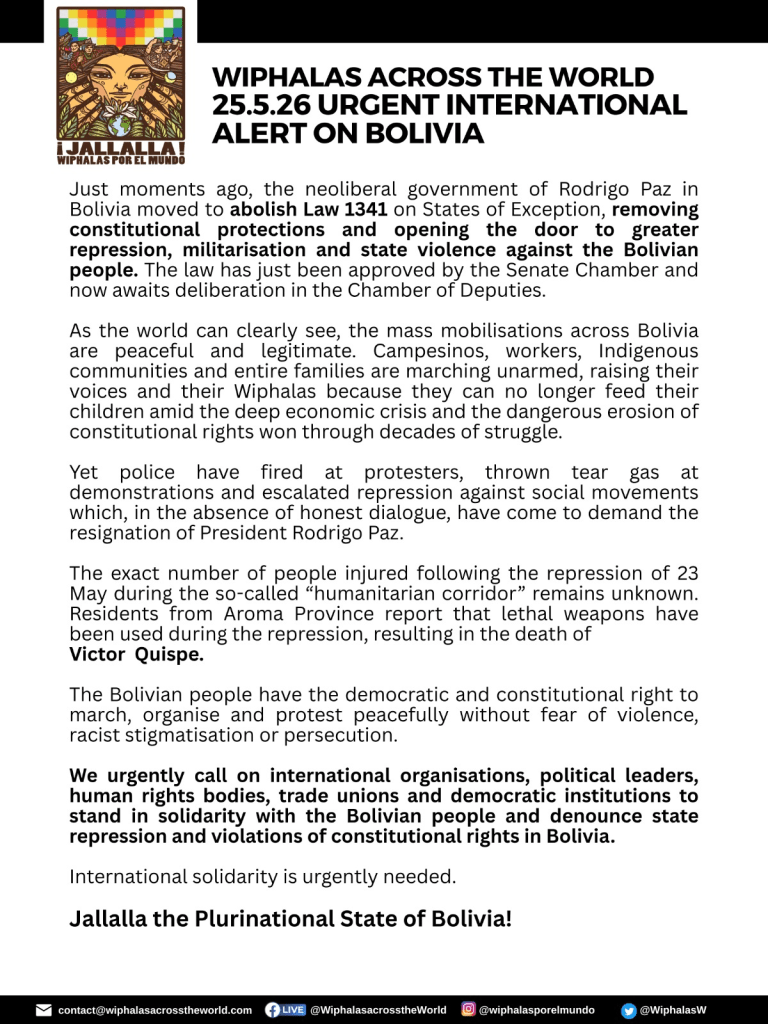
For updates follow X @WiphalasW, @Ollie_Vargas_, Radio Kawsachun Coca
Claudia Turbet-Delof is a former Hackney Councillor and a member of Wiphalas across the World. Twitter @madeinbolivia / @HackneyIndSG
Image: Demonstrators clash with police in Bolivia as protests widen https://www.latinamericareports.com/demonstrators-clash-with-police-in-bolivia-as-protests-widen/14460/ Creator: Paulo Slachevsky Copyright: Paulo Slachevsky (CC BY-NC-SA) Licence: Atribución – NoComercial – CompartirIgual 3.0 Chile CC BY-NC-SA 3.0 CL Deed


[…] This article was originally published by Labour Hub on 25 May 2026. […]