
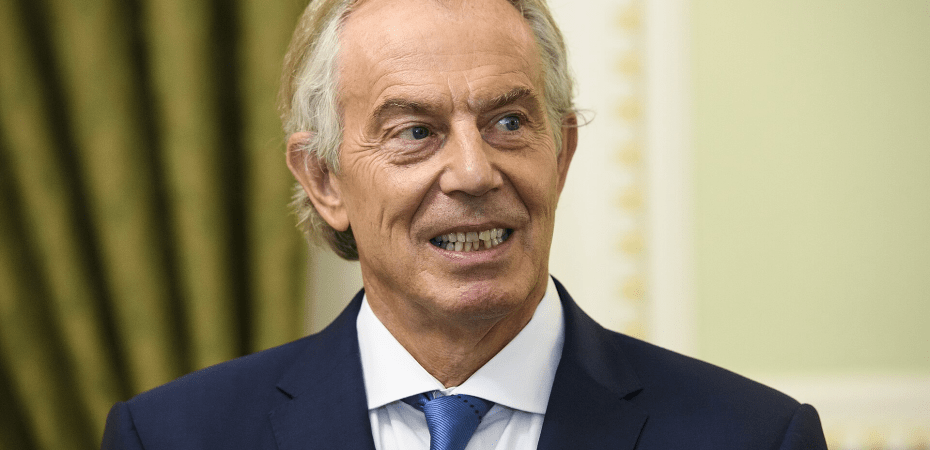
Tony Blair’s new essay channels what the global billionaire elite wants for Britain. Michael Calderbank finds it shockingly reactionary.
Tony Blair’s connection to the British labour movement has always been incredibly tenuous, but whatever lip-service he once paid to it has long since been sidelined in favour of a headlong infatuation with wealth and power. His advice to the Labour Party is offered not as someone steeped in its values, but as a strategist for global capital looking at how the Party might be made into an effective instrument to deliver the agenda of billionaires.
Thankfully, Blair’s views no longer cut any ice with the British public, and his “rare interventions” (sic) attacking Corbyn and Brexit only served to boost the popularity of the causes under attack. But his policy advice does – incredibly – still retain a certain cachet in the media and public policy circles. So the publication of his latest essay warning the Labour Party is “playing with fire” by failing to set out what he sees as the necessary policy agenda for the future has hit the headlines and is provoking debate within the Parliamentary Labour Party itself.
Blair’s vision is indeed worth reading, but only insofar as it a clear and relatively succinct outline of the dystopian future which the global billionaire elite intends for Britain and beyond, and hopes – at least for now – to deliver through the agency of the Labour Party.
Since departing Downing Street, Blair has worked assiduously on behalf of clients including Central Asian oil dictatorships, before building his “Tony Blair Institute for Global Change”, funded by AI billionaires such as Larry Ellison, founder of Oracle Corporation. From Blair’s Olympian vantage point, the everyday experiences of ordinary voters count for little – all the framing is about restoring Britain’s prestige, wealth and power in the eyes of world statesmen and the Silicon Valley tech entrepreneurs.
If the criticism of Starmer’s government for lacking a coherent policy vision is valid, Blair’s own sense of the direction Labour needs to go down is entirely the wrong one. Indeed, when boiled down to a list of policy prescriptions, the results are shockingly reactionary, even by his standards:
- work with the Tories to slash welfare
- stop illegal migration “by any means necessary” (sink the boats and drown refugees?)
- take away workers’ rights to “give business confidence”
- scrap net zero commitments
- let AI rip without regulation
- abandon the founding principles of the NHS and have private firms run rampant
- uncritically support Trump’s foreign policy
Despite his repeated attempt to claim this agenda for the “radical centre”, this agenda is deeply reactionary. Blair invokes the need for “long-term strategic thinking” and used to speak of tackling climate change as one of the great challenges of the 21st century. Clearly he now sees this as inconvenient for any government which wants to embrace AI and the huge expansion of data centres this would require.
Even New Labour used to speak about trying to lift people out of poverty and ensuring that workers were not exploited. The idea that households with people in work would have to resort to foodbanks even to feed themselves was largely unknown back then, before 14 years of austerity. But now Blair regrets that even the modest steps Starmer’s government has taken to improve rights at work and raise the National Minimum Wage have dampened the “animal spirits” of rapacious capitalism and so hit growth. From this perspective even West Streeting is left looking like a dangerous left-wing extremist!
In reality, all serious economists would recognise that Britain’s sluggish growth is the product of long term productivity challenges arising from sustained underinvestment, together with the external shocks to the global economy from events like the Russia’s war in Ukraine and Trump’s aggression towards Iran. There is no quick fix, but putting money back into the pockets of those most likely to spend it on British high streets would be a good start.
Blair’s strategy is in effect for Labour to take ownership of the far right programme which is coming down the track at the behest of the global billionaire elite, but sell it to the public as a ‘moderate’ and sensible package of measures necessary to meet the challenges Britain faces. But this programme would be a disaster for millions in Britain, whether implemented by a Labour leader or under a far right government. It would spell the absolute death of the Labour Party as any kind of progressive vehicle.
It is true that simply changing the face at the top is not, in itself, enough. If Blair’s essay sparks a policy debate about the future of the Party, this is welcome. Any candidate for the Labour leadership must disavow and repudiate this agenda, and set out an alternative based on our interests, not those of Blair’s paymasters.
New Labour used to tell people on the left that they had “nowhere else to go”. This is no longer the case, and Labour will be badly punished unless it makes every effort to rebuild a broad coalition of progressive social forces. If Labour fails to meet this challenge, Blair’s agenda might well come to pass. But it will be delivered by Nigel Farage as Prime Minister.
Michael Calderbank is Trade Union Liaison Officer of Tottenham CLP.
Image: https://commons.wikimedia.org/wiki/File:Tony_Blair_in_Ukraine_-_2018_(MUS7623).jpg Source: https://www.kmu.gov.ua/en/mediagallery/premyer-ministr-ukrayini-volodimir-grojsman-zustrivsya-z-eks-glavoyu-uryadu-velikobritaniyi-toni-blerom. Author: https://www.kmu.gov.ua/, licensed under the Creative Commons Attribution 4.0 International license.


.jpg)